Post-match media duties in Australia operate on a strict schedule. Once a winning captain completes a press conference, venue staff typically lock up the facilities, closing lights and air conditioning precisely two hours after the conclusion of the day’s play.
Following the swift end to proceedings in Mackay, however, a noticeable delay gripped the press room. While host broadcasters and print journalists waited anxiously for the visiting skipper, Najmul Hossain Shanto remained absent from the media podium.
A Quiet Conversation Near the Dugout
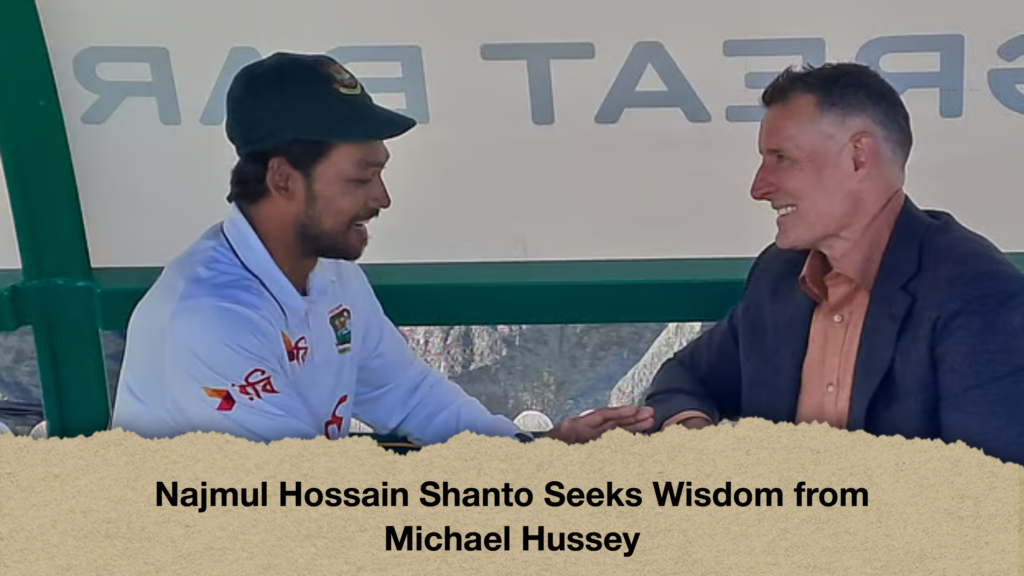
Observant eyes soon spotted the Bangladesh captain sitting deep in conversation outside the dressing room. Clad in his blazer, Shanto was engaged in extended dialogue with a well-dressed gentleman, accompanied by the team’s media manager. Initial whispers suggested a hurried radio interview or a special request from official broadcasters. Yet, the absence of camera crews quickly dismissed those theories.
The mystery was soon resolved when Shanto arrived at the media room, though he offered no public mention of the encounter beforehand. Behind the scenes, it was revealed that the individual occupying the captain’s attention for twenty-five minutes was none other than former Australian batting stalwart Michael Hussey.
The initiative, as it turned out, came entirely from the Bangladesh skipper. Speaking privately afterwards, Shanto explained how the meeting materialized. Hussey had been working at the venue as a broadcaster, and daily passing encounters prompted the Bangladesh captain to request a moment of his time once the series concluded.
“Hussey was working as a commentator here, and we would see each other at the ground every day,” Shanto noted. “After the match ended today, I asked him if we could speak for a little while. He gladly gave me about twenty-five minutes of his time.”
Seeking Counsel From Mr Cricket
When pressed on the specifics of their prolonged chat, Shanto kept the details private, describing the conversation as entirely personal. He noted that the discussion focused strictly on his batting, ways to refine his technique, and methods to elevate his overall game under the watchful eye of someone who observed the contest firsthand.
For Shanto, the opportunity to pick Hussey’s brain held immense personal significance. The Australian great, widely known across the global game as “Mr Cricket”, has long served as one of Shanto’s primary childhood idols and sits at the very top of his list of favorite cricketers.
Hussey’s storied international career for Australia featured 79 Test matches yielding 6,235 runs at an exceptional average of 51.52, alongside 19 centuries. Across 185 One-Day Internationals, he accumulated 5,442 runs at 48.15, complemented by 38 T20 appearances. Beyond the sheer numbers, Hussey earned renown for his remarkable discipline, tactical clarity under pressure, and a rare ability to adapt seamlessly to varying match conditions.
Those very traits—consistency, organizational discipline, and situational awareness—captured Shanto’s admiration from a young age. Having that level of expertise accessible immediately following a challenging Test match offered the visiting captain a unique mentorship opportunity.
While the wider tour of Australia presented its stark contrasts—highlighted by a historic nine-wicket triumph in Darwin balanced against a sobering two-day defeat in Mackay—Shanto’s private consultation with Hussey remains a valuable personal takeaway from a demanding campaign.
Would you like to explore how Shanto’s individual batting approach might evolve following this mentorship?