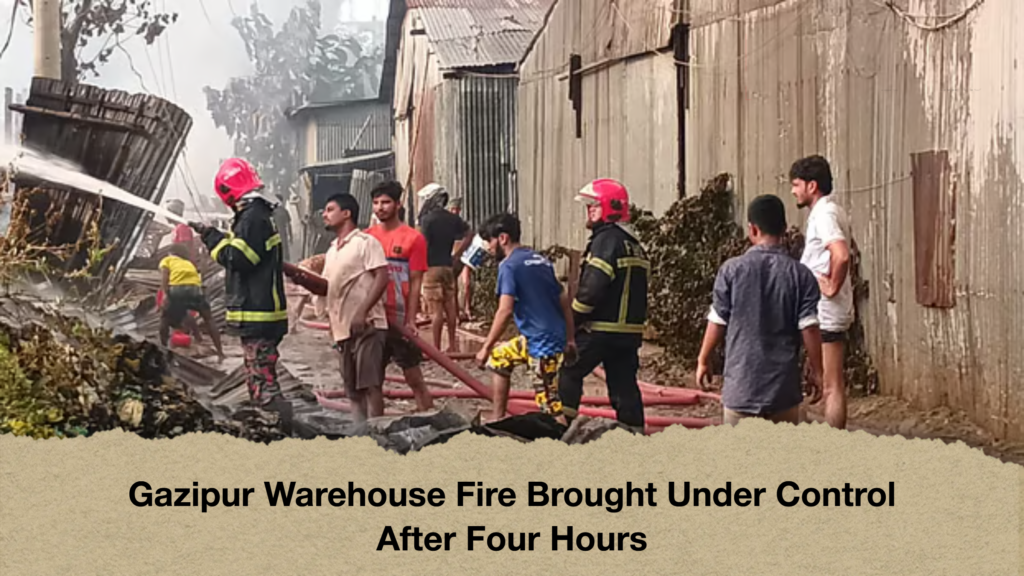
A massive fire that erupted at a jute storage facility in the Deuliabari area of Konabari, Gazipur, has finally been brought under control following a grueling four-hour operation by emergency services.
The incident began early Thursday morning at approximately 5:30 am. Flames initially sparked inside a storage unit owned by local resident Bachchu Miah before aggressively spreading to several adjacent warehouses packed with textile waste. Because these facilities store vast quantities of discarded garments and flammable industrial scrap, the fire escalated rapidly, threatening the entire commercial pocket.
Local business owners and residents spotted the dense plumes of smoke and immediately alerted the authorities. Five firefighting units rushed to the scene to tackle the blaze. Three units from the Konabari fire station and two units from the Sarabo station worked in close coordination, battling intense heat and thick smoke.
Firefighters faced considerable challenges due to the dense accumulation of material, but persistent efforts eventually paid off. The inferno was brought under control at around 9:45 am.
Even though the primary flames were contained, the situation remained volatile. Smouldering heaps of synthetic and cotton waste retain deep-seated heat, creating a high risk of reignition. To counter this, emergency personnel initiated comprehensive damping-down operations, physically moving and separating the charred debris to cool down hidden embers.
Saiful Islam, the warehouse inspector for Konabari Fire Service, confirmed that five units were dispatched immediately after receiving the emergency call at dawn. He noted that while the blaze is now under control, cleanup and cooling operations are still ongoing.
Authorities have yet to determine the exact origin of the fire or establish whether an electrical fault, human carelessness, or an external factor triggered the disaster. A full assessment of the financial losses and the exact number of affected warehouses is currently underway, pending a formal investigation by relevant departments.
This incident has once again highlighted the inherent fire risks associated with densely packed industrial scrap storage hubs. Observers point out that ensuring proper spacing, strict compliance with safety regulations, and maintaining clear access routes for emergency vehicles remain crucial challenges for manufacturing and waste-recycling zones across the region.
What steps do you think local authorities should take to improve fire safety standards in densely packed industrial storage areas?