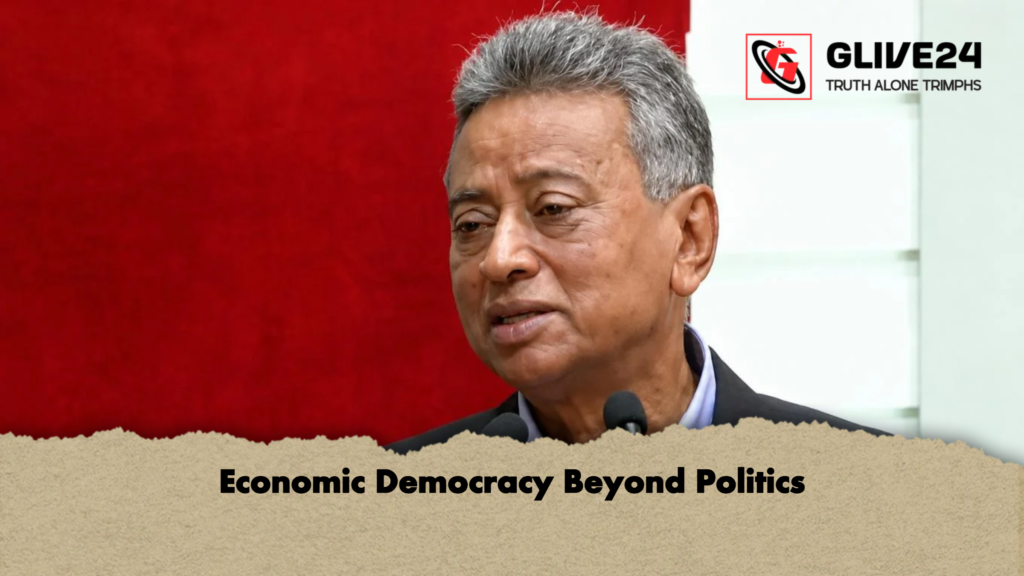
The Finance Minister Amir Khosru Mahmud Chowdhury has emphasised that democratic principles must extend beyond politics into the economic sphere, arguing that true inclusivity cannot be achieved unless economic participation is broadened for all citizens.
Speaking at the inauguration of the second phase of the “RAISE” project—an initiative jointly implemented by the Palli Karma-Sahayak Foundation (PKSF) and the World Bank to support the development of the informal sector—held in Agargaon, Dhaka on Sunday, the minister underscored the need to democratise the economy alongside political structures.
He stated that the government is placing strong emphasis on ensuring economic democratisation, with a focus on integrating those who remain outside the formal economic system into the mainstream. According to him, access to economic opportunities is not merely a policy objective but a fundamental civic right.
“The existence of democracy in politics alone is not sufficient; democracy must also exist in the economy,” he remarked, highlighting what he described as longstanding structural imbalances in the country’s economic framework.
The minister further alleged that in previous years, a privileged oligarchic class had disproportionately benefited from economic systems, limiting opportunities for ordinary citizens. He claimed that the current approach aims to dismantle such concentration of economic power and broaden participation across all segments of society.
He also drew attention to the role of women in household financial management, noting that they are often responsible for savings and maintaining family stability. In this context, he said the government is introducing measures such as the “Family Card” to provide financial relief and enhance household resilience. He added that such initiatives are expected to stimulate rural economies by increasing the flow of money at the local level.
In addition, the minister highlighted the “Farmer Card” programme, stating that it is expected to strengthen agricultural productivity and contribute positively to the national economy by supporting those engaged in farming activities.
Key Government Initiatives Discussed
| Initiative | Purpose | Expected Impact |
|---|---|---|
| RAISE Project (PKSF & World Bank) | Development of the informal sector and inclusion of marginalised workers | Greater access to finance, skills development, and formal economic integration |
| Family Card | Financial support to households, particularly managed through women | Improved household stability and increased rural economic circulation |
| Farmer Card | Support for agricultural workers and farmers | Enhanced agricultural productivity and strengthened rural economy |
The minister concluded that inclusive economic policies are essential for sustainable national development, stressing that broadening access to financial systems and opportunities will ultimately strengthen both rural and urban economies.