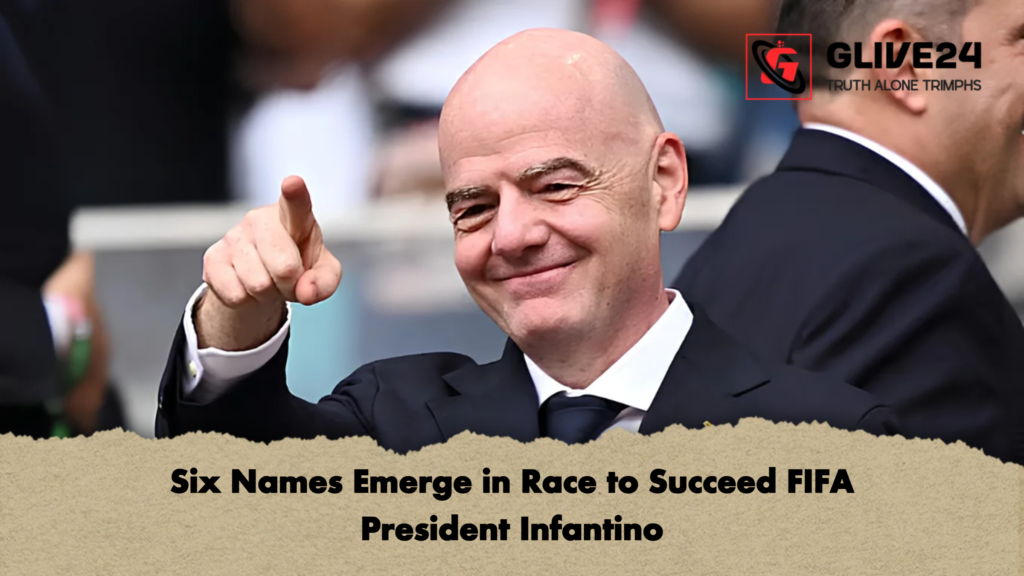
FIFA president Gianni Infantino is facing renewed scrutiny over his leadership as tensions within the international football administration continue to grow. UEFA has openly expressed its dissatisfaction with some of his decisions, while a controversial proposal to establish a separate company to manage FIFA’s commercial rights, including those linked to the World Cup, was eventually abandoned after facing resistance.
The withdrawal of the plan has not ended the dispute. Questions about Infantino’s leadership have reportedly emerged not only in Europe but also among sections of the football administrations in Asia and North America.
With the 2027 FIFA presidential election approaching, speculation is growing over whether Infantino will seek another term and, if he does, who might challenge him. Several prominent figures from the global football establishment are already being discussed as potential successors, although most have yet to declare any intention to contest the election.
Six names are currently attracting particular attention.
Victor Montagliani
Canadian football administrator Victor Montagliani is widely regarded as one of the strongest potential alternatives to Infantino. He has served as president of CONCACAF, the governing body for football in North, Central America and the Caribbean, since 2016. He is also one of FIFA’s vice-presidents.
Montagliani played an important role in Canada’s successful involvement in the bid to host the 2026 World Cup, which the country is co-hosting with the United States and Mexico. His position within CONCACAF gives him considerable influence in a region that will be at the centre of global football attention during the 2026 tournament.
According to a report by TalkSport, Montagliani could potentially build a strong electoral base if he secured the combined support of UEFA and CONCACAF and attracted additional votes from other confederations. However, he has not publicly indicated that he intends to challenge Infantino.
Sheikh Salman bin Ibrahim Al Khalifa
Another prominent name is Sheikh Salman bin Ibrahim Al Khalifa, president of the Asian Football Confederation and a senior FIFA vice-president.
The Bahraini football administrator previously stood against Infantino in the 2016 FIFA presidential election but was defeated. His experience at the highest levels of international football administration makes him a natural figure in any discussion about potential candidates.
Sheikh Salman has also been among the more outspoken critics of some of Infantino’s controversial proposals in recent times. His influence within Asian football could become significant if the presidential contest develops into a serious challenge to the current FIFA leadership.
Aleksander Čeferin
UEFA president Aleksander Čeferin is considered one of Infantino’s most prominent critics. The Slovenian lawyer leads European football’s governing body, which represents 55 member associations.
Relations between UEFA and FIFA have become increasingly strained over several issues. Čeferin has been particularly vocal in opposing certain initiatives associated with Infantino’s leadership. Reports have also suggested that he chose not to attend a recent World Cup final as a gesture of dissatisfaction with the FIFA president.
Despite his influence, Čeferin has so far given no clear indication that he plans to run for the FIFA presidency. Instead, his focus appears to be on strengthening unity within UEFA and building opposition to policies he believes are not in European football’s interests.
Mattias Grafström
FIFA secretary general Mattias Grafström is another name being discussed as a possible alternative. The Swedish sports administrator has held the position since 2023 and previously worked with the Swedish Football Association and the Asian Football Confederation.
His experience across different parts of the football administration and his position within FIFA could make him an acceptable candidate if the organisation enters a period of transition.
Some observers have also suggested that Grafström could be considered for an interim leadership role if Infantino were to step aside. However, there is currently no indication that Grafström himself intends to enter the presidential race.
Nasser Al-Khelaifi
Paris Saint-Germain president Nasser Al-Khelaifi has also been mentioned as a possible candidate. His influence extends well beyond club football. He is chairman of beIN Media Group and also leads the European Club Association, giving him strong connections with major clubs and the international sports broadcasting industry.
Despite his broad influence, reports citing people close to him suggest that Al-Khelaifi currently has no intention of contesting the FIFA presidency. His existing responsibilities at PSG, beIN Media Group and the European Club Association remain his main priorities.
That position, however, could change if the political landscape within FIFA shifts significantly before the election.
Patrice Motsepe
South African businessman Patrice Motsepe is another figure whose name has emerged in discussions about the future of FIFA leadership. He has served as president of the Confederation of African Football since 2021 and is one of the most influential figures in African football administration.
Motsepe’s position gives him considerable influence across the African football landscape, while his business background and international profile have also raised his standing within the wider football community.
Yet his close relationship with Infantino is widely recognised. For that reason, analysts believe he may be less likely to challenge the incumbent directly should Infantino seek another term.
The 2027 FIFA presidential election is still some distance away, and the political landscape could change considerably before candidates formally declare their intentions. FIFA’s electoral system also means that a successful candidate needs support from football associations across different regions rather than relying on a single confederation.
For now, none of the six figures discussed has officially confirmed a presidential bid. Their inclusion in the debate reflects the growing speculation surrounding FIFA’s future leadership rather than confirmed candidacies.
As the 2027 election draws closer, the balance of power between UEFA, CONCACAF, the AFC, CAF and other football confederations is likely to play a crucial role. Whether Infantino seeks another mandate or a credible challenger emerges, the contest could become one of the most closely watched leadership battles in world football administration.