The number of murder cases recorded across Bangladesh remains a major concern, with police statistics showing that more than 2,000 cases were filed during the first seven months of this year.
According to an analysis of Police Headquarters data, 2,076 murder cases were recorded between January and July. The monthly figures were 287 in January, 250 in February, 317 in March, 288 in April, 310 in May, 326 in June and 298 in July. This means an average of about 296 murder cases were recorded each month during the seven-month period.
The figures for the most recent three months also indicate a persistent problem. A total of 934 murder cases were recorded in May, June and July, averaging around 311 cases a month. Although the number fell from 326 in June to 298 in July, the overall level of lethal violence remains high.
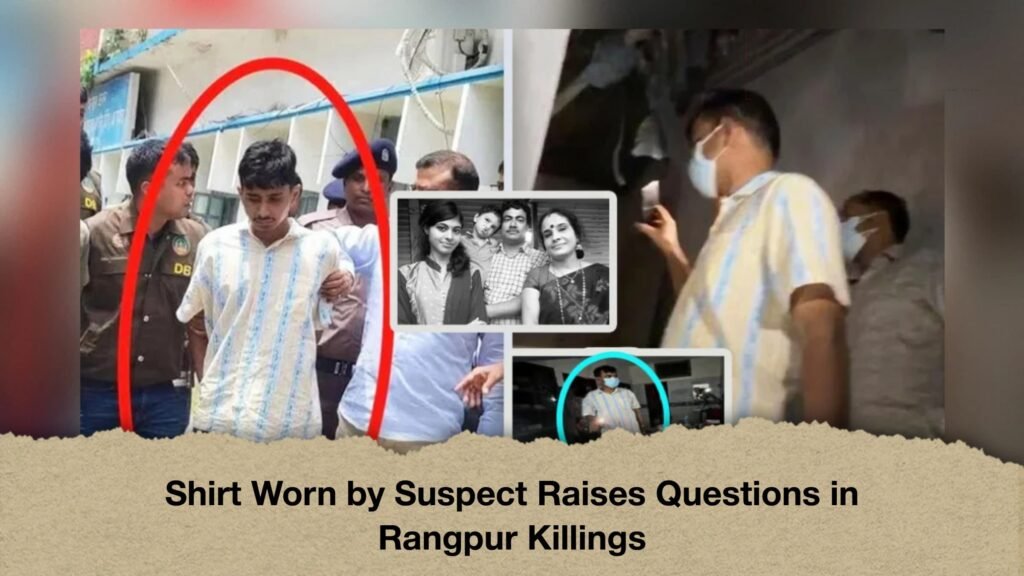
Recent incidents in different parts of the country have added to public anxiety. Five people were killed in Bagerhat, Faridpur, Ishwardi in Pabna, Jamalpur and Jhenaidah last Sunday. The previous night, the bodies of four members of the same family were recovered from the second floor of a house in Machuapara, in the Kamalkachna area of Rangpur city.
Police said the family members were allegedly killed in a planned attack after they objected to yaba consumption. The victims included former Rangpur Zilla School teacher Ganapati Chakraborty, his wife and their two children. The incident has caused considerable concern among relatives and local residents.
Table of Contents
Multiple factors behind the killings
Law enforcement officials and analysts say there is no single explanation for the continuing killings. Targeted attacks, disputes among organised criminal groups, political conflicts, local power struggles, drug-related violence, gang activity among youths, communal or group disputes, land-related conflicts and family disagreements have all been linked to different cases.
In some incidents, women and children have been killed following physical or sexual abuse. In others, longstanding personal disputes have escalated into fatal violence. The use of firearms in several incidents has also raised concerns over the availability and circulation of illegal weapons.
An analysis of data cited by Samakal found that 123 shooting incidents occurred across the country during the first seven months of the year, leaving 59 people dead.
The issue of missing firearms has added another dimension to the concern. Police data show that 1,311 looted firearms have yet to be recovered. These include 109 Chinese rifles and 30 sub-machine guns. A further 257,125 rounds of ammunition remain unaccounted for. Officials have also acknowledged that criminal networks possess a range of illegal modern weapons.
Dhaka records the highest number among metropolitan areas
Dhaka recorded the highest number of murder cases among the country’s metropolitan areas in July, with 31 cases. The figure was 23 in June and 16 in May. Altogether, 70 murder cases were recorded in the capital over those three months, showing a month-on-month rise.
In July, Chattogram metropolitan area recorded four murder cases, Khulna three, Rajshahi one, Sylhet five and Gazipur seven. No murder case was recorded in Barishal or Rangpur metropolitan areas during the month.
At the divisional police-range level, Dhaka recorded the highest number in July, with 66 cases, followed by Chattogram with 54. Khulna recorded 29, Mymensingh 27, Rajshahi 24, Rangpur 18, Sylhet 15 and Barishal 14.
During the previous two months, Dhaka and Chattogram also recorded comparatively high figures. Dhaka Range registered 74 cases in June and 72 in May, while Chattogram recorded 67 in June and 71 in May.
Over the three-month period from May to July, Dhaka Range recorded 212 murder cases and Chattogram Range 192. Khulna Range recorded 85. Khulna metropolitan area recorded nine cases during the same period, while Chattogram metropolitan area recorded 14.
Comparison with previous years
Police Headquarters statistics show significant fluctuations in the number of murder cases from year to year. In July 2025, 362 murder cases were recorded, including 90 cases relating to earlier killings. After excluding those older cases, the number of actual murders recorded for the month was 272.
In June 2025, there were 344 murder cases, of which 95 related to earlier incidents. The number of cases concerning murders committed during that month was therefore 249. In May, 341 cases were recorded, including 80 relating to previous incidents, leaving 261 cases concerning murders committed during the month.
The number of actual murder cases for May, June and July 2025 was therefore 782, averaging about 260 a month.
The figures for 2024 also show considerable variation. There were 259 murder cases in May, 268 in June and 334 in July, giving a combined figure of 861 and an average of 287 per month.
Across the whole of 2024, the monthly figures were 231 in January, 240 in February, 239 in March, 296 in April, 259 in May, 268 in June, 334 in July, 626 in August, 283 in September, 249 in October, 211 in November and 204 in December. Of the 626 cases recorded in August, 158 related to earlier incidents dating from 2009 to 2024.
In 2023, Police Headquarters recorded 3,023 murder cases, an average of approximately 251 a month. Between May and July that year, 814 cases were recorded, averaging around 271 a month.
Political disputes remain a factor
Political conflict is another factor cited in connection with killings and violent incidents. In many areas, disputes over local influence and control have escalated into serious clashes.
According to statistics from the Ain o Salish Kendra, 400 incidents of political conflict, ranging from minor confrontations to serious clashes, occurred between January and July this year. At least 77 people were killed in those incidents, including 40 who died in attacks or shootings by criminals.
Speaking to journalists after a meeting at the Secretariat on 17 August, Home Minister Salahuddin Ahmed said there had been visible improvement in the country’s law and order situation over the previous six months, or 180 days. He added that it was ultimately for the public to assess whether the situation was satisfactory and said more time was needed to strengthen law and order in line with public expectations.
Concerns over law enforcement capacity
Officials and people familiar with the situation say the law enforcement agencies have faced several challenges since the political change on 5 August 2024. Transfers, attachments, job-related uncertainty, legal cases and pressure generated through social media have contributed to concerns among some members of the forces.
In some cases, officers have reportedly faced difficulties while attempting to enforce the law. Those involved in law enforcement believe such circumstances can have an impact on policing and the broader security situation at ground level.
Officials have also pointed to the release of several high-profile criminals and known offenders on bail following the political change in August 2024. Some individuals reportedly returned to Bangladesh from abroad, while others either remained in the country or subsequently left again.
According to law enforcement officials, some of these individuals have sought to re-establish influence in particular areas, while others are allegedly attempting to settle old disputes.
On 28 April, Khondkar Naim Ahmed Titon, brother-in-law of alleged top criminal Sanjidul Islam Emon, was shot dead in the New Market area. His relatives blamed another alleged top criminal, Helal, for the killing. Helal, however, denied the allegation and claimed that associates of Emon were responsible.
On 10 November, another alleged top criminal, Tariq Saif Mamun, was shot dead near the Dhaka court area.
Recent incidents in Khulna
Several recent incidents in Khulna have further highlighted concerns over violent crime.
On 20 August, police recovered the body of an unidentified woman from a river in Batiaghata. The same night, a schoolgirl was found in a school bathroom in Dighalia, around five hours after the school had closed, with her hands, feet and mouth tied.
On 19 August, a double murder was reported in Lobonchara. Two young men were shot dead in the Ashibigha area within a period of around two hours.
On 18 August, a 26-year-old man named Raju was killed in a mob beating in the Rayermahal area after allegations that he had attempted to abduct a child. On 15 August, 27-year-old Joy Dhali was allegedly attacked with sharp weapons and killed. On 11 August, 32-year-old Fakhrul Sheikh was shot dead at a brick kiln.
Another disturbing case was reported in the capital on 6 August. Police recovered the severed head of an unidentified woman and two hands wrapped in polythene from beneath a bridge near a cattle farm in the Bagannari area under Sabujbagh police station.
With the assistance of information technology, investigators later identified the victim as 19-year-old Churaya Akter, also known as Falani. Her parents identified her from photographs of the severed head and tattoos on both hands. Police subsequently arrested five people in connection with the case.
Police say investigations are progressing
Additional Inspector General of Police Khondkar Rafiqul Islam said killings occur at a rate of around 300 cases a month and that some murders are difficult to prevent because they result from sudden anger, personal hostility or other unpredictable circumstances.
He also said Khulna, Chattogram and parts of the south-western region have recorded comparatively high numbers of killings. According to him, hired killers, extremist groups and groups associated with piracy in the Sundarbans have been linked to some incidents. Local disputes over political and social influence have also contributed to violence in certain areas.
The police official said law enforcement agencies now focus on bringing offenders before the courts through established legal procedures. He claimed that most of the recent murder cases have been investigated, with the identities of suspects established and arrests made in many cases.
Police Headquarters has also held several meetings with field-level officers to review the law and order situation. Killings, as well as violence against women and children, were among the issues discussed, and officers were given instructions on measures to contain such crimes.
The statistics show that murder figures rise and fall from month to month, but the consistently high number of cases remains a serious concern. Reducing lethal violence will require sustained efforts to recover illegal firearms, disrupt criminal networks, address local and political disputes, strengthen preventive policing and ensure timely investigations.
For ordinary citizens, however, the most immediate measure of improvement is simple: whether they can go about their daily lives without fear of becoming the next victim of violence.