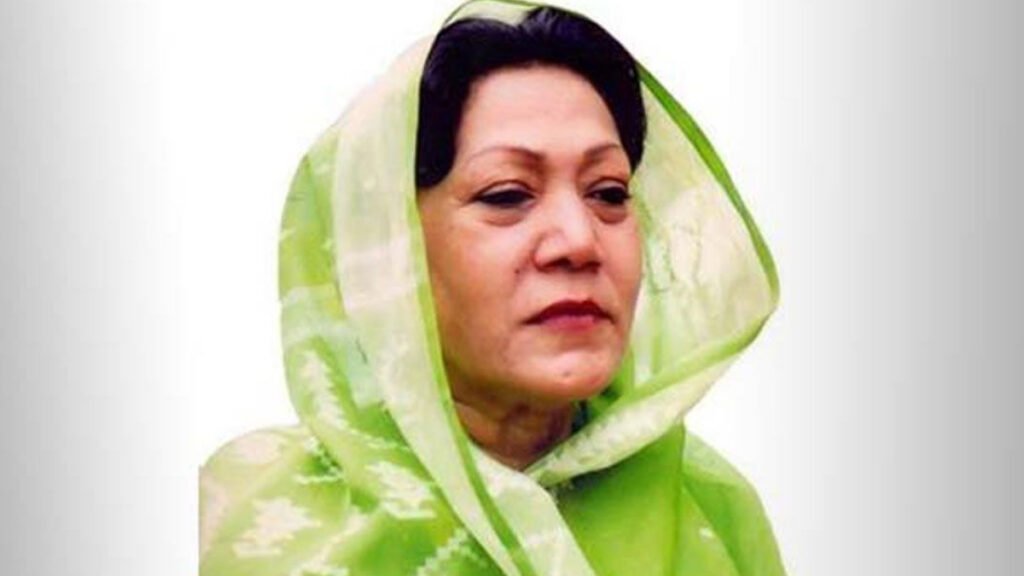
Ivy Rahman remains a prominent figure in Bangladesh’s political history, remembered for her dedication to democratic politics, women’s empowerment and grassroots organisation. A committed organiser of the Bangladesh Awami League, she was widely regarded by fellow activists as a warm and dependable colleague who remained closely connected with party workers throughout her political career. Her full name was Jebunnesa Ivy Rahman.
Born on 7 July 1936 in Chandiber village of Bhairab, in Kishoreganj district of the then greater Mymensingh region, Ivy Rahman developed an interest in social and political affairs during her student years. She later became actively involved in Awami League politics and devoted herself to strengthening the party’s organisational network at the grassroots level.
Her political career extended beyond conventional party activities. Ivy Rahman was also involved in social work and efforts to increase women’s participation in public and political life. She held important responsibilities in the Bangladesh Mahila Awami League and worked to encourage women to become more politically aware and organised.
For many women activists, her political journey represented an example of sustained participation in a male-dominated political environment. Her ability to maintain close relations with grassroots workers helped establish her reputation as a leader who was accessible to ordinary party activists.
Ivy Rahman’s political life was closely associated with the ideals of Bangabandhu Sheikh Mujibur Rahman and the Awami League’s democratic movement. Beyond politics, she also maintained a close family relationship with the Bangabandhu family. Her relationship with Sheikh Hasina was particularly close and affectionate.
She was married to veteran politician Mohammad Zillur Rahman, who later served as President of Bangladesh. Although her husband was himself a prominent political figure, Ivy Rahman developed a distinct political identity of her own through years of organisational work and active participation in the party. Colleagues remembered her for her affection towards fellow workers, while grassroots activists regarded her as a source of encouragement and strength.
21 August: A Day Marked by Bloodshed
The events of 21 August 2004 became one of the darkest episodes in Bangladesh’s political history. A rally organised by the Bangladesh Awami League on Bangabandhu Avenue in Dhaka was attacked with grenades. The gathering included senior party leaders and a large number of supporters and activists.
Sheikh Hasina, then the Leader of the Opposition, was the principal political target of the attack. As the explosions began, panic spread through the gathering. Party activists formed a human shield around her in an attempt to protect her from further attack.
The assault left numerous people dead and hundreds injured. Ivy Rahman was among those seriously wounded. She suffered multiple injuries from grenade splinters and was taken for medical treatment in critical condition.
For three days, she fought for her life. On 24 August 2004, however, she succumbed to her injuries.
Her death sent shockwaves through the Awami League and beyond. For her family, it was an immense personal loss. For the party’s grassroots activists, the death of a leader known for her warmth and commitment was deeply painful. Her passing also became permanently associated with the violence of the 21 August attack.
The significance of Ivy Rahman’s political life lies not only in the positions she held, but also in the relationships she built with ordinary workers. She remained closely connected to the people who formed the foundation of the political organisation she served. Her commitment to women’s participation in politics and her long involvement in organisational activities made her a notable figure in Bangladesh’s political history.
Twenty-two years after her death, Ivy Rahman continues to be remembered on 24 August, the anniversary of her passing. Her name remains linked with political commitment, courage and sacrifice, particularly in the context of the devastating grenade attack of 21 August 2004.
Her life ended in the aftermath of one of the country’s most traumatic political attacks, but her contribution as an organiser and advocate of women’s political participation remains part of the historical record.
On her death anniversary, Ivy Rahman is remembered with respect for a life devoted to political organisation, public service and the people who stood beside her throughout her long journey.