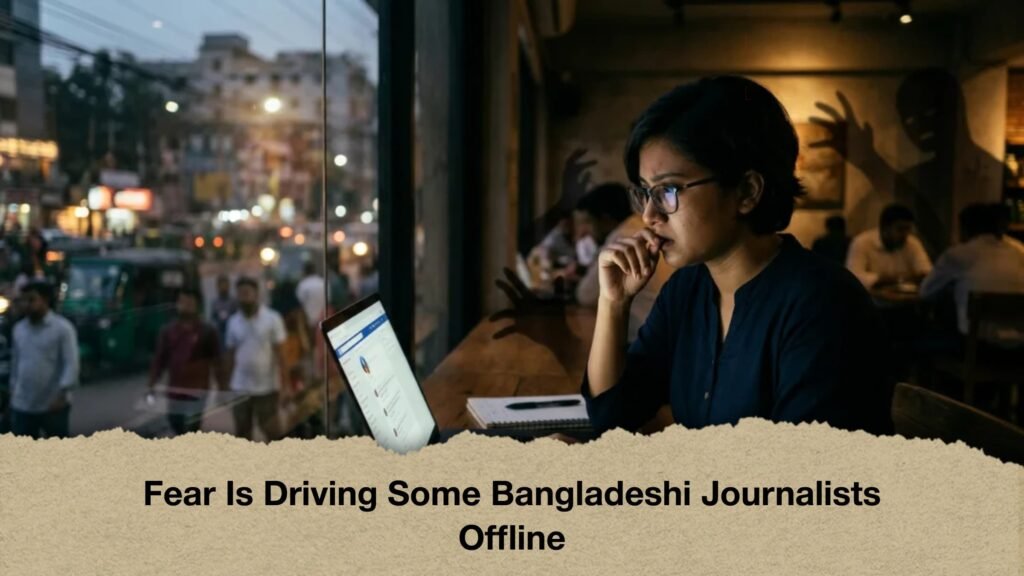
A small-scale survey has found that some journalists in Bangladesh are becoming increasingly cautious about expressing their views on social media, with concerns over threats, harassment and possible professional or personal consequences influencing what they choose to say publicly.
The findings come from the first edition of ‘Expression Pulse’, a survey conducted by Dataful, a private organisation working in data journalism. The survey sought to understand journalists’ experiences of digital expression over the previous six months, particularly their concerns about speaking publicly on issues of public interest.
Conducted between 10 and 25 August, the survey involved 22 media professionals who responded to a set of specific questions.
According to the findings, 18 of the 22 journalists said they had refrained from expressing opinions online about matters of public interest because they feared possible consequences during the six-month period covered by the survey. Among them, 13 said they had done so frequently.
Table of Contents
Experiences of colleagues are shaping behaviour
One of the clearest findings concerns what researchers describe as a ‘chilling effect’ — when the experience of another person facing harassment or retaliation discourages others from expressing themselves.
All 21 journalists who answered a question on whether attacks or harassment faced by other journalists affected their own willingness to speak online said that such incidents had an impact on them.
Of those respondents, 12 said the impact was significant, while nine said it affected them to some extent.
The finding suggests that the consequences of online harassment may extend beyond the individual targeted. When journalists see colleagues facing threats or other forms of retaliation, they may reassess their own exposure to risk before commenting on sensitive issues.
Sensitive subjects increasingly avoided
The survey also identified a broad range of subjects that journalists are currently reluctant to discuss openly on social media.
These include politics, political parties and politicians, criticism of the government, religion, communalism, law and order, the economy, foreign policy and sensitive issues such as rape.
Nineteen journalists who took part in the survey said they currently avoid discussing such subjects on social media.
The sense of comfort surrounding online expression has also declined for many participants. Fifteen of the 22 journalists said they felt less comfortable expressing their views on social media than they had six months earlier. Nine described the decline in their comfort level as substantial, while six said it had decreased to some extent.
Online threats can have offline consequences
The concerns described by participants go beyond trolling or the risk of losing access to a social media account. Some journalists said they were worried about organised online harassment, threats, the disclosure of personal information, damage to their reputation and possible professional consequences.
Other concerns included pressure at the workplace, political repercussions, legal complications and the physical safety of themselves and their families.
This suggests that the boundaries between online expression and real-world consequences are becoming an important consideration for some journalists. The possibility that an online comment could trigger consequences outside the digital space appears to be influencing decisions about whether to speak at all.
The impact is also being felt in professional journalism. Thirteen journalists said concerns about negative consequences had affected both their personal expression and their professional work.
A wider debate over digital expression
Freedom of expression in Bangladesh’s digital public sphere has been a longstanding subject of debate. Journalists and rights organisations have previously raised concerns about laws governing online activity and their potential impact on free expression and independent journalism.
Such concerns have also been linked to the growth of self-censorship, whereby journalists or other members of the public limit what they say because they fear possible legal, professional or personal repercussions.
Dataful’s survey seeks to capture whether such experiences are changing among journalists and how concerns surrounding digital expression are affecting their behaviour.
However, the organisation has clearly acknowledged the limitations of the research. The survey is not nationally representative, and the participants were not selected through random sampling. Only 22 journalists took part.
As a result, the findings cannot be taken as a definitive picture of the experiences of all journalists in Bangladesh. They instead offer a snapshot of the concerns reported by a small group of media professionals.
Even with those limitations, the responses point to several issues that merit attention: journalists withholding views on matters of public interest, changing their behaviour after seeing colleagues face harassment, avoiding sensitive subjects and worrying that online expression could have consequences in their professional and personal lives.