Table of Contents
1. The Great Divergence: Exploding Deposits vs. Collapsing Credit Demand
-
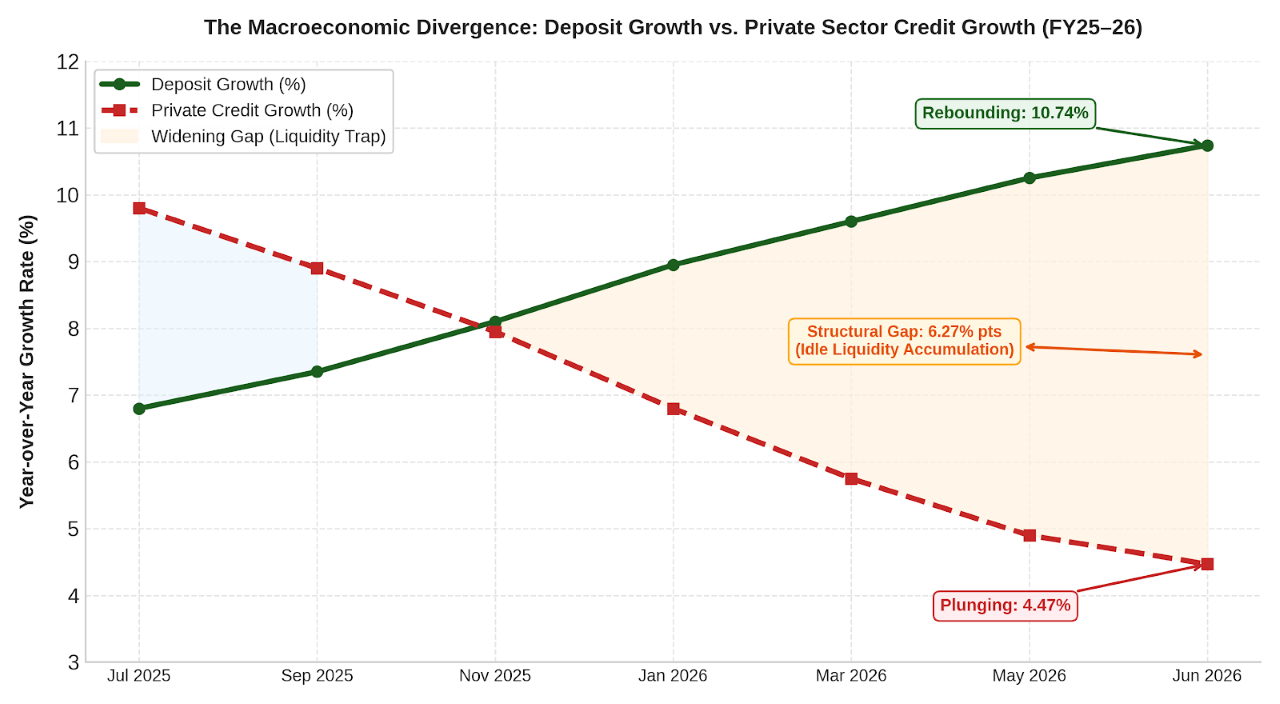
The Acceleration of Deposit Inflows: After months of negative real interest rates, liquidity squeezes, and macroeconomic volatility, commercial banks experienced a sharp rebound in deposit growth, touching 10.74 per cent in June (up sharply from 7.73 per cent a year prior). This surge was driven by two primary forces: retail savers seeking safe havens amidst high inflation, and banks aggressively adjusting deposit rates upward to comply with shifting monetary policy frameworks.
-
The Freefall of Private Sector Credit: Conversely, the private sector—the primary engine of gross domestic product (GDP) growth—has pulled back dramatically. Private sector credit growth plummeted to a multi-year low of 4.47 per cent in June. Businesses are not borrowing because expansion plans have been shelved. Working capital requirements have shrunk as industrial capacity utilization drops, leaving corporate boardrooms focused strictly on survival, deleveraging, and inventory liquidation rather than capital expenditure (CapEx).
2. The Non-Performing Loan (NPL) Overhang and Risk Aversion
-
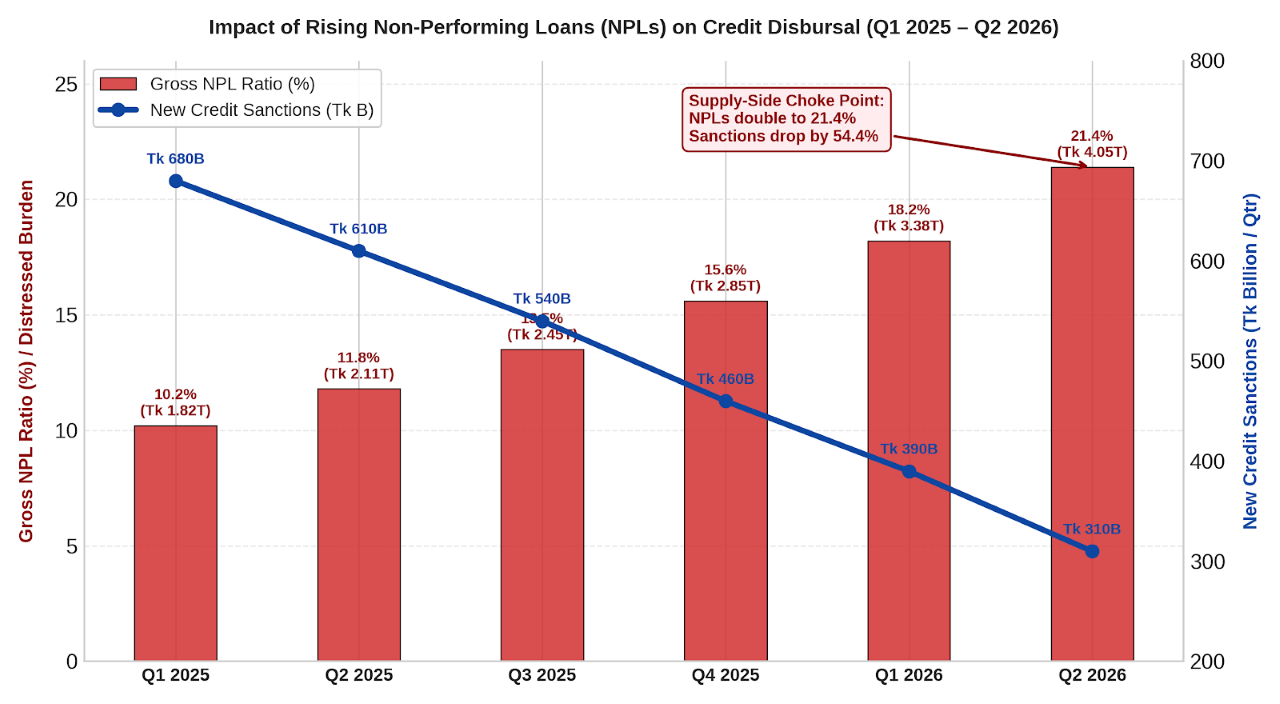
The Credit Cautiousness: Credit committees across private commercial banks are demanding pristine balance sheets, heavy collateral, and immaculate compliance histories before sanctioning fresh loans.
-
The Missing Middle: Small and medium-sized enterprises (SMEs)—which form the backbone of employment and domestic supply chains—find themselves entirely frozen out of formal credit channels. Banks prefer holding risk-free government securities or parking cash at the central bank over extending loans to an industrial sector facing high default vulnerabilities.
3. The Energy Crisis as the Primary Industrial Bottleneck
-
Unviable Capacity Utilization: Factories cannot operate at optimal shifts when gas pressure drops unpredictably or power outages disrupt continuous production lines.
-
The Investment Paralysis: Under such volatile operational conditions, even if a manufacturer secures a low-interest loan, deploying that capital into new factory lines or machinery is economically unviable. Without a reliable, predictable supply of primary energy inputs, industrial expansion is impossible.
4. The SDF Trap: Parking Surplus Cash at a Loss
-
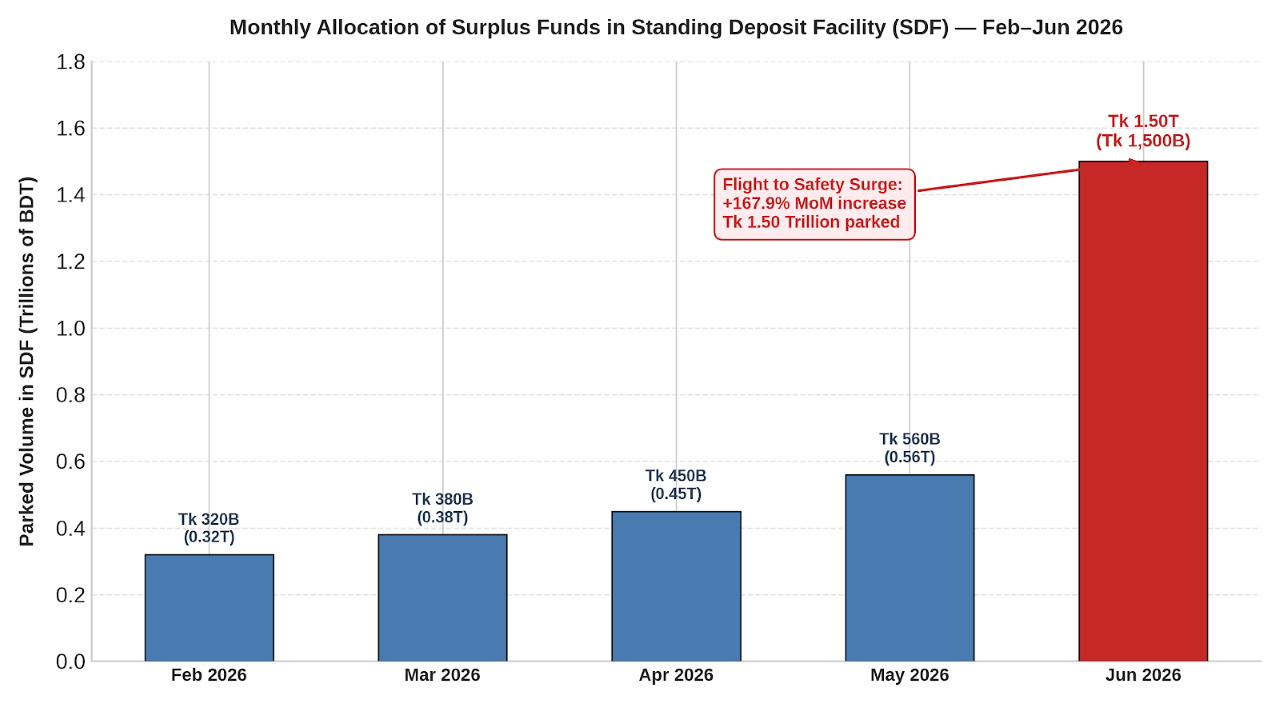
The Mechanics of SDF: The SDF is a low-yielding central bank deposit window designed to mop up excess overnight liquidity. The SDF rate is pegged at a modest 7.50 per cent, considerably lower than alternative short-term instruments like the call money market.
-
A Historic High: Driven by a complete lack of better alternatives, affluent commercial banks parked a cumulative record of approximately Tk 1.50 trillion in the SDF window during June. Monthly volumes parked in the SDF hovered between Tk 444 billion and Tk 578 billion over preceding months before exploding.
5. Disruption in Interbank Liquidity and Monetary Transmission
-
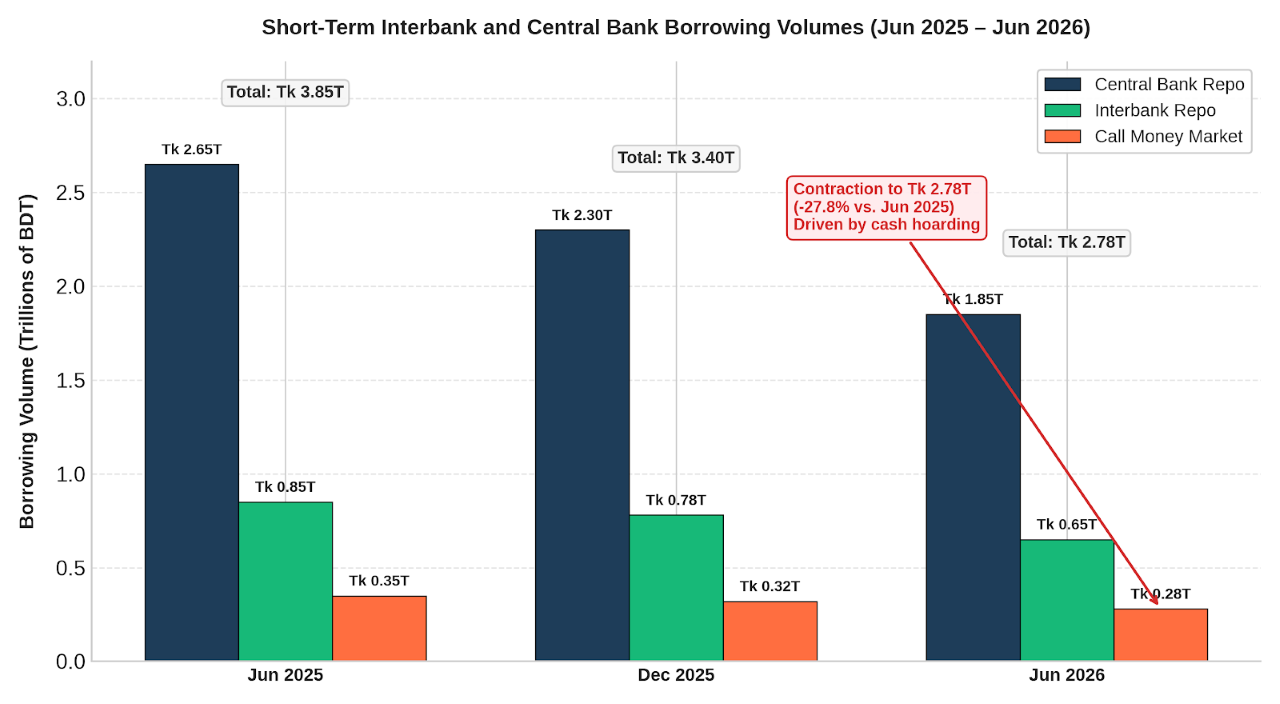
Shifting Borrowing Patterns: Total borrowing across these three major instruments rose from Tk 2.66 trillion in June 2025 to a peak of Tk 3.97 trillion by June 2026, driven by fragmented liquidity distributions among liquidity-rich and liquidity-stressed banks (often categorized between strong private/foreign banks and struggling state-owned or weak private lenders).
-
Recent Contraction: However, as excess liquidity peaked in June, total borrowing across these instruments dropped significantly to Tk 2.78 trillion, as liquidity-rich banks chose to hoard cash internally or park it directly with the central bank rather than lending to peers in the interbank market, reflecting systemic counterparty cautiousness.
6. Long-Term Macroeconomic Implications and Risks
-
Net Interest Margin (NIM) Compression: As banks absorb high-cost retail deposits (fueling the 10.74% deposit growth) while failing to deploy those funds into high-yielding private sector loans, their incremental cost of funds outweighs asset yields.
-
Downward Pressure on Rates: If this sluggish economic cycle persists, commercial banks will inevitably be forced to slash both deposit and lending rates to protect their profitability.
-
Negative Real Returns for Depositors: In a worst-case scenario, if deposit rates are forced below the prevailing headline inflation rate, the real income of ordinary depositors will turn negative, penalizing savers and discouraging formal financial intermediation.
Strategic Policy Recommendations
-
Resolve the Energy Bottleneck: Prioritize emergency structural reforms in the energy sector, ensuring uninterrupted gas and electricity supplies to export-oriented manufacturing industries to instantly unlock pent-up industrial demand.
-
Accelerate NPL Resolution: Implement robust asset-management company frameworks and strengthen legal mechanisms (such as specialized financial courts) to clean up legacy bad loans, restoring commercial banks’ risk appetite.
-
Targeted Credit Guarantees: Introduce central-bank-backed credit guarantee schemes for SMEs and high-potential manufacturing sectors to lower the perceived risk of lending to underserved economic segments.
-
Calibrated Yield Curve Adjustments: Optimize government securities issuance pacing to better absorb systemic liquidity without overcrowding private sector borrowing needs when demand eventually recovers.

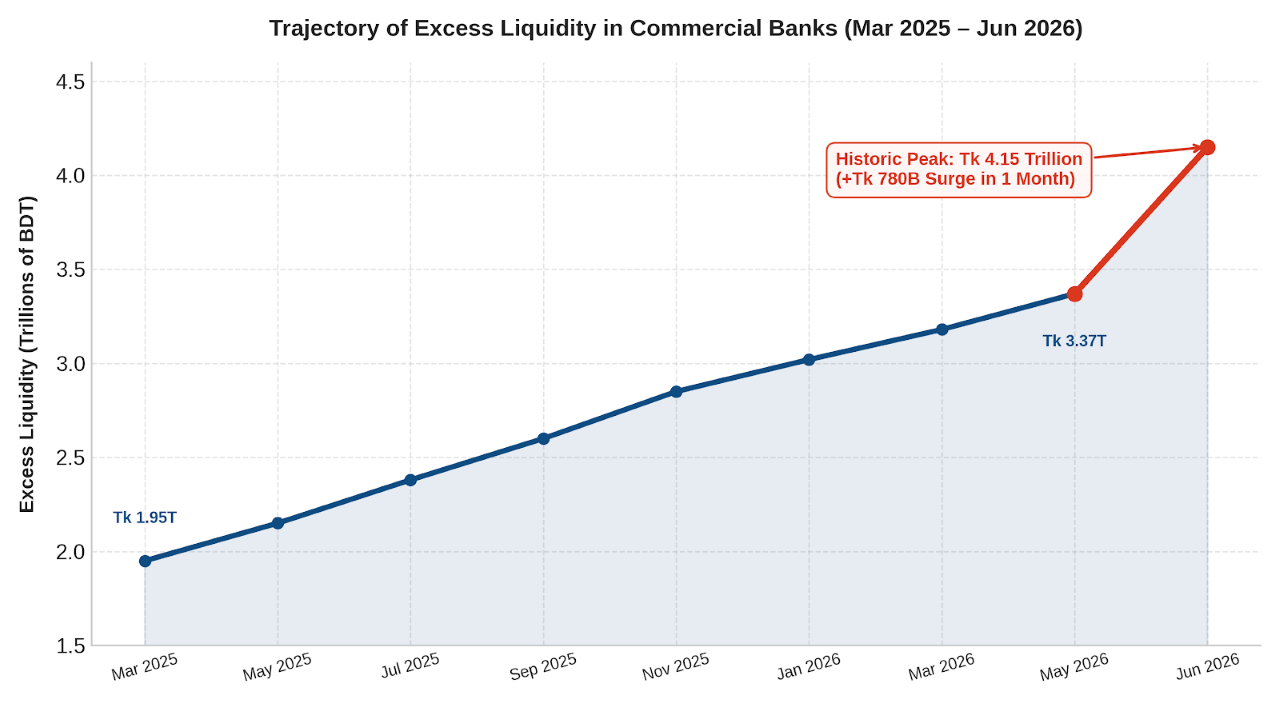
Ultimately, the monumental surge in excess liquidity to over Tk 4.15 trillion is not a badge of financial strength, but a glaring warning light for macroeconomic stability. It reveals a fractured financial pipeline where capital pools uselessly in central bank vaults instead of catalyzing industrial expansion, employment, and GDP growth.
Resolving this liquidity paradox demands a paradigm shift: monetary policy tools alone cannot coax risk-averse lenders or hesitant entrepreneurs into action while foundational constraints like the chronic energy crisis and legacy bad loans remain unaddressed. By aggressively clearing industrial power and gas bottlenecks, accelerating non-performing loan resolution, and redirecting trapped capital toward productive enterprise, policymakers can break the cycle of stagnation—transforming an idle cash mountain into the vital engine of a resilient, modern economy.