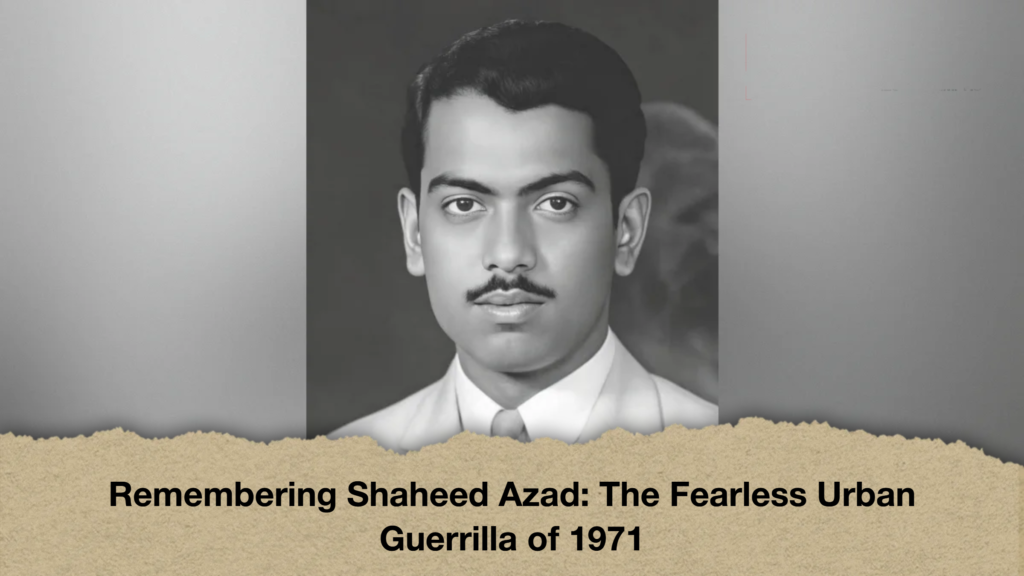
History is seldom built on grand political declarations alone; it is carved out by the blood, courage, and unyielding sacrifice of ordinary individuals who rise to meet extraordinary times. Among the luminaries of the Bangladesh Liberation War, Magfar Ahmed Chowdhury Azad—universally remembered as Shaheed Azad—stands out as a symbol of youthful defiance and supreme patriotism. His life and tragic death encapsulate both the fierce romanticism of the fight for independence and the profound, enduring grief borne by the families left behind.
Born on 11 July 1946, Azad was the only child of affluent businessman Yunus Ahmed Chowdhury and Safia Begum. Raised in a comfortable household in Dhaka’s New Eskaton, his early life took a sharp turn following domestic friction between his parents. His mother, carrying deep resentment over her husband’s second marriage, chose to leave the family estate and relocate with young Azad to a residence in Farashganj. Despite the turbulence, Azad grew into a vibrant, independent-spirited young man with an eclectic passion for literature, cinema, and music. Though he never conformed to rigid academic routines, his sharp intellect carried him through his studies. After completing his schooling, he pursued higher education at the University of Karachi before returning to earn a Master’s degree in International Relations from the University of Dhaka in 1970.
When the flames of the Liberation War swept across East Pakistan in 1971, Azad could easily have chosen the path of safety. Instead, he answered the call of the motherland, leaving behind the comforts of privilege to join the Crack Platoon, the legendary urban guerrilla unit operating under Sector 2. Operating right under the noses of the occupying Pakistan Army in Dhaka, Azad and his comrades executed daring sabotage operations that rattled enemy command and galvanized a terrorised civilian population.
The turning point of tragedy arrived on 30 August 1971. Betrayed or tracked down by hostile forces, Azad was arrested alongside fellow freedom fighters from his residence. He was subjected to brutal physical and psychological torture in captivity, as military interrogators desperately sought the names, safe houses, and operational secrets of the guerrilla network. Through unimaginable agony, Azad remained a fortress of silence. He chose death over betrayal, protecting his brothers-in-arms and sealing his fate as a martyr of absolute integrity.
The human toll of his execution is most poignantly mirrored in the life of his mother, Safia Begum. During a brief, heart-wrenching visit to the prison camp, she had asked her detained son what he wished to eat. Azad simply replied that he longed for a plate of home-cooked rice. The grieving mother returned the next day with the meal, only to discover that her son had already been executed. That single, unfulfilled wish haunted Safia Begum for the remaining fourteen years of her life; consumed by unbearable sorrow, she never touched a grain of rice again until her dying day.
This poignant saga of maternal grief and youthful sacrifice was later immortalised by acclaimed author Anisul Hoque in his celebrated biographical novel, Maa. Shaheed Azad remains far more than a historical footnote. He is a testament to the cost of sovereignty, reminding contemporary generations that the freedom of Bangladesh was forged through genuine human heartbreak and uncompromised courage. As the nation pauses to reflect on its foundational sacrifices, the silent resilience of Shaheed Azad continues to speak across the decades.