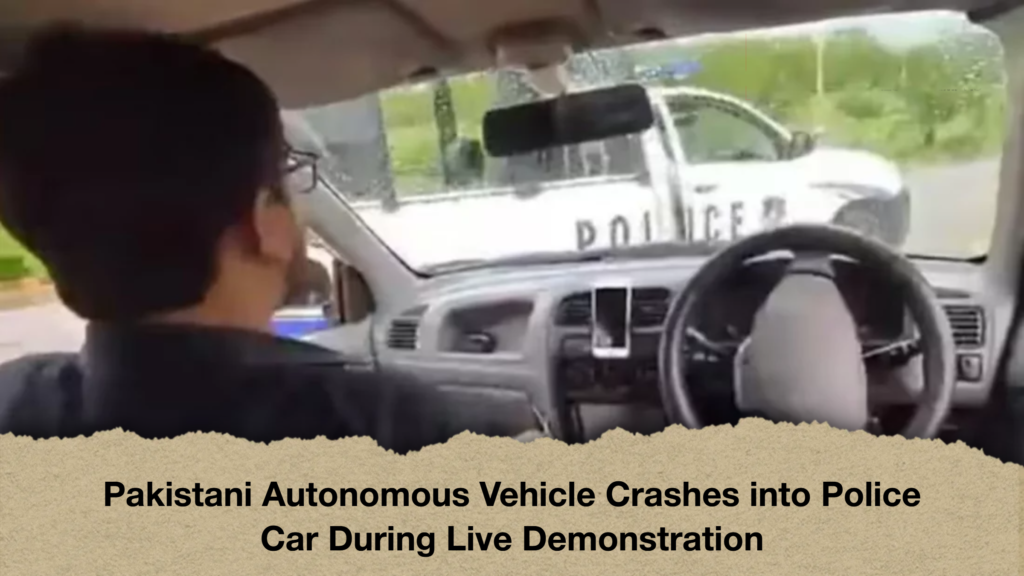
An indigenous self-driving car built in Pakistan crashed into a parked police vehicle during a live demonstration in Islamabad’s high-security D-Chowk area, turning a flagship technology showcase into a viral sensation.
The prototype driverless car was developed by Ehsan Zafar, an independent technology enthusiast based in Abbottabad. Designed to showcase local engineering capabilities in autonomous navigation, the vehicle was being tested publicly to demonstrate its steering, tracking, and automated braking systems. However, the presentation took an unexpected turn when the vehicle suffered an immediate loss of control.
According to journalist Muhammad Alizah, who covered the event, the mishap was caused by a sudden breakdown in communication systems. The vehicle relied on real-time internet telemetry and satellite navigation to map its route and process obstacle data. When satellite and network signals were unexpectedly lost, the onboard software failed to initiate an automated emergency stop. Left without continuous spatial data, the vehicle drifted off its intended line and moved directly towards a stationary police car.
Footage captured at D-Chowk shows the self-driving car steadily advancing despite manual intervention. The operator attempted to engage a secondary handbrake, but the mechanical system proved insufficient to halt the momentum before impact. The collision damaged the police vehicle, though no injuries were reported.
Alizah noted that the choice of location prevented a far more serious outcome. D-Chowk is a heavily guarded, restricted zone with minimal pedestrian traffic, which limited the physical consequences of the system failure. Had a similar telemetry loss occurred on a crowded municipal road or busy highway, the lack of a fail-safe override could have caused severe casualties.
The video rapidly circulated across social media platforms, drawing widespread amusement and light-hearted criticism. Pakistani netizens posted memes mocking the reliance on fragile satellite links for critical transport infrastructure. The clip also caught international attention when Indian actor Ranvir Shorey reshared the footage with satirical commentary, expanding the online debate across regional digital spaces.
Beyond the social media banter, the crash highlights fundamental engineering challenges inherent to autonomous mobility. Self-driving vehicles require multi-layered redundancy, ensuring that if primary satellite connections or web feeds fail, onboard visual sensors, lidar, and hard-coded mechanical safeguards immediately take over to bring the vehicle to a controlled stop.
Engineers and observers have urged the public to view the setback as a crucial learning phase rather than a definitive failure. Early-stage testing in controlled environments is intended to expose system vulnerabilities before commercial adoption. Alizah similarly called for responsible development, emphasizing that rigorous safety audits, fail-safe protocols, and robust secondary brakes must take priority over public demonstrations as local innovators continue refining autonomous transport.