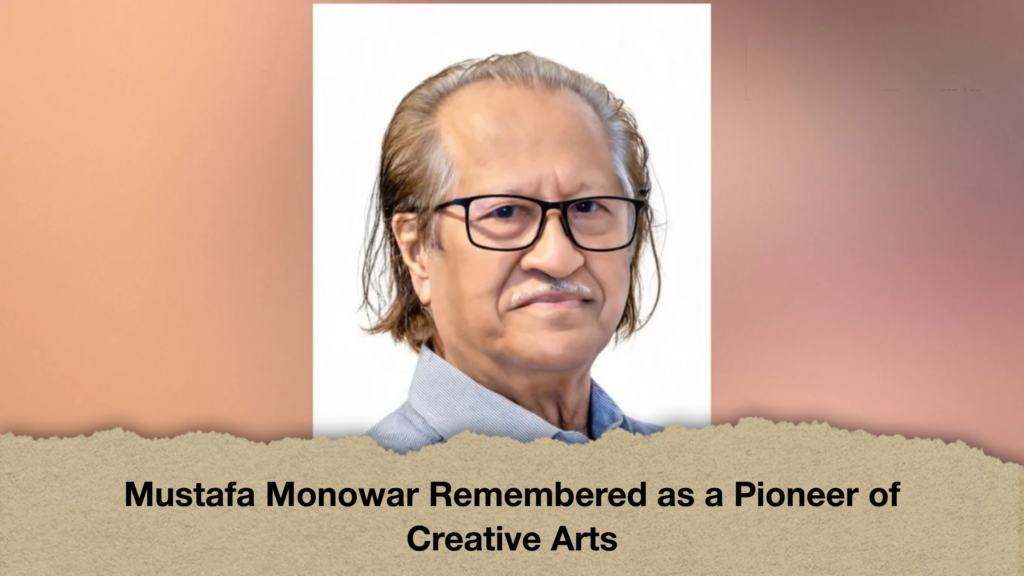
Mustafa Monowar, one of Bangladesh’s most versatile cultural figures, left an enduring mark across painting, puppetry, television, theatre and arts education. His creative journey was never confined to a single medium. From the canvas to the television screen and from puppet theatre to stagecraft, he consistently sought new ways of making art accessible, meaningful and engaging to ordinary people.
Born on 1 September 1935, Mustafa Monowar was the son of celebrated Bengali poet Golam Mustafa. His early attraction to art eventually led him to pursue formal training at the Government College of Art and Craft in Kolkata. Painting became an important foundation of his artistic career, and he developed a distinctive visual language through his use of line, colour and composition.
Yet it was his work beyond traditional painting that made him a particularly recognisable figure in Bangladesh’s cultural landscape.
Mustafa Monowar played a pioneering role in developing and popularising puppetry in Bangladesh. His contribution earned him widespread affection and the popular title of the country’s ‘Puppetman’. He brought Bengali folklore, fairy tales and elements of indigenous cultural traditions to children through imaginative puppet characters and performances.
Characters such as Parul, Bagha and Mini became familiar to generations of young viewers. His television puppet programme Moner Kotha was particularly popular, while his treatment of traditional stories such as Sat Bhai Champa demonstrated how folk narratives could be adapted for modern television without losing their cultural roots.
His association with television began in 1964, when he joined Pakistan Television as a producer. He later became involved in the development of Bangladesh Television during its formative years and contributed to a range of creative programmes. His work was also associated with Notun Kuri, a popular programme designed to encourage and showcase the talents of children and young people.
Theatre and literary adaptation provided another avenue for his creativity. He brought major works of literature to television, including Rabindranath Tagore’s Raktakarabi and William Shakespeare’s The Taming of the Shrew. His approach reflected a broader understanding of visual storytelling, in which literature, performance, design and television could work together rather than remain separate artistic disciplines.
His artistic role became particularly significant during Bangladesh’s Liberation War in 1971. In refugee camps in West Bengal, he used puppet performances as part of the cultural resistance in support of the independence struggle. Puppet plays such as Agacha, Rakkhosh and Ek Sahosi Krishak reflected the realities and spirit of that period. Some footage of his puppetry later appeared in Tareque Masud’s documentary Muktir Gaan, helping preserve an important aspect of the cultural history of the Liberation War.
Mustafa Monowar’s creative work also extended into public art and design. His contributions included the creation of ‘Mishuk’ for the second South Asian Games, as well as the installation representing a red sun behind Dhaka’s Central Shaheed Minar. Such projects illustrated his ability to apply artistic ideas beyond conventional galleries and performance spaces.
He was equally respected as a teacher and mentor. For Mustafa Monowar, art was not simply about producing attractive images or performances. He viewed creativity as a means of awakening thought, refining an appreciation of beauty and encouraging younger generations to imagine possibilities beyond the familiar. Many artists and cultural practitioners drew inspiration from his guidance and approach to creative work.
His contribution was recognised by the state when he received the Ekushey Padak in 2004. He also received other honours during his long career, including lifetime recognition for his contribution to the arts and culture of Bangladesh.
Mustafa Monowar died on the morning of 29 June 2026 while receiving treatment at a hospital in Dhaka. He was born on 1 September 1935 and was aged 90 or 91, depending on how his age is calculated.
His death marked the passing of a remarkable generation of Bangladeshi cultural practitioners. But his influence extends well beyond the dates of his birth and death. His paintings remain part of the country’s artistic heritage, while his puppet characters, television productions, theatrical adaptations and educational contributions continue to form part of Bangladesh’s cultural memory.
What distinguished Mustafa Monowar was his refusal to treat artistic disciplines as isolated worlds. He moved naturally between painting, television, puppetry, theatre and design, carrying ideas from one medium into another. In doing so, he made art more approachable while preserving its cultural depth.
His legacy is therefore not limited to the works he created himself. It also lives in the artists he inspired, the audiences who grew up with his characters and programmes, and the generations that encountered Bengali culture through his imaginative interpretations.
Mustafa Monowar is no longer here to add another stroke to the canvas. Yet the distinctive marks he left behind remain. His career stands as a lasting reminder that art can connect tradition with modernity, imagination with reality, and creators with the people they seek to reach.
His was a life devoted to creation. His contribution will remain an enduring part of Bangladesh’s cultural heritage.