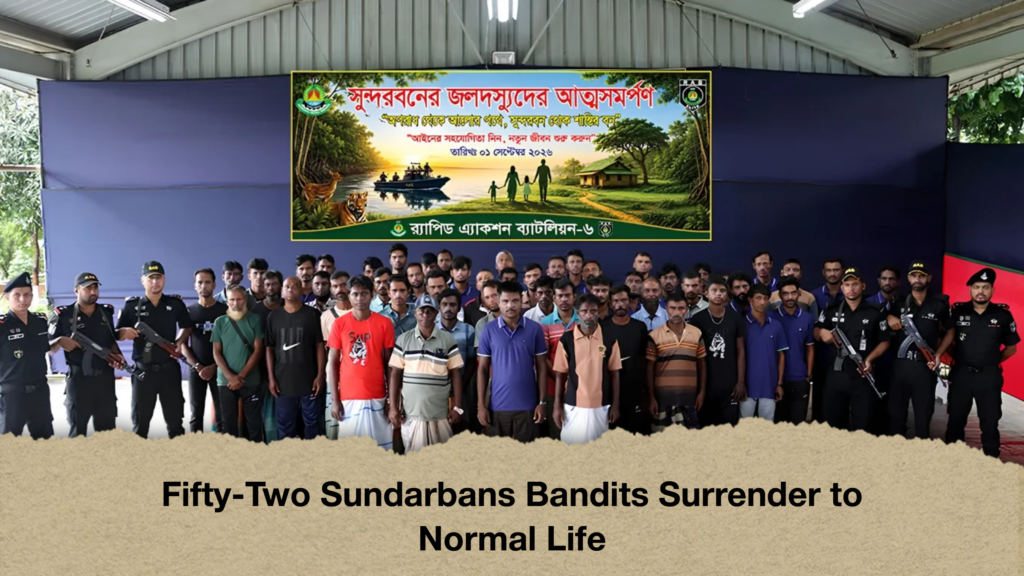
In a significant breakthrough for the security of Bangladesh’s coastal region, fifty-two members belonging to four different outlawed bandit gangs have formally laid down their arms. Choosing to abandon a life of crime in pursuit of rehabilitation and peace, these individuals surrendered to the Rapid Action Battalion (RAB-6) on Monday. This collective surrender marks another crucial milestone in the ongoing security operations aimed at eradicating maritime and forest banditry from the world’s largest mangrove forest.
For generations, the livelihoods of local fishermen, woodcutters (bawalis), and honey collectors (mawalis) have been severely compromised. Operating deep within the treacherous terrain of the Sundarbans, criminal syndicates routinely subjected these vulnerable forest-dependent communities to brutal abductions and extortionate ransom demands. According to RAB-6 commander Nistar Ahmed, the mass surrender was facilitated through sustained intelligence surveillance and targeted security operations, coupled with structural pathways offered to outlaws willing to return to lawful civic life.
An analysis of the surrender figures reveals that the highest number of defectors came from the infamous Boro Jahangir gang, with sixteen members turning themselves in. They were joined by thirteen members from the Anarul gang, fifteen from the Afzal alias Dulabhai faction, and eight from the Aftab gang, bringing the total number of surrendered individuals to fifty-two.
The timing of this development is particularly crucial. The surrender unfolded precisely on the eve of the reopening of the Sundarbans. Authorities had imposed a strict three-month seasonal ban on public entry to safeguard the breeding and movement patterns of local wildlife. With that restriction lifting on September 1, the forest is once again welcoming tourists, researchers, and local forest-dependent workers. Security analysts note that the neutralization of these criminal factions right before the reopening dramatically boosts safety measures for visitors and locals alike, breathing fresh momentum into the regional eco-tourism economy.
Addressing the media, RAB-6 commander Nistar Ahmed assured that despite their voluntary surrender, standard legal protocols would be strictly observed. Necessary judicial proceedings will be processed, and the suspects will be handed over to the appropriate courts in due course. Furthermore, the elite security agency has vowed that its intelligence-gathering operations and patrols will remain vigilant to preserve ecological balance, protect local communities, and stamp out any residual organised crime syndicates lurking within the mangrove ecosystem.
A comprehensive breakdown of the surrender statistics, gang distribution, and operational metrics is detailed below:
| Parameter / Category | Details & Statistics | Operational Significance |
| Total Surrendered Bandits | 52 individuals | Major reduction in active forest gangs |
| Law Enforcement Agency | RAB-6 (Rapid Action Battalion) | Spearheaded the surrender and intelligence operations |
| Boro Jahangir Gang | 16 members surrendered | Largest contingent among the defecting factions |
| Afzal alias Dulabhai Gang | 15 members surrendered | Significant operational blow to local criminal networks |
| Anarul Gang | 13 members surrendered | Contributed to the collective peace initiative |
| Aftab Gang | 8 members surrendered | Strengthens regional security footprint |
| Seasonal Forest Ban Duration | 3 months | Implemented to protect wildlife breeding seasons |
| Sundarbans Reopening Date | 1 September | Resumption of tourism and forest livelihoods |
| Primary Beneficiaries | Fishermen, bawalis, mawalis, and tourists | Enhanced safety and freedom of movement |
| Subsequent Legal Action | Handed over to courts via standard procedures | Adherence to the rule of law and judicial process |