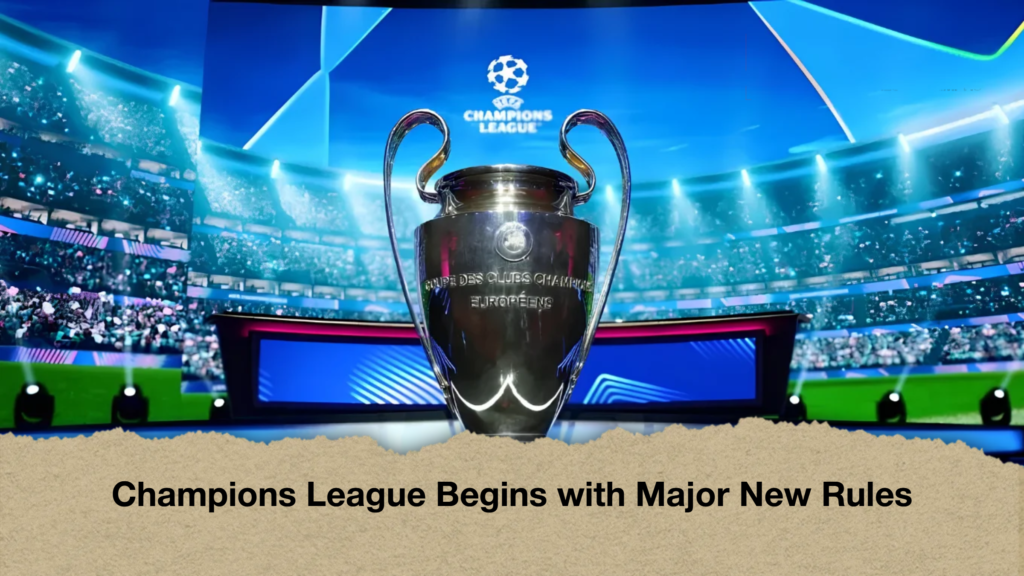
The 2026–27 UEFA Champions League league phase begins today, with 36 clubs preparing for another demanding campaign in European football’s premier club competition.
The league phase will again feature eight matchdays, with each team facing eight different opponents. The top eight sides in the final standings will advance directly to the last 16, while teams finishing from ninth to 24th will enter the knockout play-offs. Those placed from 25th to 36th will be eliminated from the competition.
Paris Saint-Germain begin their title defence after beating Arsenal on penalties in May to claim the Champions League trophy for the second time. Luis Enrique’s side will be among the leading contenders again, although they face competition from several of Europe’s established powers, including Arsenal, Manchester City, Liverpool, Barcelona, Real Madrid and Bayern Munich.
While the league-phase qualification structure remains unchanged, several important refereeing and disciplinary measures have been introduced for the new season.
Stricter measures against time-wasting
One of the biggest changes concerns efforts to prevent teams from deliberately slowing down the game.
Players being substituted will now be expected to leave the pitch within 10 seconds. If a player takes longer, the incoming substitute may have to wait until the required period has elapsed and the next appropriate stoppage before entering the field.
Referees will also have the authority to use a five-second countdown when players delay restarts from throw-ins and goal-kicks. If a team fails to restart play before the countdown expires, the throw-in can be awarded to the opposition. In the case of a delayed goal-kick, the opposing team can instead be awarded a corner.
The rules also introduce a minimum period away from the pitch for players who receive medical treatment. Subject to specified exceptions, a player who receives treatment or assessment on the field must remain off the pitch for at least one minute after play restarts. Goalkeepers are exempt from this particular requirement.
There are also exceptions where the injury results from a foul that leads to disciplinary action against the opponent. The intention is to prevent players from using minor injuries or stoppages as a routine method of wasting time.
VAR given a wider remit
Video Assistant Referee intervention is also being expanded in several areas.
One important change concerns mistaken identity. If the referee sanctions the wrong player for an offence, VAR officials can intervene to correct the disciplinary decision. The review is limited to the identity issue rather than reopening the original offence itself.
VAR can also become involved when a player is incorrectly shown a second yellow card, provided the decision meets the relevant threshold for intervention. In such cases, the referee can be sent to the pitchside monitor to review the incident.
Other areas now receiving greater attention include fouls committed by the attacking team immediately before a corner or free-kick and certain potential handball situations arising from goal-kicks.
The changes are designed to correct clear errors without turning VAR into a tool for routinely re-examining every decision. UEFA’s approach remains focused on limiting unnecessary interruptions and ensuring that reviews are used only when the evidence is sufficiently clear.
Covering the mouth can bring a yellow card
Another rule attracting attention concerns players covering their mouths during heated exchanges with opponents.
The issue became particularly prominent after an incident involving Benfica’s Gianluca Prestianni and Real Madrid’s Vinícius Júnior in February. Prestianni covered his mouth with his shirt while speaking to Vinícius, prompting allegations about what had been said. UEFA subsequently found Prestianni guilty of homophobic conduct and imposed a six-match suspension, with three matches suspended.
FIFA subsequently introduced a stricter approach at the 2026 World Cup, allowing players to be sent off for covering their mouths during confrontations with opponents.
UEFA, however, has chosen a different approach for its club competitions. A player who covers his mouth in circumstances considered unsporting can be shown a yellow card. Serious incidents can also be examined retrospectively, meaning disciplinary action may follow after the match if further investigation is warranted.
The distinction means that covering the mouth will not automatically result in a red card in the Champions League. Context and the nature of the player’s behaviour will remain important factors for match officials.
Yellow-card suspension threshold has changed
The accumulation system for yellow cards has also been revised.
Previously, a player in the competition could receive a one-match suspension after collecting three yellow cards, with further suspension thresholds following at five and seven bookings.
Under the new system, the first suspension will come after four yellow cards. Subsequent suspensions will follow at six, eight and 10 bookings, provided the player has not received a red card in the meantime.
The change gives players a little more room before reaching their first suspension, while the longer league phase means disciplinary management will remain important for clubs competing deep into the tournament.
Another significant change comes after the quarter-finals. Yellow-card accumulation will be cleared at that stage, meaning bookings from the earlier rounds will not carry into the semi-finals. A player could therefore only miss the final because of a red-card offence in the semi-final stage rather than through accumulated yellow cards carried over from the previous rounds.
A new era of match management
The Champions League has already undergone a major structural transformation since the introduction of the 36-team league phase. The 2026–27 season adds another layer of change, this time focused on the way matches are managed.
Time-wasting is being targeted more aggressively, VAR has been given additional responsibilities, and disciplinary rules have been adjusted to reflect the demands of the expanded league phase. The changes are intended to keep matches moving while giving officials clearer tools to deal with situations that have previously caused controversy.
For the leading clubs, however, the central objective remains unchanged: reaching the knockout rounds and ultimately lifting the trophy.
The journey begins today, with Paris Saint-Germain seeking to defend their crown and Europe’s leading clubs looking to stop them.