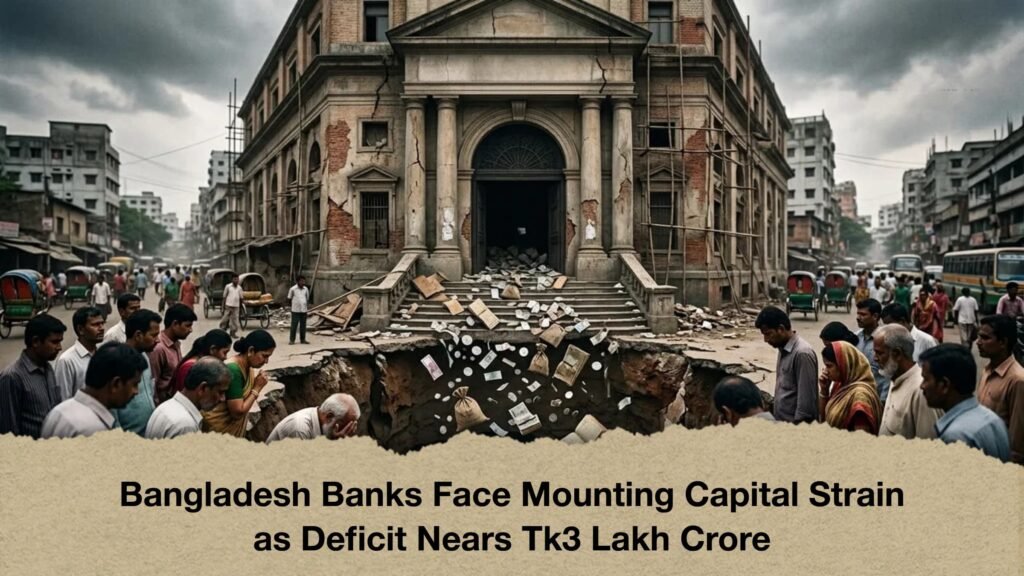
Bangladesh’s banking sector is facing a deepening capital crisis, with 21 banks reporting a combined capital shortfall of nearly Tk2.94 lakh crore in March 2026, according to Bangladesh Bank data. The figure was around Tk2.74 lakh crore at the end of December 2025, meaning the deficit increased by roughly Tk20,000 crore in just three months.
The deterioration has come amid a sharp rise in non-performing loans and the growing requirement for banks to set aside provisions against potential losses. The figures indicate that a substantial portion of the banking sector remains financially vulnerable, with weak capital positions placing pressure on profitability, lending capacity and depositor confidence.
Across the country’s 61 banks, the overall net capital shortfall stood at Tk2.39 lakh crore in March, after capital surpluses held by some banks were taken into account. This was about Tk22,000 crore higher than the Tk2.17 lakh crore recorded in December.
The provision shortfall has also worsened. Bangladesh Bank data show that banks had a provision shortfall of Tk2,05,665 crore in March, compared with Tk1,98,260 crore at the end of December 2025. By June, the provision shortfall had risen further to Tk2,22,357 crore.
Rising defaults intensify pressure on banks
Bankers and economists say the deterioration in capital positions is closely linked to the continued rise in defaulted loans. When loans become classified, banks are required to maintain larger provisions to cover possible losses. That reduces the amount of profit available to strengthen their capital base.
Syed Mahbubur Rahman, managing director and chief executive officer of Mutual Trust Bank, said the increase in defaulted loans directly contributes to the widening capital shortfall. Banks must maintain provisions against such loans, which reduces profits, while continued losses further erode capital.
The problem has developed over several years. Bankers and economists have attributed the weakening of the sector to aggressive lending, inadequate supervision and loan approvals influenced by political considerations.
For regular or performing loans, banks generally need to maintain provisions of around 1% to 2%. For classified loans, however, the provisioning requirement can rise to as much as 100%, depending on the classification of the loan.
Provisioning is intended to create a financial buffer against potential losses and protect depositors. Yet when defaulted loans become widespread, the resulting provisioning burden can significantly affect a bank’s profitability and capital position.
The scale of the problem is reflected in the volume of defaulted loans. Total defaulted loans stood at Tk5,88,704 crore in March 2026, equivalent to 32.26% of total outstanding loans.
Government spending billions to recapitalise weak banks
The government has also begun using public funds to strengthen financially weak banks. Finance Minister Amir Khosru Mahmud Chowdhury recently told Parliament that around Tk40,000 crore was being spent in the current fiscal year to recapitalise weak banks.
The move forms part of wider efforts to restore discipline and stability to the financial sector. However, the continuing rise in capital and provision shortfalls highlights the scale of the challenge facing policymakers.
Recapitalisation can provide banks with additional financial strength, but the underlying causes of the capital weakness remain closely tied to loan quality and the ability of banks to recover troubled assets. Persistent losses can quickly erode newly strengthened capital if the deterioration in loan portfolios is not contained.
Weak capital can undermine depositor confidence
Zahid Hussain, former lead economist at the World Bank’s Dhaka office, said capital shortfalls could affect the banking sector in two significant ways.
The first is depositor confidence. Capital serves as an important buffer for protecting depositors and enabling banks to withstand financial shocks. A bank with negative or inadequate capital may face greater difficulty conducting business normally, while depositors may become increasingly concerned about the safety of their funds.
The second concern extends beyond weak banks themselves. Financially stronger banks could also face pressure if overseas lenders and creditors become reluctant to extend credit to Bangladeshi banks because of concerns about the wider financial system.
According to Zahid, a capital shortfall at one or two banks might be manageable. But when 20 or 21 of the country’s 61 banks remain in deficit for an extended period, it points to a broader weakness across the banking sector.
Banking sector’s CRAR falls further into negative territory
Another worrying indicator is the banking sector’s capital-to-risk-weighted assets ratio, commonly known as CRAR. Bangladesh Bank data show that the sector’s CRAR declined to negative 3.17% at the end of March, compared with negative 2.64% in December.
CRAR measures a bank’s capital strength against the risks associated with its assets. International regulatory standards require banks to maintain a minimum CRAR of 12.5%.
The gap between Bangladesh and several other South Asian banking systems is significant. According to Bangladesh Bank’s Financial Stability Report 2025, Pakistan’s banking sector had a CRAR of nearly 21% at the end of 2025. Sri Lanka’s exceeded 19%, while India’s banks recorded an average CRAR of 17.20%.
Md Touhidul Alam Khan, managing director and chief executive officer of NRBC Bank, said failure to maintain the required regulatory capital, particularly CRAR, could create serious regulatory, financial and operational consequences.
These could include restrictions on dividend payments and incentive bonuses, deterioration in credit ratings, declining depositor confidence, higher solvency and funding risks and increased operating costs. Trade finance could become more expensive, while higher provisioning requirements could place additional pressure on profitability.
He also warned that inadequate capital could restrict a bank’s lending capacity and reduce its ability to absorb future losses. That creates a difficult cycle: weak capital limits lending and risk-bearing capacity, while poor-quality lending can generate further losses and deepen the capital deficit.
Ten banks with the largest capital shortfalls
The extent of the problem varies considerably among banks. First Security Islami Bank had by far the largest capital deficit in March 2026, followed by Bangladesh Krishi Bank and Social Islami Bank.
| Bank | Capital shortfall in March 2026 |
|---|---|
| First Security Islami Bank | Tk66,264.80 crore |
| Bangladesh Krishi Bank | Tk31,687.17 crore |
| Social Islami Bank | Tk30,936.67 crore |
| Union Bank | Tk30,594.56 crore |
| Exim Bank | Tk30,302.23 crore |
| Janata Bank | Tk18,354.90 crore |
| Global Islami Bank | Tk16,297.61 crore |
| National Bank | Tk11,984.98 crore |
| AB Bank | Tk8,487.59 crore |
| Agrani Bank | Tk8,234.92 crore |
First Security Islami Bank’s deficit stood at Tk66,264.80 crore, making it the bank with the largest capital shortfall in the country. Bangladesh Krishi Bank followed with Tk31,687.17 crore, while Social Islami Bank recorded a deficit of Tk30,936.67 crore.
Union Bank and Exim Bank also had deficits exceeding Tk30,000 crore. Janata Bank’s shortfall was Tk18,354.90 crore, while Global Islami Bank faced a deficit of Tk16,297.61 crore. National Bank, AB Bank and Agrani Bank recorded shortfalls of Tk11,984.98 crore, Tk8,487.59 crore and Tk8,234.92 crore respectively.
The figures underline the scale of the financial pressure facing Bangladesh’s banking industry. With defaulted loans accounting for nearly one-third of outstanding loans, provision requirements rising and the sector’s overall CRAR remaining deep in negative territory, restoring financial strength will require more than simply addressing individual banks’ capital deficits. The continuing deterioration in asset quality and the resulting pressure on profitability remain central challenges for the stability of the banking sector.