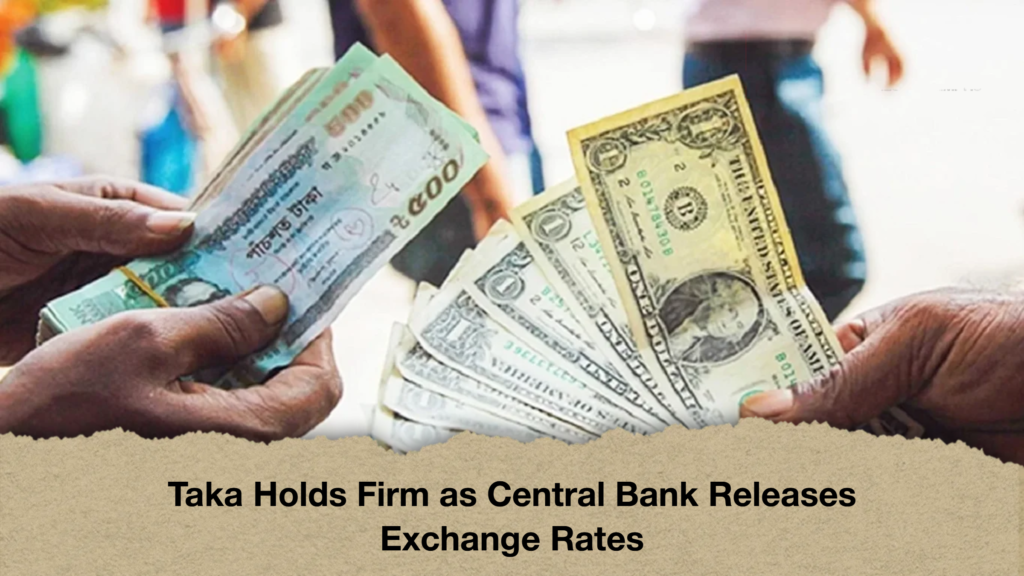
The Bangladeshi Taka maintained relative stability against major international currencies today, according to official foreign exchange figures published by Bangladesh Bank on 19 September 2026.
Under the latest central bank directives, the US Dollar—the cornerstone of international trade and sovereign import settlements—is priced at a buying rate of 122.90 Taka and a selling rate of 123.00 Taka. The British Pound sterling stands at 164.45 Taka for buying and 164.62 Taka for selling. The Euro trades at 140.89 Taka buying and 141.04 Taka selling.
Regional currencies present a mixed picture, reflecting distinct bilateral trade balances and regional market pressures. The Indian Rupee, a key currency for bilateral cross-border commerce, medical tourism, and educational travel between Bangladesh and India, is listed at 1.28 Taka for both buying and selling. The Chinese Yuan trades at 18.31 Taka buying and 18.32 Taka selling. The Japanese Yen holds steady at 0.79 Taka for both transactions.
Across other Asia-Pacific currencies, the Australian Dollar is set at 87.09 Taka buying and 87.21 Taka selling. The Singapore Dollar is quoted at 96.13 Taka buying and 96.24 Taka selling.
Official figures indicate a consistent, slight spread between buying and selling quotes across most major currencies, reflecting standard administrative margins. However, both the Indian Rupee and Japanese Yen exhibit identical buying and selling benchmarks in today’s official figures.
Foreign exchange rates remain pivotal for managing inflation, calculating import tariffs, and assessing real income yields on remittances sent home by migrant workers. Whilst central bank benchmarks set the baseline, actual transactional rates across commercial banks, money changers, and authorised financial institutions may vary slightly. These fluctuations depend on specific transaction types, operational timing, and individual institutional margins. Market participants and individual traders are advised to consult their respective banks or authorised exchange centres for real-time rates prior to executing financial trades.
The Bangladeshi Taka maintained relative stability against major international currencies today, according to official foreign exchange figures published by Bangladesh Bank on 19 September 2026.
Under the latest central bank directives, the US Dollar—the cornerstone of international trade and sovereign import settlements—is priced at a buying rate of 122.90 Taka and a selling rate of 123.00 Taka. The British Pound sterling stands at 164.45 Taka for buying and 164.62 Taka for selling. The Euro trades at 140.89 Taka buying and 141.04 Taka selling.
Regional currencies present a mixed picture, reflecting distinct bilateral trade balances and regional market pressures. The Indian Rupee, a key currency for bilateral cross-border commerce, medical tourism, and educational travel between Bangladesh and India, is listed at 1.28 Taka for both buying and selling. The Chinese Yuan trades at 18.31 Taka buying and 18.32 Taka selling. The Japanese Yen holds steady at 0.79 Taka for both transactions.
Across other Asia-Pacific currencies, the Australian Dollar is set at 87.09 Taka buying and 87.21 Taka selling. The Singapore Dollar is quoted at 96.13 Taka buying and 96.24 Taka selling.
Official figures indicate a consistent, slight spread between buying and selling quotes across most major currencies, reflecting standard administrative margins. However, both the Indian Rupee and Japanese Yen exhibit identical buying and selling benchmarks in today’s official figures.
Foreign exchange rates remain pivotal for managing inflation, calculating import tariffs, and assessing real income yields on remittances sent home by migrant workers. Whilst central bank benchmarks set the baseline, actual transactional rates across commercial banks, money changers, and authorised financial institutions may vary slightly. These fluctuations depend on specific transaction types, operational timing, and individual institutional margins. Market participants and individual traders are advised to consult their respective banks or authorised exchange centres for real-time rates prior to executing financial trades.