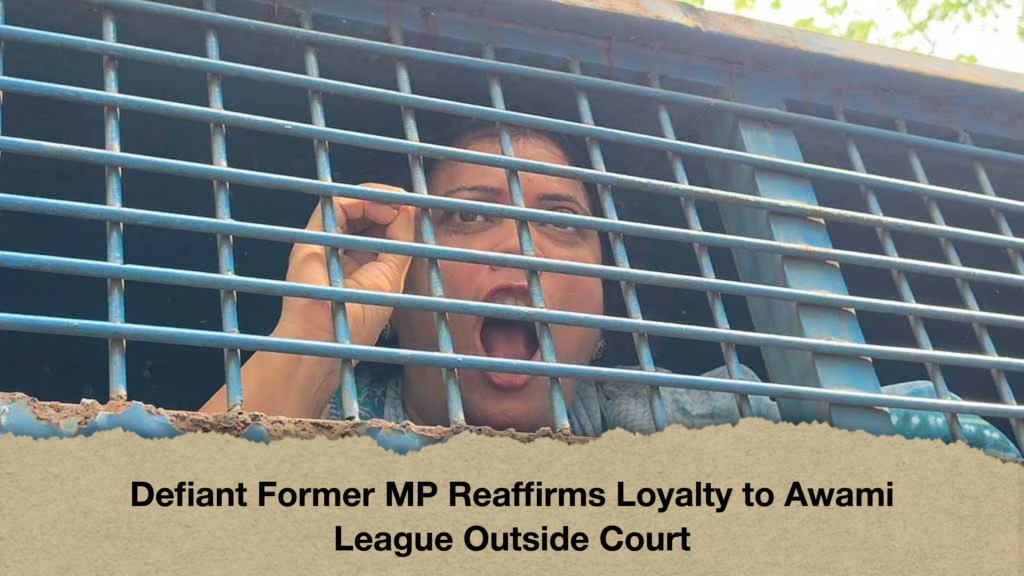
In a striking display of political defiance, Sabina Akter Tuhin, a former Member of Parliament from the reserved women’s seat, declared her unwavering loyalty to the Bangladesh Awami League directly from inside a prison van on the grounds of the Dhaka court complex. Facing grave sedition charges alongside ousted former Prime Minister Sheikh Hasina and scores of party members, Ms Tuhin asserted her innocence, maintaining that active participation in mainstream politics should never be treated as a punishable offence.
The bold stance emerged on Wednesday following a postponement in the framing of charges against 286 individuals linked to a treason case. The lawsuit alleges that the accused engaged in state-subversive activities and plotted to overthrow the interim administration during a Zoom conference organised under the banner of the “Joy Bangla Brigade”.
Proceedings at the Dhaka Third Additional Metropolitan Sessions Court were halted as the presiding judge, Moin Uddin Chowdhury, was on leave. The acting judge, Mosaddek Minhaj, subsequently rescheduled the hearing for 15 October, according to court bench assistant Golam Nabi.
When security personnel escorted Ms Tuhin and three other female defendants back into the transport vehicle, the former lawmaker addressed members of the press gathered outside. Banging her fist against the vehicle’s metal grating, she insisted that local residents could vouch for their clean records.
“The people of my area know very well that we have committed no wrongdoing. We are not involved in terrorism, nor are we connected to any murder,” Ms Tuhin shouted over the din of the court crowd. “We simply practiced politics. Yes, we belong to the Awami League, we have supported the Awami League, and we shall continue to support the Awami League. Even if I am hanged for the crime of being with the Awami League, I will still remain with the party. How long can you keep us in jail?”
She further pointed out that political involvement is guaranteed under the country’s legal framework. “We did not commit any murder or crime; we merely carried out party duties. Is that a crime? How many days must these women remain in custody for simply supporting a party? The Chief Adviser stated that the innocent would be released. Engaging in politics is our democratic and constitutional right.” Her co-defendants chimed in from the rear of the van, echoing similar claims of innocence before police drivers cleared a path through the crowded premises.
The high-profile legal battle stems from a complaint filed on 27 March last year by Assistant Superintendent of Police Enamul Haq of the Criminal Investigation Department (CID). The initial filing named 73 individuals, but following an extensive probe, CID submitted a formal charge sheet on 30 July targeting 286 defendants. The court formally accepted the charge sheet on 14 August, issuing arrest warrants for those named. Subsequent orders placed an international travel ban on all suspects on 11 September, followed by a court directive on 14 October ordering public notices in national daily newspapers summoning absconding figures.
Formal arguments concerning the framing of charges commenced on 21 January, with Dhaka Metropolitan Public Prosecutor Omar Farooq Farooqui advocating strongly for trial proceedings to move forward. Of the total 286 accused, 246 individuals—including deposed Prime Minister Sheikh Hasina—remain absconding. High-profile figures among the accused include Khulna Jubo League leader Parvez Khan Emon, Joy Bangla Brigade chief Kabirul Islam Akash, and regional figures Kamrul Islam, Sohana Parveen Runa, Hafizur Rahman Iqbal, Mahbubur Rahman Madhu, A.K.M. Akhtaruzzaman, Al Maruf, Elahi Newaz Masum, and Sajjadul Anam.
The legal proceedings unfold against a backdrop of deep political transformation in Bangladesh. Following mass popular uprisings that culminated in the fall of the Awami League-led administration in August 2024, an interim government took charge, pledging comprehensive constitutional reforms and accountability for past administrative excesses. As state agencies continue to clamp down on alleged subversive networks and former regime loyalists, trial proceedings like the Joy Bangla Brigade case serve as crucial touchstones in the country’s ongoing legal and political realignment.