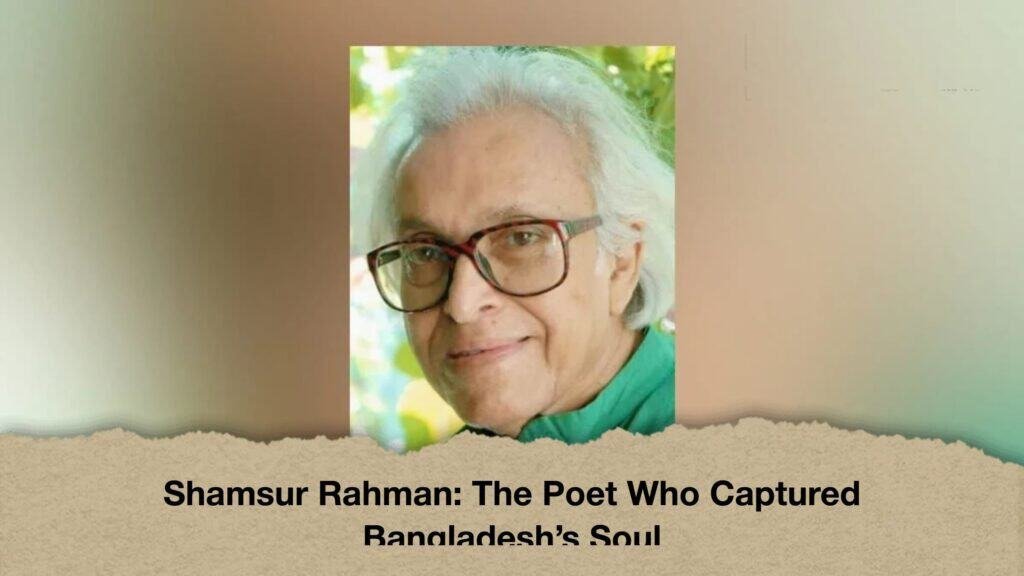
Born on 23 October 1929 in Mahut-Tuli, in Old Dhaka, Rahman developed a deep interest in literature and culture from an early age. Over several decades of creative work, he helped shape modern Bengali poetry, bringing together urban experiences, contemporary thought and the complex emotions of ordinary life. His distinctive voice earned him a lasting place among the most influential Bengali poets of the twentieth century.
Rahman emerged as a major literary figure in the tradition of Bengali poetry after Jibanananda Das. His work explored a broad range of themes, including the loneliness of city life, love, nature, human vulnerability, social injustice, political oppression and the aspiration for freedom. His language was accessible yet evocative, allowing him to express profound ideas without sacrificing the natural rhythm and emotional depth of poetry.
His ability to capture the realities of contemporary life distinguished him from many of his contemporaries. The city, with its crowded streets, personal isolation and social contradictions, became an important setting in his poetic imagination. At the same time, his writing reached beyond individual experience to engage with the wider political and cultural forces shaping Bengali society.
One of the defining characteristics of Rahman’s poetry was his commitment to freedom, democracy and secularism. He repeatedly challenged discrimination under Pakistani rule, authoritarian repression, communalism and the denial of fundamental rights. For him, poetry was not merely an art form concerned with beauty and expression. It was also a means of resisting injustice, defending human dignity and keeping alive the hope of a more humane society.
His literary voice became particularly significant during the turbulent period surrounding Bangladesh’s Liberation War in 1971. At a time when the people of the country were struggling for independence, his poetry gave expression to their aspirations, sacrifices and determination.
Two of his best-known poems, Shadhinata Tumi (Freedom, You Are) and Tomake Pawar Jonno, He Swadhinata (To Attain You, O Freedom), remain closely associated with the spirit of Bangladesh’s struggle for liberation. Through powerful imagery and emotional language, these works convey the profound longing for independence and the human cost of achieving it.
For Rahman, freedom meant more than the establishment of a sovereign state. It also represented human dignity, individual rights, intellectual liberty and the opportunity for people to shape their own future. His poetry gave literary expression to these ideals, helping connect the political struggle for independence with the broader aspirations of a society seeking justice and self-determination.
Another important dimension of his work was the relationship between patriotism and criticism. Rahman loved his homeland deeply, but he did not regard that affection as a reason to remain silent about its shortcomings. He confronted political failures, social disorder and the erosion of public values through poetry that could be both passionate and sharply critical.
His collection Udbhot Ut-er Pitthay Cholese Swadesh (The Homeland Moves on the Back of an Absurd Camel) reflects his sceptical view of an unsettled national reality. The title itself suggests a country moving through confusion and contradiction. His writing often served as a mirror held up to society, exposing the distance between national ideals and political practice.
This critical approach remains one of the enduring strengths of his literary legacy. Rahman’s patriotism was rooted not in unquestioning loyalty but in a concern for the country’s future and the well-being of its people. His poems encouraged readers to recognise injustice, question authority and consider the responsibilities that accompany citizenship.
His contribution to Bengali literature extended beyond poetry. He also wrote prose, essays and newspaper columns, and worked on translations. Across these forms, he demonstrated a sustained engagement with the intellectual and cultural questions of his time. His wide-ranging literary output enriched modern Bengali writing and strengthened the relationship between literature and public life.
Over the course of his career, Rahman received several prestigious honours, including the Bangla Academy Literary Award, the Ekushey Padak and the Independence Award. These recognitions reflected the significance of his contribution to Bengali language and literature. Yet his greatest achievement arguably lies in the enduring connection he established with readers and his continuing presence in the literary history of Bangladesh.
Rahman died in Dhaka on 17 August 2006, aged 76. His death marked the loss of a major literary voice, but his work continued to reach new generations of readers. His poems invite reflection, encourage people to question injustice and remind them of the importance of protecting freedom and human dignity.
His writing also offers a way to understand the complex relationship between an individual and the city, between personal emotions and public events, and between love for one’s country and the responsibility to challenge its failures. These themes give his work a relevance that extends beyond the historical circumstances in which many of his poems were written.
As Bangladesh marks his birth anniversary on 23 October, Rahman deserves to be remembered not only as a celebrated poet but also as a powerful literary voice for freedom, democracy and humanism. His work preserves important aspects of the nation’s collective memory while continuing to raise questions about justice, identity and the values on which a society should be built.
For younger readers, his poetry offers an introduction to the emotional landscape of Bangladesh’s struggle for independence and the complexities of modern urban life. It also demonstrates how literature can transcend its immediate context, turning the experiences of one generation into a lasting inheritance for those who follow.
Shamsur Rahman remains a shining star in the firmament of Bengali poetry. His words continue to give expression to the hopes and anxieties of his homeland, while his commitment to freedom and human dignity serves as a reminder of the enduring power of literature.
As long as Bangladesh cherishes its independence, democratic aspirations and secular traditions, his poetry will continue to offer readers a source of reflection and inspiration.
A humble tribute to Shamsur Rahman, the poet whose words gave lasting expression to the soul of Bangladesh.