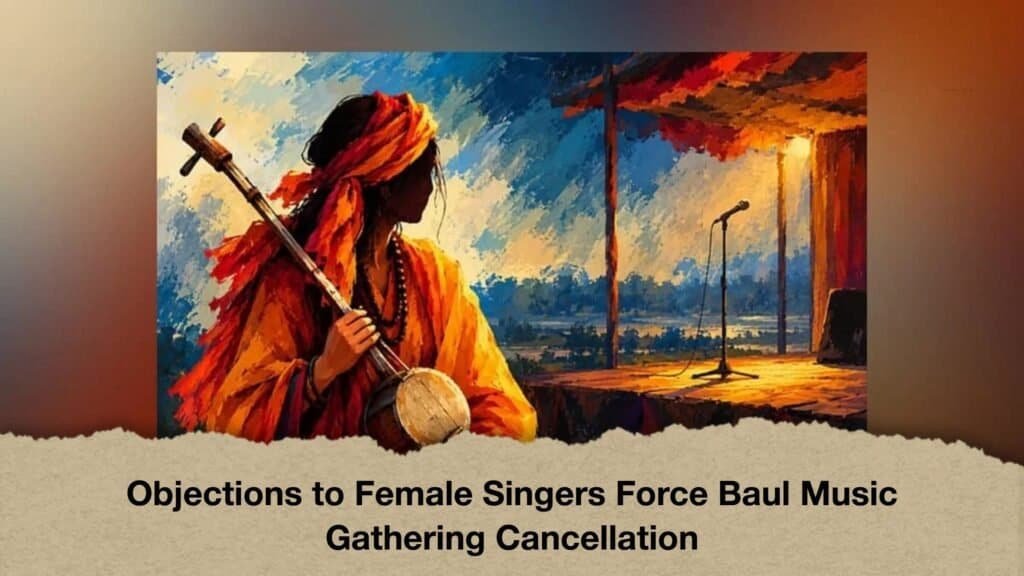
A private Baul music gathering in Sunamganj’s Dirai upazila has been cancelled after local residents objected to the planned participation of female performers, raising concerns about religious values and the possibility of unrest.
The event was scheduled for Thursday at a private residence in Hatia village, Kulanj Union. Following a written complaint to the police, the organiser, Shawkat Ali, decided to call off the programme to avoid an unpleasant situation and preserve social harmony.
The incident has drawn attention to the challenges facing cultural activities in rural Bangladesh, particularly when women’s participation in music or sport becomes a source of local controversy.
Hatia lies near Ujan Dhal village in Taral Union, the birthplace of Shah Abdul Karim, one of Bangladesh’s most celebrated Baul musicians. His songs, rooted in the traditions of the haor region, explore spirituality, love, human relationships and the realities of everyday life.
According to police and local residents, Shawkat Ali, a Bangladeshi expatriate living in the United Kingdom, had planned a small musical gathering at his home to celebrate his daughter’s birthday. Two local female Baul singers, Tanisha and Nila, were expected to perform.
However, the proposed event faced opposition before it could take place.
Residents raise religious concerns
On Wednesday, Ataur Ali and Kamrul Hasan submitted a written application to Aminul Islam, officer-in-charge of Dirai Police Station, on behalf of local residents. They requested that the gathering be stopped.
The application described Hatia as a village with a longstanding religious tradition and Islamic heritage. It referred to the presence of an alim madrasa, a shrine associated with a religious figure, and a number of Islamic scholars living in the area.
The applicants argued that a musical programme featuring female performers could cause resentment among residents and lead to an unwanted confrontation. They asked the authorities to take appropriate measures to protect the village’s religious traditions and maintain social harmony.
Kamrul Hasan said musical gatherings had taken place in the village in the past, but such events were no longer common. He pointed to the village’s mosques and madrasas and the religious gatherings held there each year.
According to Hasan, some residents feared that a programme presented as music could involve what they regarded as obscene content. He said the objections were based on their interpretation of Islamic principles and that they had requested the event be cancelled.
However, the available account does not establish that the proposed performance would have contained obscene material. The concern was expressed by opponents of the event rather than supported by evidence of any planned inappropriate performance.
Organiser cancels gathering after police contact
After receiving information about the objections, police contacted Shawkat Ali. He subsequently decided not to proceed with the event.
Ali said the gathering had been planned on a small scale to mark his daughter’s birthday. However, after objections were raised and he received a telephone call from the police, he chose to cancel it, taking the importance of social harmony into consideration.
Dirai Police Station officer-in-charge Aminul Islam confirmed that the proposed event was a private Baul music gathering. He said police had spoken to the organiser following the objections and that Ali later informed them he would not hold the programme.
The available information indicates that the organiser cancelled the event after the objections and police contact. It does not establish whether the police issued any formal prohibition.
Cancellation follows dispute over girls’ football
The latest incident comes after a girls’ friendly football match in Dirai was cancelled following local opposition.
The match had been scheduled for 5 October at the stadium in Dirai upazila headquarters, between local club Swapnachura Sporting Club and Jara Sporting Club of Sylhet. It was called off following objections from the ‘Committee for Preventing Anti-Islamic Activities in Dirai’.
The cancellation prompted widespread discussion and criticism. The two incidents have now brought renewed attention to the difficulties that cultural organisers and sporting groups can face when their activities encounter opposition from sections of the local community.
Although the proposed events were different in nature, both involved activities that were abandoned following objections. One concerned girls’ participation in sport; the other involved a private musical gathering featuring female performers.
Cultural representatives express concern
Jahangir Alam, vice-president of the Sunamganj district committee of Udichi Shilpi Goshthi, described the cancellation of the two events as regrettable.
He noted that a girls’ football match had previously been affected by local opposition and that a Baul music gathering had now met a similar fate. He said it was unfortunate that two planned activities had been cancelled or suspended following objections.
Alam argued that the authorities and law-enforcement agencies needed to consider how cultural activities and opportunities for girls to participate in sport could be protected, even when objections were raised in the name of religious values and social harmony.
A wider debate over culture and participation
Baul music occupies an important place in Bangladesh’s folk heritage, particularly in the north-eastern haor region. Its songs often explore spiritual beliefs, human dignity, love, social relationships and the struggles of everyday life. Shah Abdul Karim’s contribution to this tradition has made his work widely recognised across generations.
The cancellation of a musical gathering near his birthplace has therefore raised questions beyond the fate of a single private event. It has highlighted the challenge of accommodating local religious sensitivities while allowing cultural expression and women’s participation in music and sport.
Residents have the right to express their concerns peacefully. At the same time, disagreements over planned activities raise questions about how lawful cultural events can proceed without unnecessary disruption or confrontation.
The recent developments in Dirai underline the importance of dialogue among organisers, community representatives and local authorities. Addressing concerns before tensions escalate could help prevent further cancellations while respecting religious sensitivities and preserving opportunities for cultural and sporting activities.
Whether similar events can take place in the future without disruption will depend partly on how these competing concerns are addressed. For now, the cancellation of the Baul gathering has added to a growing local debate over the place of women in public cultural life and the balance between community expectations and cultural participation.