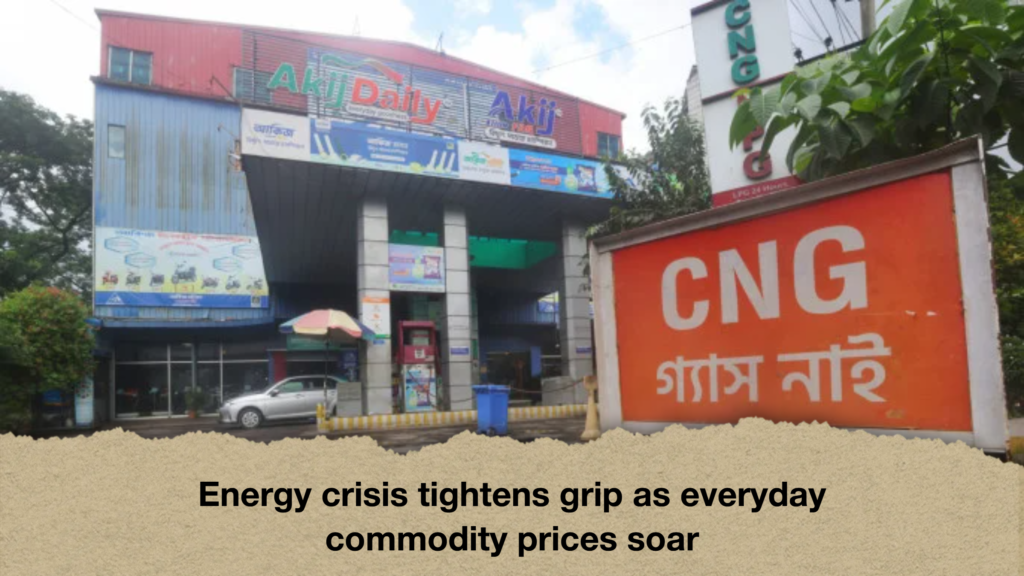
The crippling utility shortage in Bangladesh has broken past factory gates, cascading directly into kitchen markets, transport networks, and household budgets. What began as intermittent disruptions in gas and electricity supply has transformed into a multifaceted economic strain. Escalating operational overheads, dwindling raw material flows, and forced manufacturing shutdowns have triggered widespread price hikes for essentials, leaving ordinary citizens struggling to balance their monthly expenditures.
Households across Dhaka are feeling the immediate pinch. In Mogbazar, loose soybean oil recently retailed at 195 taka per litre, a notable jump from the 180 taka price tag recorded just a fortnight earlier. Shoppers at kitchen markets report similar spikes. Sugar prices in Karwan Bazar climbed from 110 taka to 130 taka per kilo within a three-day window, driven by wholesale distributors hiking bulk prices overnight. Salaried workers note that while utility and fuel expenses mount, incomes remain stagnant, creating severe friction in domestic financial planning.
The root of the instability traces back to critical infrastructure bottlenecks. A temporary suspension of operations at a floating liquefied natural gas terminal in Maheshkhali following a fire put severe pressure on national gas reserves. The resulting shortage forced power plants to curtail generation, triggering rolling blackouts that crippled industrial productivity. Because manufacturing units rely heavily on continuous energy inputs, any disruption in the utility grid immediately compresses output volume, driving up per-unit production costs and ultimately inflating retail prices.
The ripple effects are clearly visible across key consumer staples:
-
Edible Oil: Loose soybean oil sells at 190 to 195 taka per litre, surpassing the government-fixed rate of 180 taka, while palm oil trades slightly above regulated thresholds.
-
Flour & Grain: Open wheat flour trades at 45 to 50 taka per kilo, while packaged variants reach 70 taka. Refined flour (maida) commands up to 85 taka per kilo.
-
Pulses: Various lentil varieties have climbed by 5 to 10 taka per kilo over recent weeks.
-
Dairy Products: Powdered milk brands have seen price adjustments ranging from 20 to 120 taka per kilo, with premium options touching 960 taka.
-
Aromatic Rice: Premium polao rice prices have advanced by 50 to 80 taka per kilo over a two-month period.
-
Poultry & Eggs: Broiler chicken prices increased from 180 to nearly 200 taka per kilo, while a dozen eggs surged to 150 taka.
-
Detergents & Soaps: Major brands have raised per-kilo detergent prices by 15 to 20 taka, pushing popular washing powders up to 195 taka.
-
Shrinkflation Items: Popular bath soap bars have dropped in weight from 300 to 275 grams while retaining a 40 taka price tag.
-
Hair Care: Personal care manufacturers reduced bottle volumes from 200 to 190 millilitres while raising prices by 20 taka.
-
Industrial Metals: Steel producers report steep losses of 4,000 to 5,000 taka per tonne due to fixed utility expenses on reduced output.
The poultry sector faces acute operational hurdles. Hatcheries require uninterrupted power supplies for twenty-one-day incubation cycles. Frequent grid collapses force operators to rely on expensive diesel generators, while extreme heat stress simultaneously lifts mortality rates among livestock. These compounding pressures have driven broiler chicken and egg prices to uncomfortable highs.
Industrial manufacturers are navigating similar distress. More than nine hundred textile mills have faced temporary shutdowns due to low gas pressure, while steel, paper, cement, and ceramic factories operate far below capacity. Heavy manufacturing units note that unexpected grid failures require hours to restart complex machinery, adding substantial energy wastage to their balance sheets. Cement producers estimate that production costs have grown by at least 10% over the past month alone.
Urban transportation has not escaped the crisis. Compressed natural gas shortages force auto-rickshaw drivers to queue for hours, limiting daily driving windows to six or seven hours. Consequently, drivers demand inflated fares—such as 500 taka instead of the standard 350 taka for cross-town commutes—to meet daily vehicle rentals and living costs.
Unless energy supplies stabilize, the compounding pressure of production deficits and transport bottlenecks will continue to erode household purchasing power, cementing a challenging economic reality for consumers nationwide.