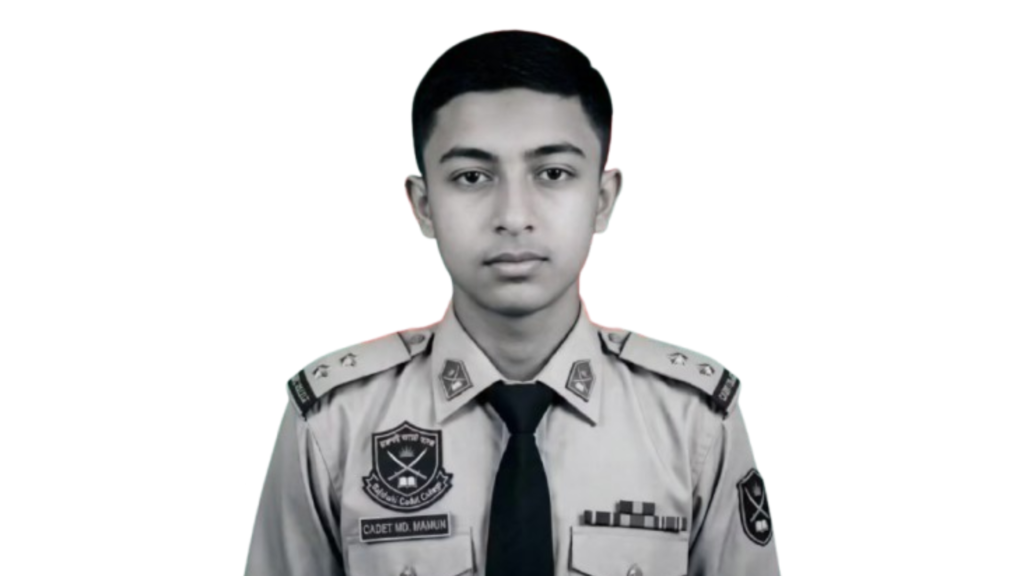
Abdullah Al Mamun was only 15 when his life was cut short during Bangladesh’s Liberation War. Yet, despite his young age, he had already taken on responsibilities that demanded courage, discipline and a deep commitment to the country’s struggle for independence.
Born on 1 July 1956 in Ramkura village of Niamatpur upazila in Naogaon, Mamun came from a prosperous and educated family. His father, Nazrul Islam, was a doctor. Mamun spent much of his childhood and adolescence in Ukilpara in Naogaon town, where his memory remains closely associated with the area.
Known by his nickname Mamun, he was described as bright and lively from an early age. He began his primary education at Naogaon PTI School before attending the well-known Government K.D. High School. In 1971, he was a Class Nine student at Rajshahi Cadet College. He was also particularly proficient in English.
His adolescence, however, unfolded against the backdrop of one of the most turbulent periods in the history of Bengal.
When the Liberation War began in 1971, Mamun, then around 14 or 15, chose to join the armed struggle. Alongside his elder brother Mujahid, he received initial resistance and military training at the then East Pakistan Rifles camp in Naogaon.
Around the middle of June, he travelled to Haflong in Assam, India, where he joined the Mujib Bahini and underwent further military training. After completing the training, he returned to the country towards the end of July.
Back home, a group of around 10 to 11 freedom fighters was formed. The group worked in different unions and villages of Manda upazila, organising preparations and training activities connected with the Liberation War. Despite being one of the youngest members, Mamun served as the group’s deputy leader.
His age did not prevent him from taking on responsibility. His courage, sense of duty and leadership qualities earned him the confidence of his fellow fighters.
By August 1971, the conflict had intensified across the country. In Naogaon, resistance groups were conducting operations against forces and local collaborators supporting the Pakistani military authorities.
On 26 August, Mamun took part in an operation in the Kalikapur area of Manda upazila targeting members of the Peace Committee. During a grenade attack operation in Kalikapur, he was captured by the opposing forces.
What followed was brutal treatment.
According to accounts of his life and death, Pakistani troops and their local collaborators subjected the young freedom fighter to severe physical torture. He was only 15, but his brief life had already become intertwined with the struggle for Bangladesh’s independence.
Mamun died on 27 August 1971.
His death marked the loss of a teenager who had barely begun his education and had his entire adult life ahead of him. Had he survived, he could have pursued higher education, built a career and lived an ordinary family life. Instead, his life became part of the immense human cost of Bangladesh’s independence.
His sacrifice has continued to be remembered in Naogaon. In 1973, Ghatgari Shahid Mamun High School and College was established in Manda in his memory. The place where he was captured was later named Mamun Bazar, preserving his name within the local landscape.
His memory is also reflected in Naogaon municipality. The road stretching from Taj Cinema intersection to the Border Guard Bangladesh camp was named Shahid Mamun Road, while the municipal market was named Shahid Mamun Market.
These names serve as more than geographical references. They preserve the memory of a young freedom fighter whose life ended during a defining chapter in Bangladesh’s history. They also offer later generations a reminder that the country’s independence came at an enormous human cost, with people from different backgrounds and age groups taking part in the struggle.
Mamun’s story is particularly poignant because of his age. At 15, he was still a schoolboy. His future was only beginning to take shape. Yet the events of 1971 compelled him to make choices far beyond the expectations normally placed on someone of his age.
Today, 27 August, marks the anniversary of his death. Abdullah Al Mamun is remembered as one of the young freedom fighters who gave his life during the Liberation War.
His life lasted only 15 years, but his name remains connected with the history of Naogaon and the wider story of Bangladesh’s independence. The institutions, roads and marketplace bearing his name ensure that the memory of the teenage freedom fighter continues to have a place in public life.
Abdullah Al Mamun did not live to see an independent Bangladesh. He did not get the opportunity to grow older, complete his education or experience the ordinary milestones of adulthood. But his sacrifice became part of the struggle through which the country emerged as an independent nation.
More than five decades after his death, his story remains a reminder of the young lives lost in 1971 and of the personal sacrifices behind Bangladesh’s independence.