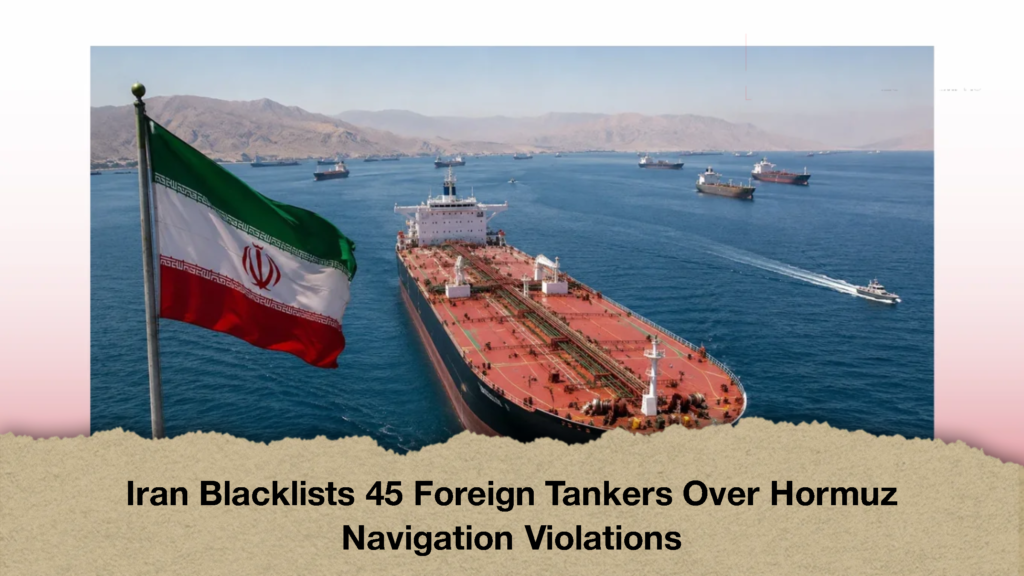
Tehran has designated 45 international crude oil, liquefied natural gas (LNG), and refined fuel tankers on a maritime blacklist, accusing them of repeatedly flouting transit and safety regulations within the Strait of Hormuz. Iranian authorities have also widened the scope of the decree, warning that any secondary vessels conducting mid-sea ship-to-ship cargo transfers with the blacklisted fleet will face matching administrative and operational sanctions.
The official notification was published on social media platform X by Iran’s newly formed Persian Gulf Strait Authority, a body recently created by the government to tighten oversight across the strategic waterway. The agency announced that any listed vessel entering waters under Iranian jurisdiction could face hefty financial penalties, direct interdiction, boarding operations, and the judicial seizure of both the vessels and their onboard petroleum cargoes.
The aggressive maritime stance arrives amid mounting friction between Tehran and Washington, following recent US warnings threatening some of the most comprehensive economic sanctions ever imposed against Iranian maritime and energy networks. Iranian political and military figures had previously asserted that any fresh economic pressure would trigger sharp reciprocal actions across regional shipping channels.
The designated list covers a wide variety of vessel classes, including Very Large Crude Carriers (VLCCs), specialised gas carriers, and product tankers carrying refined fuels. Among the ships cited are vessels managed by the United Arab Emirates’ state-owned ADNOC Logistics & Services and its affiliate Navig8 Tankers, as well as tankers operated by Saudi Arabia’s national shipping carrier, Bahri. Several prominent European and East Asian operators were also targeted, including Norway’s Klaveness Ship Management and Stolt Tankers, alongside South Korea’s Sinokor Merchant Marine.
While the Persian Gulf Strait Authority did not detail the precise technical breaches committed by each vessel, Iranian authorities have previously demanded that merchant vessels obtain prior transit authorisation and remit required service fees for maritime security and navigational assistance in the strait. Affected shipowners wishing to appeal against the designation must submit formal documentation directly to Iranian maritime authorities. Cargo owners, trading houses, and charterers across the Gulf have been advised to review the registry to avoid logistical and legal disruptions.
The geopolitical confrontation has added severe friction to a shipping lane historically responsible for transporting roughly 20 per cent of global petroleum and LNG supplies. Heightened risks have prompted the United States Navy to coordinate maritime convoys and facilitate offshore ship-to-ship transfers outside the narrow strait to keep trade moving. US Energy Secretary Chris Wright noted on X that seven-day average crude volumes transiting the waterway had recovered past eight million barrels per day under naval protection. Nonetheless, Tehran’s latest enforcement measures threaten to push maritime insurance premiums higher and inject fresh volatility into international energy markets.