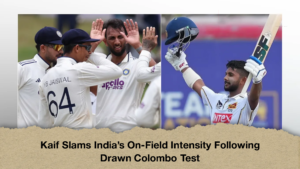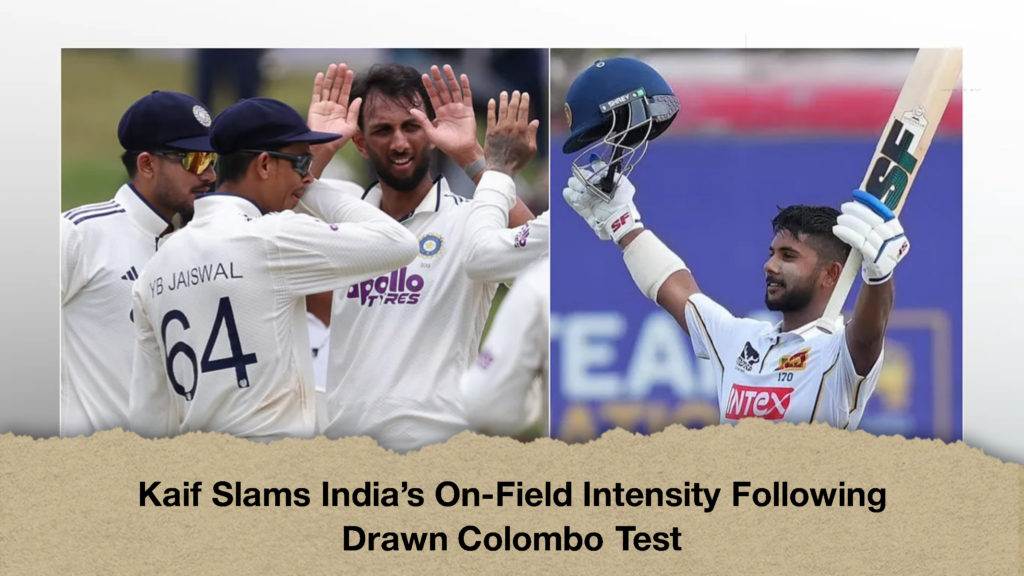
Former Indian international Mohammad Kaif has launched a scathing critique of the national side’s tactical approach and passive body language after India failed to convert a dominant position into victory against Sri Lanka in the second Test in Colombo. Despite holding a substantial 213-run lead and enforcing the follow-on, the visitors were held to a draw, a result Kaif attributed to an absence of relentless psychological pressure and vociferous on-field leadership.
India seized complete control early in the encounter, declaring their first innings at a formidable 503 for nine. The total was underpinned by brilliant centuries from Devdutt Padikkal, who scored 117, and wicketkeeper-batter Dhruv Jurel, who remained unbeaten on 115. Sri Lanka struggled in response, tumbling to 290 all out in their first attempt, despite a resilient 103 from left-handed batter Dinusha. Standing firmly in the driver’s seat, Indian skipper Shubman Gill opted to enforce the follow-on, eyeing a comprehensive 2-0 series sweep following their convincing victory in the opening Test at Galle.
The host nation showed remarkable grit in their second outing. Dinusha once again anchored the Lankan resistance, playing a heroic, unbeaten knock of 133 to steer his side to safety and salvage a draw. Though Sri Lanka thwarted India’s push for a clean sweep, the visitors secured the two-match series 1-0 on the back of their initial win at Galle.
Reflecting on the match, Kaif—who featured in 138 international fixtures for India—expressed deep frustration over the team’s inability to dismantle the opposition when it mattered most. He argued that the younger core led by Gill and KL Rahul displayed a passive mindset, appearing to rely solely on the turning pitch rather than applying tactical pressure through vocal aggression and relentless field placements.
Evaluating the performance, Kaif remarked that Test cricket demands continuous physical and mental exertion. He noted that the side seemed to adopt a complacent attitude, operating under the assumption that a spin-conducive surface would naturally deliver wickets without the need for sustained pressure or tactical intimidation.
Highlighting a perceived leadership void, Kaif pointed to the absence of seasoned stalwarts such as Virat Kohli, Rohit Sharma, MS Dhoni, and Ravichandran Ashwin. He stressed that iconic figures of their calibre consistently created an uncomfortable atmosphere for opposition batters through strategic sledging, vocal encouragement, and imposing physical presence. Kaif observed that Dinusha was allowed to settle without being subjected to any real psychological interrogation or targeted discomfort from senior members of the bowling attack.
Creating constant friction and maintaining intense energy remain vital tools for breaking stubborn partnerships in red-ball cricket. Kaif asserted that had a figure like Kohli been present, he would have ensured non-stop vocal support, relentlessly driving the bowlers and unnerving the batters. In Kaif’s estimation, the failure to weaponise intensity allowed Sri Lanka’s middle order to bat through the critical closing sessions with relative ease.