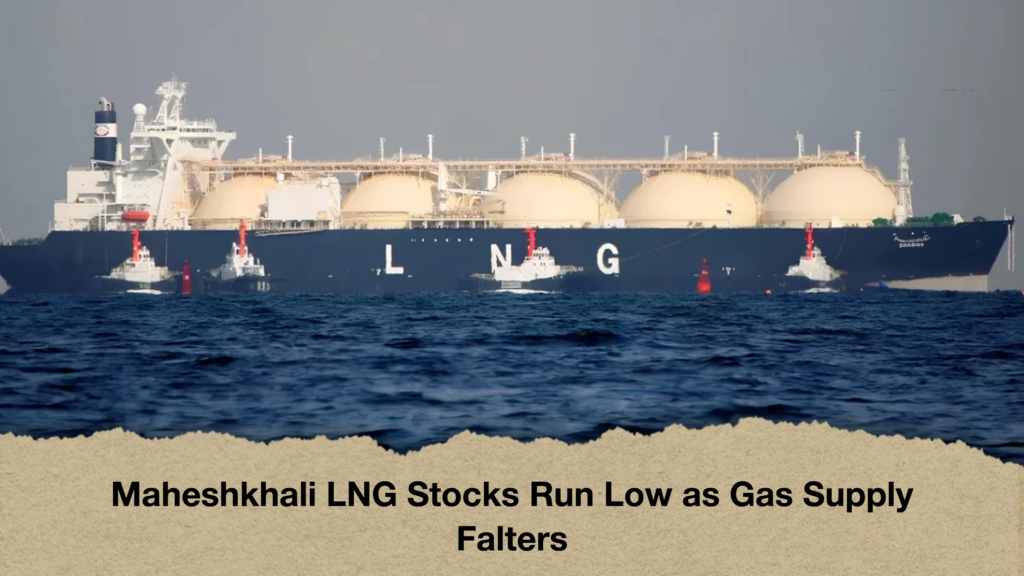
Gas supplies from Bangladesh’s two floating liquefied natural gas terminals in Maheshkhali, Cox’s Bazar, have yet to return to normal, raising concerns over a widening shortfall in the national grid.
The two floating storage and regasification units have a combined maximum supply capacity of around 1.1 billion cubic feet of gas per day. On Tuesday, however, only about 660 million cubic feet reached the national grid, leaving a deficit of roughly 440 million cubic feet against their combined capacity.
The reduced supply is already being felt across several parts of the economy. Manufacturing industries are facing lower gas pressure and interruptions to production, while compressed natural gas filling stations and residential consumers are also experiencing supply constraints. Officials have not yet been able to provide a firm timeline for when the situation will return fully to normal.
One of the two terminals is operated by US-based Excelerate Energy, while the other is operated by Summit LNG Terminal Company, part of the domestic Summit Group. Both facilities play an important role in meeting Bangladesh’s gas demand by receiving LNG cargoes and converting the fuel into gas for delivery to the national grid.
LNG stocks fall at Excelerate terminal
The most immediate concern is the sharp reduction in LNG stocks at Excelerate Energy’s floating terminal. With supplies running low, the terminal’s contribution to the national grid has fallen significantly.
According to officials of the state-owned Rupantarita Prakritik Gas Company Limited, or RPGCL, the Summit terminal was supplying around 550 million cubic feet per day on Tuesday, while Excelerate’s terminal was providing only about 110 million cubic feet.
That means the two terminals together were supplying 660 million cubic feet a day, considerably below their combined potential.
The situation has been complicated by the absence of an LNG carrier at Chattogram port at the time of reporting. RPGCL officials said another LNG cargo was expected to arrive on 20 August, raising hopes that supplies from the Excelerate terminal could increase after the cargo is transferred.
A separate LNG cargo from Saudi Arabia had already arrived in Bangladesh under a short-term arrangement with Saudi Aramco. However, Excelerate Energy reportedly declined to receive the cargo, citing safety concerns over transferring the LNG to the terminal. Officials said arrangements were under way to send the vessel back.
Supply disruptions have occurred before
The latest shortage follows a series of operational problems at the Maheshkhali terminals in recent weeks.
Excelerate Energy’s terminal stopped supplying gas on 21 July after a technical problem. Partial operations resumed late on 5 August. During the same period, Summit’s terminal also faced an interruption after an LNG carrier could not berth, resulting in a temporary halt in gas supplies. Operations at the Summit terminal resumed on Friday night.
The repeated disruptions highlight the importance of reliable LNG deliveries and uninterrupted terminal operations for Bangladesh’s gas-dependent economy. When supplies from the floating terminals fall, the impact can quickly spread beyond the energy sector.
Industries that rely heavily on gas for boilers, furnaces and power generation are particularly vulnerable to fluctuations in supply. Lower pressure can reduce production capacity, while prolonged interruptions may affect factory schedules and operating costs. CNG stations can also face difficulties when pressure falls, creating inconvenience for transport operators and passengers.
For households, reduced pressure can mean weaker supplies for cooking, particularly during periods of high demand.
The immediate focus is now on the expected LNG cargo on 20 August. Once the cargo reaches the country and the LNG is transferred to the Excelerate terminal, officials expect gas supplies from that facility to increase.
Until then, however, the national grid will continue to operate below the two terminals’ combined supply capacity. The episode also underlines the wider challenge facing Bangladesh’s gas system: maintaining a steady flow of imported LNG while dealing with technical problems, shipping constraints and the operational risks associated with floating terminals.