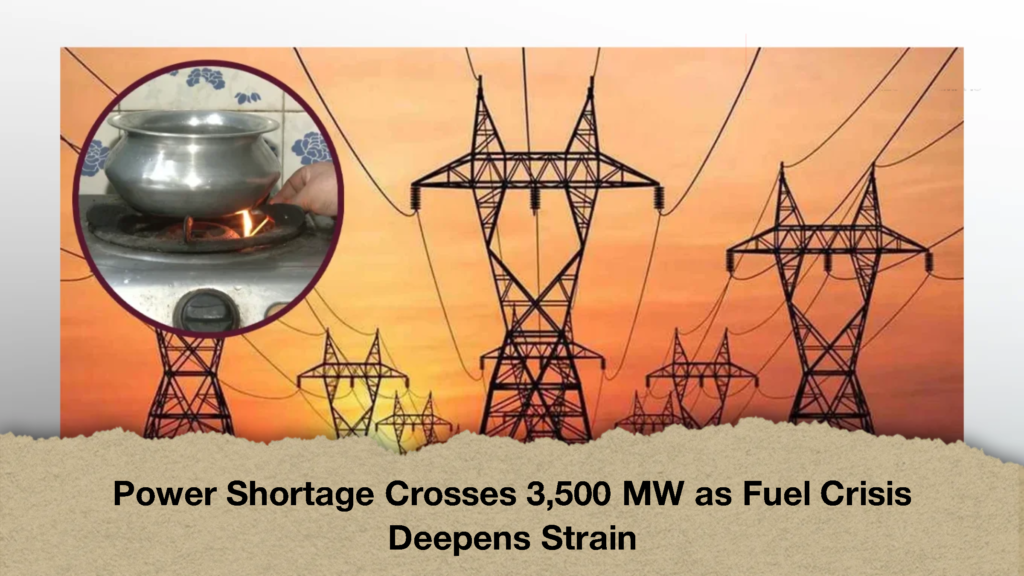
Public life across Bangladesh has been plunged into severe distress as an unrelenting late-summer heatwave collides with a rapidly deteriorating energy supply chain. A crippling combination of diminishing natural gas reserves, sharp output reductions at primary coal-fired power stations, and an acute deficit of liquid fuels pushed the national electricity deficit past 3,500 megawatts (MW) on Saturday afternoon. From densely populated residential areas in Dhaka to key industrial corridors across the country, widespread load-shedding and severe drops in gas pressure have disrupted daily domestic life and brought industrial operations to a standstill.
Data provided by Power Grid Bangladesh highlights the extent of the gap between consumer demand and actual power generation throughout the day. At 5:00 pm on Saturday, total demand reached 16,469 MW against an available supply of just 12,952 MW, leaving a deficit of 3,517 MW. By 6:00 pm, demand stood at 16,389 MW against a supply of 13,362 MW, resulting in a 3,027 MW shortfall. As evening set in and household appliance usage peaked, demand rose to 17,541 MW at 7:00 pm, whilst generation reached 14,531 MW, maintaining a gap of 3,010 MW. By 7:30 pm, demand edged up to 17,551 MW against a supply of 15,019 MW, leaving a 2,532 MW deficit.
These supply deficits disrupted the power grid from early morning. Unpredictable transmission patterns led to frequent outages in several regions, where power was restored briefly for an hour before cutting out again, often well beyond published load-shedding schedules.
The current grid instability stems from severe disruptions across primary fuel import and distribution networks. Natural gas remains the bedrock of electricity generation in Bangladesh, but gas-fired facilities are operating significantly below their total capacity. Figures from Petrobangla show that national gas supply on Saturday night fell to 2,192 million cubic feet per day (mmcfd). This total comprised 1,612 mmcfd from domestic fields and 580 mmcfd from Liquefied Natural Gas (LNG) imports—a marked drop from earlier in the week when LNG supplies consistently exceeded 750 mmcfd.
A key factor behind this decrease was scheduled maintenance at Summit’s floating storage and regasification unit (FSRU), which remained offline between 6:00 am and 8:00 pm on Saturday. During the outage, Excelerate’s terminal operated as the primary import conduit, supplying between 550 and 570 mmcfd. Although officials expect a modest recovery following the evening restart of Summit’s facility, medium-term supply prospects remain tight. While two LNG shipments are expected on 1 September and 4 September, the cancellation and non-arrival of several earlier cargoes have strained fuel inventories. Official estimates place daily national gas demand at 3,800 mmcfd, whereas energy sector analysts estimate structural demand at 5,000 to 5,500 mmcfd. Standard supply typically averages around 2,650 mmcfd, maintaining a persistent supply-demand gap.
Rezaul Karim, Chairman of the Bangladesh Power Development Board (BPDB), confirmed that generation at major coal-fired power plants—including Payra, Matarbari, and the Adani facility in India—has dropped significantly. With gas allocations for power generation falling below 700 mmcfd, total output from gas-fired power stations has dropped beneath 4,500 MW. Meanwhile, oil-fired generation facilities have been unable to make up the difference due to constrained fuel stocks.
The coal sector faces similar operational constraints. One unit at the Matarbari power plant remains offline, and supply limitations at the Adani facility in Jharkhand have reduced cross-border imports by 500 to 600 MW. The Payra power plant requires essential, long-overdue maintenance; however, grid operators cannot take the facility offline without worsening existing deficits. Efforts by the BPDB to ramp up liquid fuel generation have been hindered by inventory shortages, leading to concurrent deficits across gas, coal, and oil supplies.
This dual breakdown in power and gas utilities has directly affected residential communities. With mains gas pressure dropping significantly in urban hubs, many households attempted to use induction cookers and electric appliances, only to face prolonged power outages. Residents in Dhaka’s Mirpur neighbourhood reported that pipeline gas pressure drops sharply early in the morning, forcing reliance on Liquefied Petroleum Gas (LPG) cylinders and adding to household expenses.
Industrial sectors are facing similar operational challenges. Manufacturing centres across Gazipur, Narayanganj, and Narsingdi report substantial drops in pipeline gas pressure, halting production lines for extended periods. To maintain operations, factory managers have had to rely heavily on heavy-duty diesel generators, which increases operational expenditure and impacts export schedules for the ready-made garment sector. At the same time, Compressed Natural Gas (CNG) stations are seeing long queues of commercial and private vehicles, with drivers facing extended waiting times to refuel. Energy analysts warn that unless primary fuel import schedules stabilize, rolling blackouts could worsen in the coming days.