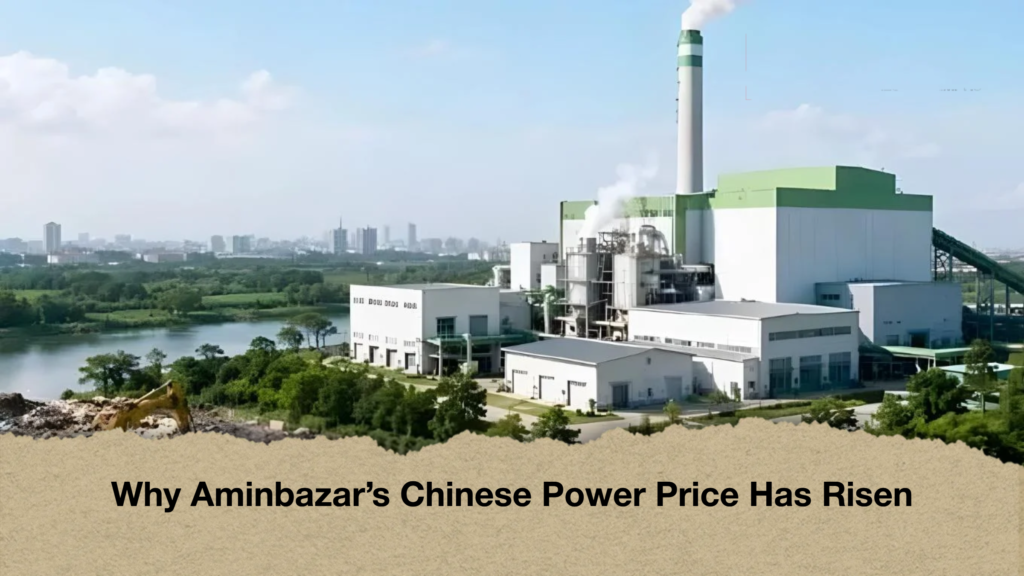
The proposed waste-to-energy project at Aminbazar in Dhaka has revived a question over the cost of electricity Bangladesh is preparing to purchase from a Chinese company. The government is expected to sign the final tripartite agreement for the project on 2 September, with the plant targeted to supply around 42 megawatts of electricity to the national grid within the next 18 months.
The striking point is the tariff. The government is now expected to purchase the electricity at around Tk25 per unit, although the project had originally been approved at a dollar-denominated tariff of roughly US$0.218 per kilowatt-hour. At the exchange rate prevailing when the original agreement was approved, that translated into about Tk18.30 per unit.
In other words, the dollar-denominated price has remained broadly similar, but the cost in taka has increased significantly because of the depreciation of the Bangladeshi currency.
The project involves China Machinery Engineering Corporation, which is expected to construct and operate a 42.5MW waste-to-energy plant at Aminbazar. The facility is designed to process approximately 3,000 tonnes of municipal waste each day and generate electricity from it. Recent government statements indicate that the plant is expected to begin supplying power to the national grid by 2028 and could operate for 25 years.
Table of Contents
A project delayed for years
The roots of the project go back several years. The government approved the 42.5MW scheme during the previous administration, with the electricity purchase agreement structured around a long-term arrangement. Under the original framework, the power purchase price was about US$0.2178 per unit, equivalent to Tk18.295 at the time. The government was projected to spend more than Tk15,000 crore on electricity purchases over the 25-year contract period.
Yet the plant did not begin commercial generation within the expected timeframe. An environmental and social assessment prepared for the project had earlier envisaged commercial operation in 2025, but that target was not achieved.
The delay has become financially significant because Bangladesh’s exchange rate has changed considerably since the original agreement. A tariff fixed in US dollars therefore translates into a much higher taka payment today.
That raises a fundamental policy question: if the project has taken years longer than initially expected, should the additional foreign-exchange burden automatically be passed on to the government and, ultimately, electricity consumers?
Why is the price now around Tk25?
The simplest explanation is the exchange rate. A dollar-based tariff does not remain equivalent in taka when the domestic currency loses value.
The original price of about US$0.218 per unit was equivalent to roughly Tk18.30 when the agreement was approved. By 2024, an environmental policy assessment calculated the equivalent price at around Tk25.56 per unit using the prevailing exchange rate.
The latest government position puts the purchase price at around Tk25 per unit. So the apparent increase is not necessarily the result of a fresh increase in the dollar tariff. Much of the difference comes from the depreciation of the taka.
But that explanation does not settle the wider issue. The government has had several years in which it could reassess the project’s financial structure, implementation timetable, waste-supply arrangements and electricity tariff. Whether those terms were renegotiated, and whether a lower dollar-denominated price could have been secured, remains a key question for public scrutiny.
The government’s argument: the benefit is not only electricity
Officials argue that judging the project solely by the electricity tariff would give an incomplete picture.
The proposed plant is intended to process roughly 3,000 tonnes of municipal waste every day. Dhaka faces persistent challenges in collecting, transporting and disposing of enormous quantities of urban waste. Turning part of that waste into energy could reduce pressure on landfill facilities while producing electricity at the same time.
The government has also said the Chinese investor will finance the project, meaning Bangladesh would not have to make a direct investment in constructing the power plant. The company is also expected to pay rent to the city corporation for use of the landfill.
From that perspective, the project is being presented not simply as a power-generation scheme but as a combined waste-management and energy initiative.
That distinction matters. If the project reduces the cost of waste disposal, extends the useful life of landfill facilities and creates other economic or environmental benefits, those savings should be included when assessing its overall value.
But the environmental case remains contested
The economic argument is not universally accepted.
Environmental groups have questioned whether an incineration-based waste-to-energy plant is the most appropriate solution for Dhaka. Concerns have been raised about emissions, ash disposal, waste quality, recycling and the long-term financial burden of purchasing relatively expensive electricity. One assessment has also pointed out that the calorific value of waste at Aminbazar may be too low for self-sustaining combustion without careful management of the waste stream.
The quality and composition of Dhaka’s municipal waste are therefore crucial. A waste-to-energy plant cannot operate efficiently simply because large quantities of rubbish are available. Moisture content, calorific value, recyclable materials and organic matter can all affect the amount of usable energy that can be recovered.
The project also requires a reliable supply of waste. Earlier technical assessments indicated that around 3,000 tonnes of municipal waste a day would be needed for the plant’s planned generation capacity.
The foreign-exchange risk remains
Another important issue is the structure of the power purchase agreement.
If the tariff remains linked to the US dollar, any further depreciation of the taka could increase the government’s cost in domestic currency even if the plant’s dollar tariff does not change.
That means Bangladesh would carry a substantial currency risk throughout the contract period. The longer the agreement runs, the more important that risk becomes.
The phrase “no electricity, no payment” may protect the government from paying for power before generation begins, but it does not eliminate the exchange-rate risk once the plant starts operating. The central question is therefore not only how much the electricity will cost today, but how much the country could ultimately pay over the project’s full operating life.
A transparent calculation is needed
The controversy over the Tk25 tariff cannot be resolved simply by comparing Tk18.30 with Tk25. The original tariff was fixed in dollars, while the exchange rate has changed substantially. That explains much of the increase in taka terms.
However, the public interest requires a broader calculation. The government should make clear how the current tariff was determined, whether the original dollar price was renegotiated, what assumptions were used for the exchange rate, and how the costs and benefits of waste management were incorporated into the final agreement.
The project is designed to generate 42.5MW while processing around 3,000 tonnes of waste each day. Recent government plans indicate that electricity supply to the national grid is targeted for 2028, with the facility expected to operate for 25 years.
For Bangladesh, the real test will therefore be whether the project can deliver reliable electricity while providing measurable improvements in waste management at a cost that remains defensible over the long term.
A Tk25-per-unit tariff may be justified if the wider economic and environmental benefits genuinely outweigh the additional cost. But that case needs to be demonstrated through transparent financial, environmental and technical assessments rather than assumed from the promise of turning waste into electricity.