In a precision tactical operation conducted in the early hours of Thursday, 12 February 2026, the Bangladesh Army successfully neutralised a suspected temporary base of the Kuki-Chin National Army (KNA). The raid took place in the rugged, inaccessible terrain of the Pratap Para area within the Ruma Upazila of Bandarban, a region that has seen heightened security activity in recent months.
Tactical Execution and Seizures
Acting on high-grade intelligence regarding the movement of armed insurgents, a specialised unit from the Ruma Zone launched the assault at approximately 1:00 am. According to a statement released by the Inter-Services Public Relations (ISPR), the military personnel successfully identified and breached a hidden encampment used by the militant group.
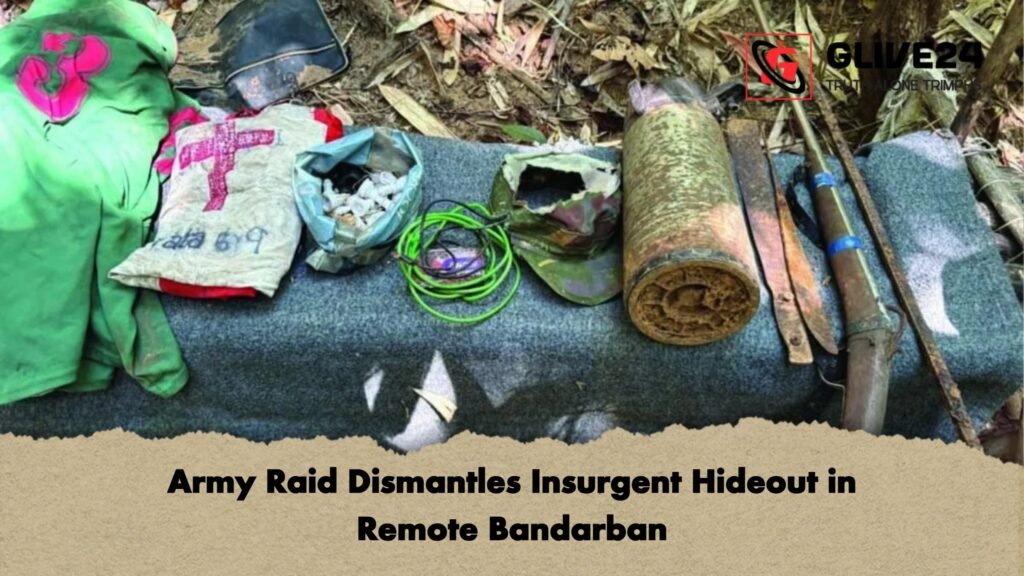
While the insurgents—estimated to be a squad of 10 to 15 armed members—managed to retreat into the dense forest under the cover of darkness after detecting the army’s approach, they were forced to abandon a significant cache of supplies. The subsequent search of the site yielded a variety of items that suggest the location served as a logistical hub for the group.
Summary of Recovered Items: Pratap Para Raid
| Category | Items Recovered |
| Armaments | One airgun and several indigenous sharp weapons (Daos). |
| Logistics | Large quantities of dry rations and fresh food supplies. |
| Operational Gear | Military-style uniforms and tactical clothing. |
| Maintenance | Extensive cooking utensils and makeshift bedding. |
| Miscellaneous | Communication aids and various daily necessities. |
Strategic Context and Regional Stability
The KNA, often referred to as the “Bawm Party,” has been a source of significant concern for the security apparatus in the Chittagong Hill Tracts (CHT). Intelligence suggests that this specific group had been occupying the Pratap Para hideout for several days, likely using it as a staging point for reconnaissance or to disrupt local administrative activities.
The Bangladesh Army has reiterated its commitment to maintaining the sovereignty and peace of the hilly regions. A senior military official noted that “continuous patrols and surgical strikes” remain a priority to prevent armed factions from establishing permanent bases or restricting the movement of local ethnic communities.
Community Cooperation
The ISPR further noted that the success of such operations increasingly relies on the cooperation of the local populace, who have grown weary of the instability caused by insurgent activity. The army has assured residents that security cordons will remain in place to facilitate a return to normalcy.
As the nation observes a sensitive political and electoral period, the military’s proactive stance in the CHT is seen as a vital component of the broader national security framework. Authorities have confirmed that operations will continue until the threat posed by such separatist elements is fully contained.