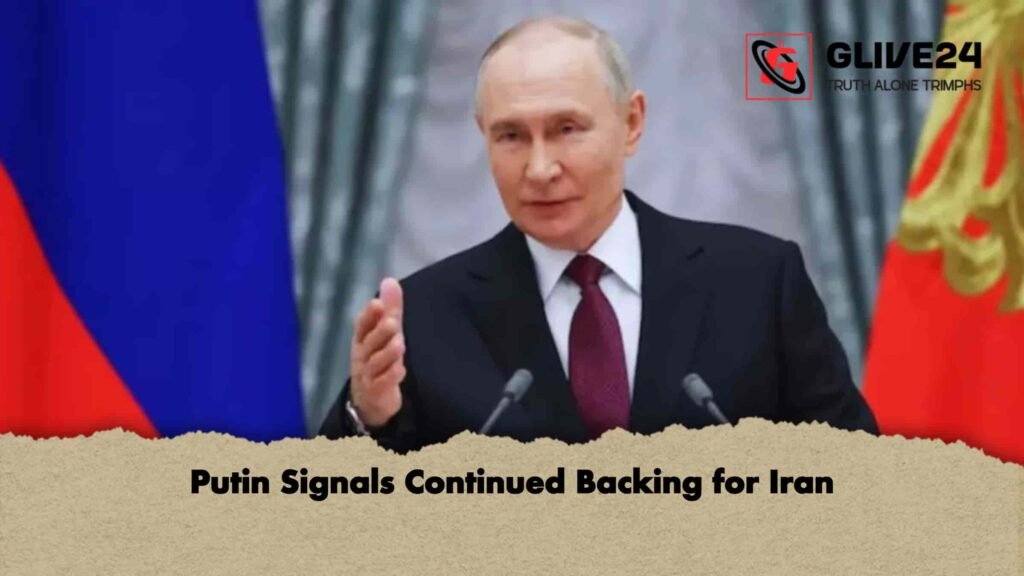
Russian President Vladimir Putin has reaffirmed Moscow’s political support for Iran by extending official greetings on the occasion of Nowruz and the upcoming Eid festivities, while pledging continued solidarity with Tehran amid rising regional tensions. The message, released by the Kremlin, highlights Russia’s intention to preserve and strengthen its partnership with Iran despite mounting international scrutiny.
In separate communications addressed to Iran’s Supreme Leader Ayatollah Ali Khamenei and President Masoud Pezeshkian, Putin conveyed his best wishes to the Iranian people and expressed confidence in their resilience. He emphasised that Iran would be able to overcome current adversities with determination, portraying the country as a steadfast partner in a volatile geopolitical environment.
The Kremlin simultaneously issued a pointed critique of recent military actions carried out by the United States and Israel, arguing that such interventions risk deepening instability across the Middle East. According to Moscow, escalating tensions in the region have already contributed to significant fluctuations in global energy markets, with rising oil prices placing additional strain on the international economy.
Putin also condemned what he described as a “brutal” killing of a former Iranian supreme leader, although details surrounding the incident remain disputed. The episode has prompted renewed questions among global observers regarding the extent of Russia’s practical involvement and influence in Iran’s security affairs.
Despite their close diplomatic ties, analysts stress that relations between Russia and Iran are not underpinned by a formal military alliance. Instead, cooperation largely centres on energy, trade, and coordinated political positioning on key international issues. The absence of a mutual defence agreement means that neither country is formally obligated to provide direct military assistance to the other, a factor that continues to shape expectations during times of crisis.
A summary of the bilateral relationship is outlined below:
| Category | Description |
|---|---|
| Strategic ties | Longstanding and active |
| Military alliance | None |
| Defence obligations | No formal treaty |
| Energy collaboration | Extensive and mutually beneficial |
| Nuclear coordination | Measured and strategically cautious |
In a separate development, a report by an international news outlet suggested that Russia had proposed a conditional arrangement to the United States, offering to limit intelligence-sharing with Iran if Washington ceased providing intelligence support to Ukraine. However, the Kremlin has categorically rejected this claim, labelling it inaccurate and without factual basis.
Specialists in international relations suggest that Moscow is deepening its engagement with Tehran as part of a broader strategy to rebalance global power structures and counter Western influence. Additionally, the surge in oil prices linked to Middle Eastern instability has delivered some economic advantage to Russia, reinforcing its strategic interest in the region.
Nevertheless, while Russia continues to project strong diplomatic backing for Iran, uncertainty persists over how far that support would extend in practical or military terms. This ambiguity leaves the future direction of Russia–Iran relations open to interpretation, with the international community maintaining close attention on further developments.