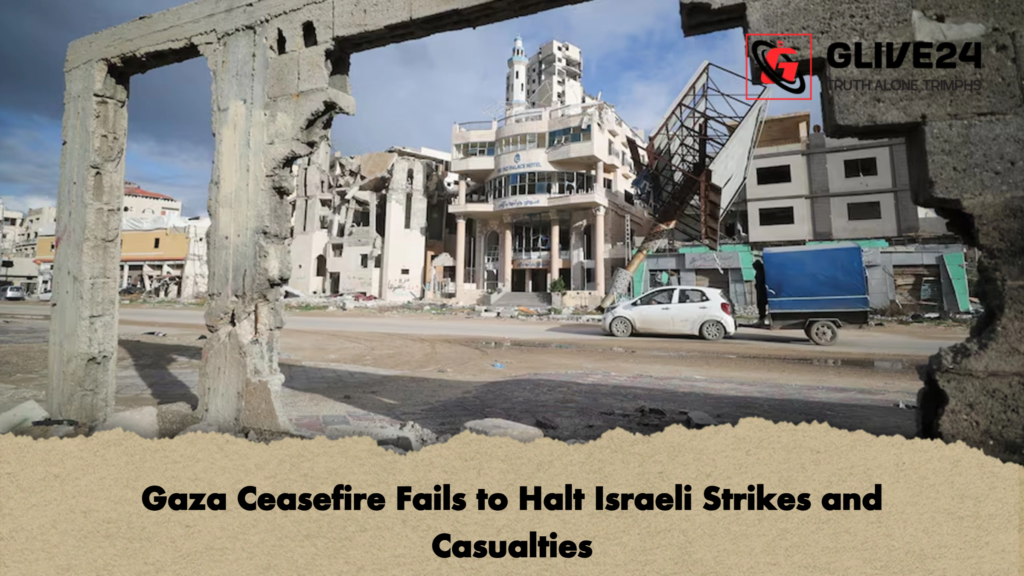
Israeli attacks on the Gaza Strip have continued despite a ceasefire that took effect in October last year, with at least 1,257 Palestinians killed and 4,131 injured since the truce began, according to the Palestinian Health Ministry.
The ministry’s latest figures show that two Palestinians who had previously been wounded in Israeli attacks died while receiving treatment and were taken to hospitals in the past 48 hours. During the same period, six more people were injured in fresh attacks. The figures underline the continued violence in Gaza despite the formal ceasefire.
According to Palestinian health authorities, reports of Israeli strikes have emerged from different parts of the Gaza Strip on an almost daily basis since the truce came into effect. The continued casualties have raised persistent concerns over the safety of civilians and the ability of humanitarian and medical services to operate in a territory already devastated by prolonged conflict.
The pressure on Gaza’s health system extends well beyond treating newly wounded people. Medical facilities must also deal with patients suffering from injuries sustained in earlier attacks, while emergency teams face the difficult task of recovering bodies and searching for people who may remain trapped beneath collapsed buildings. Years of damage to infrastructure have made such operations particularly difficult.
The latest ceasefire-period figures represent only a fraction of the overall toll since the conflict began on 7 October 2023. According to the Palestinian Health Ministry, Israeli attacks have killed a total of 73,384 people in Gaza since the start of the war, while 174,242 others have been wounded.
The scale of the casualties has left Gaza facing enormous humanitarian and reconstruction challenges. Beyond the immediate need for medical care and emergency assistance, the territory faces the long-term task of restoring damaged homes, public facilities and essential infrastructure. Any durable political arrangement will therefore have to address both security concerns and the practical requirements of rebuilding civilian life.
The question of Hamas’s weapons has emerged as one of the most contentious issues in discussions over Gaza’s future. Hamas has said it will not agree to disarm unless Israel fully withdraws its forces from the Gaza Strip.
Ghazzi Hamad, a senior Hamas official and member of the group’s negotiating team, reiterated that position in an interview with Al Jazeera. He said discussions over disarmament could not be separated from broader questions concerning an Israeli military withdrawal, Gaza’s reconstruction, future security arrangements and the territory’s political administration.
Hamad argued that disarmament should not be treated as an isolated measure. In his view, it must form part of a wider arrangement covering Gaza’s future. He also said Israel should have no role in overseeing the disarmament process, which he said should instead be supervised by a Palestinian national committee.
The continuing violence has consequently cast fresh doubt over the durability and effectiveness of the ceasefire. While the cessation of hostilities was intended to reduce bloodshed and create conditions for longer-term negotiations, the persistence of attacks and casualties indicates that the underlying disputes remain unresolved.
The central challenges now include the complete withdrawal of Israeli forces, Hamas’s position on disarmament, arrangements for Gaza’s future governance and the enormous task of reconstruction. Agreement on these issues remains critical to preventing renewed escalation.
For civilians in Gaza, however, the immediate reality remains one of insecurity. Even under a declared ceasefire, deaths and injuries continue to be reported, while medical and emergency services remain under severe strain. The latest casualty figures therefore illustrate not only the continuing danger faced by Palestinians but also the difficulty of translating a ceasefire into lasting stability on the ground.