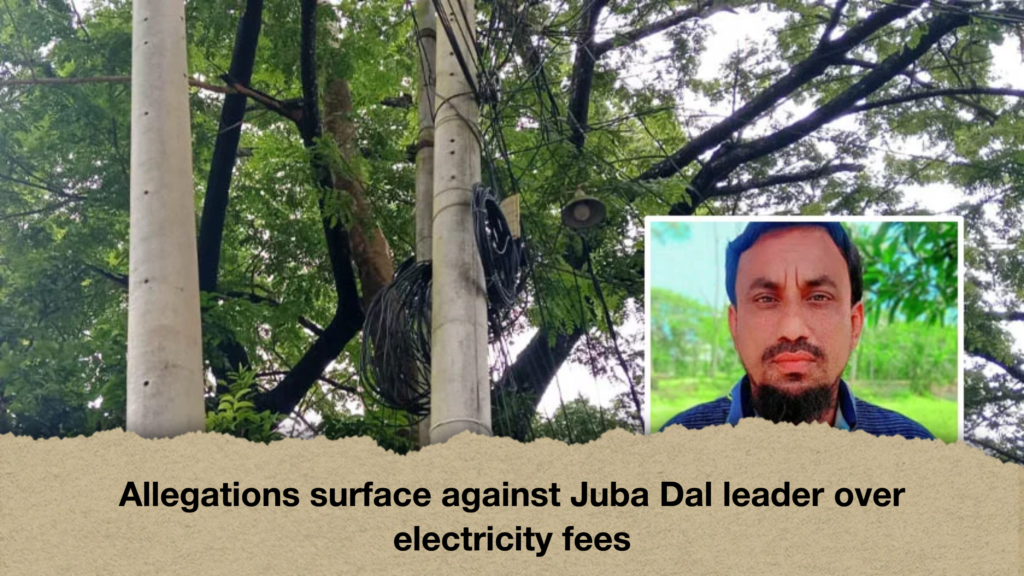
Unofficial payments demanded for grid connections in Patuakhali
For generations, families residing in the remote villages of Islampur and Dakshin Charpara within the Mithaganj Union of Kalapara Upazila have navigated daily life without access to a reliable electricity supply. Recently, however, hope for electrification arrived in the region following administrative directives facilitated through local parliamentary representative ABM Mosharraf Hossain. Contractors commissioned by the authorities began deploying utility poles and laying distribution infrastructure across the locality to bridge the long-standing infrastructural gap.
Yet, this development has been overshadowed by allegations of financial exploitation. According to local residents, Riaz Sikdar, the president of the Mithaganj Union Juba Dal, has allegedly demanded and collected money from more than fifty underprivileged households under the guise of covering pole transportation and installation expenses.
Financial strain on low-income villagers
Affected locals stated that each family was reportedly forced to pay two thousand Bangladeshi Taka just to secure the physical placement of poles near their homesteads. Furthermore, victims claimed they were instructed to hand over an additional two thousand Taka per household upon final meter installation. For many low-income residents reliant on daily wages or subsistence farming, these unbudgeted expenses have caused severe financial distress.
Desperate to illuminate their homes, several villagers resorted to extreme financial measures. Accounts from the neighbourhood reveal that individuals pawned household jewellery, diverted funds saved for seasonal agricultural cultivation, or cut back on essential grocery and medical expenditures to meet the monetary demands.
Local resident Nasir Uddin shared a particularly stark account of the pressure faced by villagers. When he initially failed to pay the requested sum as utility poles were being hauled past his property, contractors allegedly attempted to relocate the infrastructure elsewhere. It was only after he managed to deliver one thousand Taka later that night that the poles were finally installed near his residence the following morning.
Denials and official responses
When confronted with the accusations, Riaz Sikdar categorically denied extorting residents for electrical connections during a telephone interview. While he rejected claims of systematic financial coercion, he admitted that some money had been collected from locals, which he characterised as voluntary contributions intended to cover meals for the on-site labourers. He dismissed all other allegations as fabricated and groundless.
However, conflicting statements emerged from the contracting side. Sumon, a sub-contractor working with the rural electrification board, acknowledged that funds gathered from the villagers via Mr Sikdar had indeed been accounted for and adjusted within their operational logistics.
Organizational and regulatory authorities have taken note of the unfolding situation. Harun Or Rashid, convener of the Kalapara Upazila Juba Dal branch, stated that internal investigations would be conducted and strict disciplinary measures enforced should the accusations be substantiated.
Meanwhile, Sheikh Abdur Rahman, Deputy General Manager of the Kalapara Rural Electricity Association, clarified the official policy regarding infrastructural deployment. He emphasised that electrification projects are fully funded and managed under public arrangements, meaning that consumers are strictly prohibited from paying any fees for basic line installation. He warned that if investigations confirm illegal monetary transactions, formal legal actions will be initiated against those responsible.
The controversy has left the rural community anxious and unsettled. Residents are calling for a transparent inquiry to uncover the truth behind the financial demands, urging authorities to ensure that access to essential public utilities remains free from corruption and exploitation.