A severe energy crunch has gripped the industrial belt of Gazipur, forcing garment factories to abandon automated machinery in favour of manual labour. With gas pressure plummeting far below required operational thresholds, exporters find themselves struggling to maintain productivity, meet strict delivery deadlines, and protect their profit margins from steep buyer discounts.
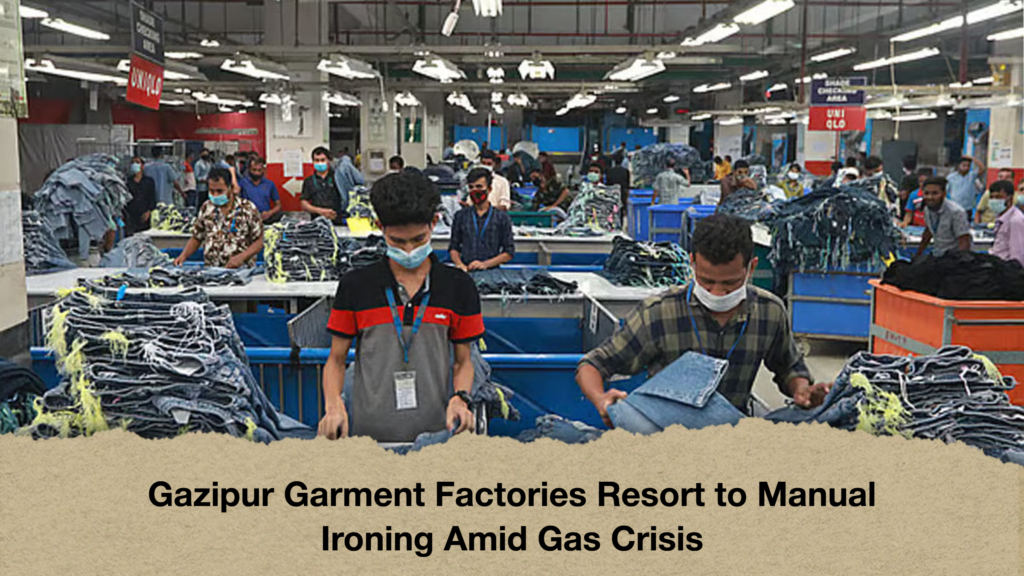
At Sparrow Apparels Ltd, the impact is visible on the factory floor. Workers are forced to press denim garments entirely by hand because the low gas pressure renders heavy pressing machinery unusable. Industry leaders note that a normal supply would allow these processes to run efficiently through automated machines. Instead, output has slowed considerably, threatening export schedules.
The Anatomy of the Shortage
Gazipur hosts roughly 2,500 registered export-oriented garment factories, with over 400 relying directly on a steady gas supply. While standard textile operations—including dyeing, finishing, denim processing, knitting, and woven manufacturing—require a consistent pressure of 7 to 8 PSI to function effectively, meters in many facilities have dropped below 2 PSI, occasionally reading near zero.
The regional shortfall is acute. According to data from industry stakeholders and Titas Gas, the industrial hubs across Gazipur demand about 550 million cubic feet per day (mmcfd), yet receive only 300 mmcfd. This leaves a massive deficit of roughly 250 mmcfd, amounting to a 45% shortage.
Key Impacts on Gazipur’s Industrial Belt
-
Severe Shortfall: Daily gas supply stands at 300 mmcfd against a demand of 550 mmcfd.
-
Pressure Drop: Operational pressure has plummeted from the required 7 to 8 PSI down to under 2 PSI.
-
Affected Areas: Tongi BSCIC, Gacha, Basan, Konabari BSCIC, Kashimpur, Gazipur Sadar, Safipur, Chandra, and Sreepur.
-
Production Deficit: BGMEA-member factories are currently operating 30 to 35% below their full capacity.
-
Cost Surges: Overall production expenses have climbed by approximately 30% due to alternative energy use.
-
Air Freight Penalties: Exporters are spending up to $50,000 extra on emergency air shipments.
-
Buyer Discounts: Late deliveries are attracting punitive buyer discounts ranging between 20 and 25%.
-
Daily Losses: Individual factory groups report losses running into millions of Taka while maintaining idle workforces.
-
Capacity Strains: Heavy reliance on expensive diesel generators keeps partial lines open but erodes profitability.
-
Supply Chain Bottlenecks: Backward-linkage units like spinning and dyeing face temporary closures, fracturing the wider export ecosystem.
Escalating Costs and Buyer Uncertainty
To keep lines moving and preserve lead times, factory owners have turned to expensive diesel generators, driving up operating costs by roughly 30%. Major units, such as those under the Divine Group and Sadma Group, have experienced temporary shutdowns in their core dyeing operations.
The financial toll is mounting rapidly. Exporters are absorbing heavy auxiliary expenses, including up to $50,000 in emergency air freight charges and 20 to 25% price discounts demanded by jittery buyers for delayed shipments. Meanwhile, factory owners must continue paying wages to thousands of workers sitting idle during localized shutdowns.
International buyers are watching the situation closely, with some already exploring alternative sourcing hubs across the region. While local utility and law enforcement officials maintain that formal shutdown notices have yet to be officially logged, the day-to-day disruption across Gazipur’s manufacturing backbone remains profound.
How do you think policymakers can best balance domestic energy allocation between residential needs and critical export industries during peak winter or summer deficits?