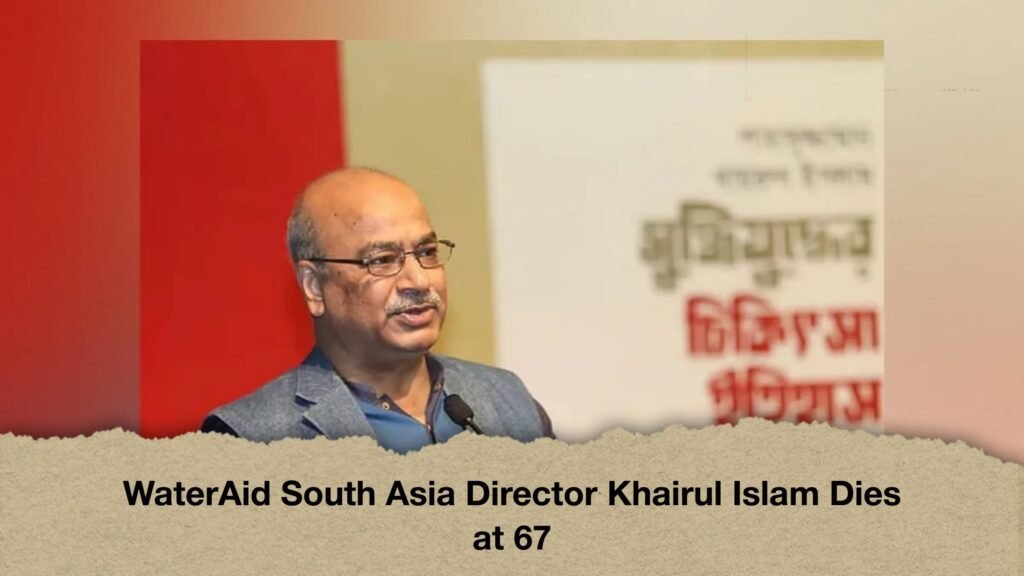
Dr Khairul Islam, the South Asia Regional Director of international development organisation WaterAid, has died at the age of 67. He passed away in the early hours of Friday at Continental Hospital in Dhaka, formerly known as United Hospital, after suffering a heart attack.
The death was confirmed by Plabon Gangopadhyay, WaterAid’s Coordinator for Communications.
According to WaterAid sources, Islam suffered a cardiac attack on Thursday night and was subsequently taken to hospital for treatment. He died there early on Friday.
His close friend M Tamim, an energy specialist and Vice-Chancellor of Independent University, Bangladesh, said Islam’s son, Arko, is travelling from Australia to attend the funeral. His funeral prayer is scheduled to be held after Asr prayers on Saturday at Azad Mosque in Gulshan, Dhaka. He is expected to be buried at Rayerbazar, although the final arrangements will depend on the family.
Islam had a long and distinguished career spanning medicine, public health, research, writing and development work. He graduated in medicine from Sir Salimullah Medical College Hospital and later pursued postgraduate studies at the National Institute of Preventive and Social Medicine and in Boston.
He was particularly recognised for his work on public health and for his contributions to discussions surrounding Bangladesh’s healthcare system. His professional interests extended beyond clinical medicine, encompassing health policy, research, sanitation, water management and wider social development issues.
Islam contributed to several publications on the country’s health sector. He served as a member of the editorial board and a contributor to Development of the Health Sector in Bangladesh, published by Prothoma Prokashan. He also contributed to a book on corruption in the health sector published by Oxford University Press, as well as to Mujibpedia, where he wrote on health-related issues.
One of his notable scholarly projects was The Medical History of the Liberation War, which he co-authored with acclaimed fiction writer Shahaduzzaman. The book was the outcome of five years of research into medical services and healthcare during Bangladesh’s Liberation War. It was published by Prothoma Prokashan in 2022.
The work documented an important but relatively specialised aspect of the 1971 war, focusing on the medical history associated with the conflict. Its publication brought together historical research and accounts relating to healthcare during a critical period in Bangladesh’s history.
For many years, Islam was also involved in efforts to improve Bangladesh’s water, sanitation and hygiene sector. His work with WaterAid placed him at the centre of initiatives concerning access to safe water, sanitation and hygiene, areas that remain closely linked to public health and living standards.
He was due to retire from his position as WaterAid’s South Asia Regional Director this month. His death therefore came shortly before the planned end of a long professional association with the organisation.
Alongside his organisational responsibilities, Islam regularly wrote newspaper columns on medicine, public health, the water, sanitation and hygiene sector, and other social issues. His writing reflected his experience as both a medical professional and a researcher.
WaterAid Bangladesh Country Director Hasin Jahan said in a Facebook post that Islam’s body would be taken to the mortuary at BIRDEM Hospital on Friday. It will remain there until his son returns from Australia.
Colleagues and friends remembered Islam as a courteous and approachable person. His career brought together several fields that are central to Bangladesh’s development — healthcare, public health, research, sanitation and access to essential services.
Islam completed his higher secondary education at Mirzapur Cadet College before pursuing his medical studies. Over the course of his career, he worked across professional and academic spheres, contributing both to institutional programmes and to public discussion through research and writing.
His death marks the loss of a public health professional whose work extended well beyond medicine. Through his research, publications and long involvement in the water and sanitation sector, Islam became associated with some of the key public health and development debates in Bangladesh and the wider South Asian region.