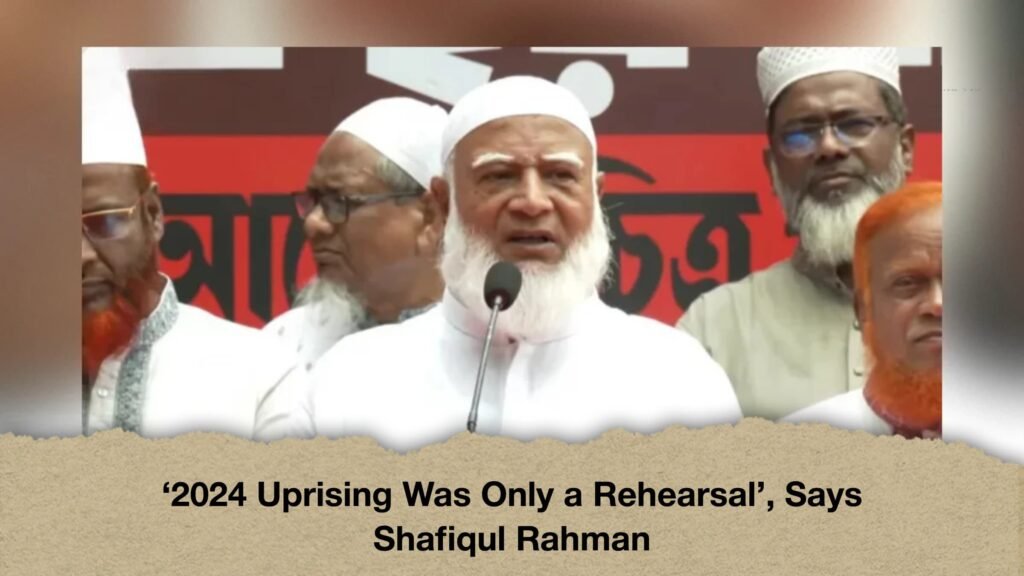
Bangladesh Jamaat-e-Islami Ameer Dr Shafiqul Rahman has described the 2024 student-led mass uprising as merely a “rehearsal”, cautioning against viewing the movement as the “final battle”. He also accused the current government of following what he described as a fascist path and called for a change in that approach.
Dr Shafiqul Rahman made the remarks on Sunday (23 August) at a discussion meeting and prize-giving ceremony held at the Diploma Engineers Institution Bangladesh (IDEB) auditorium in Kakrail, Dhaka.
The programme was organised to mark Seeratunnabi (PBUH), with the theme ‘The Prophet’s Principles and Ideals for State Reform’. A writing competition was also held as part of the event, with prizes distributed among the winners.
Recalling the events of 2024, the Jamaat chief urged people not to consider the student-public uprising as the final stage of political struggle. He said the movement should instead be regarded as a rehearsal, suggesting that the awakening witnessed during the uprising had not disappeared.
“The people who rose in 2024 for freedom have not died; they are still awake and keeping a close watch on everything happening in the country,” he said.
His remarks come in the context of the political upheaval surrounding the 2024 mass movement, which became a defining moment in Bangladesh’s recent political history. The protests, initially driven by students, developed into a broader movement involving sections of the public and eventually led to a major change in the country’s political landscape.
Dr Shafiqul Rahman also spoke at length about fascism. He argued that fascism should not be viewed as the exclusive characteristic of any particular political party or organisation. Rather, he described it as a “contagious disease” that can affect anyone or any group adopting such practices.
According to him, the lesson of the 2024 uprising is that political power alone cannot guarantee lasting change unless the underlying culture of governance also changes. He called for an end to practices that, in his view, reproduce authoritarian tendencies under a different political identity.
Referring to the fall of the previous government, Dr Shafiqul Rahman said that, according to his interpretation of history, those who leave a country after losing power do not return to it. He also alleged that important memories and materials related to the 2024 movement had been removed from the ‘July Mass Uprising Museum’ in order to please a particular foreign country.
The allegation was made without providing specific details about which materials had allegedly been removed or identifying the country he referred to.
The Jamaat leader also called for unity to build what he described as an equitable and humane society. Referring to what he sees as a wider global movement for social change, he urged people to work together towards a system based on justice, human dignity and fairness.
The theme of the gathering centred on the principles and ideals of Prophet Muhammad (PBUH) in the context of reforming the state. The event therefore combined discussion of contemporary political change with a religious framework focused on governance, justice and social responsibility.
Dr Shafiqul Rahman’s comments underline Jamaat-e-Islami’s continuing emphasis on political and institutional change following the events of 2024. His description of the uprising as a “rehearsal”, rather than a final political confrontation, also signals his view that the demands for wider change that emerged from the movement remain relevant.