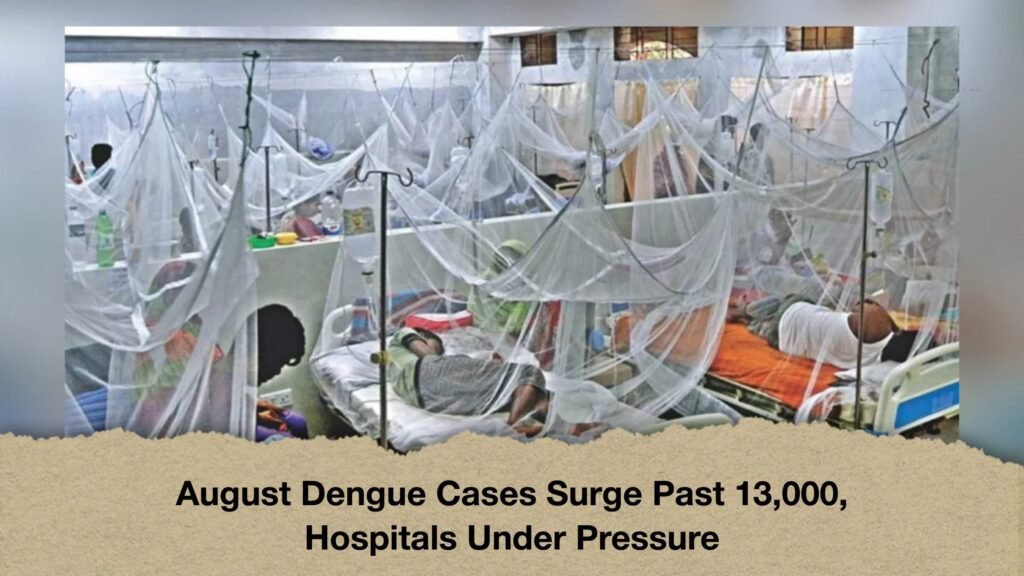
Dengue infections are rising rapidly across Bangladesh as the monsoon reaches its peak, with hundreds of new patients being admitted to hospitals each day and fatalities continuing to climb. The growing number of cases is placing additional pressure on healthcare facilities, not only in the capital but also across districts and divisions. Hospitals in Dhaka are facing particular strain as patients from different parts of the country continue to seek treatment there.
According to the latest data released by the Directorate General of Health Services, 839 new dengue patients were admitted to hospitals across the country in the 24 hours to 23 August, while five people died from the disease. With these additions, the number of patients hospitalised with dengue since the beginning of the year had reached 28,929 by 23 August. The death toll stood at 82, while 26,897 patients had recovered and been discharged from hospitals.
The monthly figures show how sharply the outbreak has intensified during the monsoon. Dengue admissions remained relatively modest during the first few months of the year, but the situation began to change in June. July saw a particularly steep increase, with 9,206 patients admitted to hospitals and 36 deaths recorded. The upward trend has continued into August, when more than 13,000 patients had already been hospitalised by 23 August.
Table of Contents
839 admissions mark the year’s highest daily figure
The 839 patients admitted during the latest 24-hour period included 287 from Dhaka Division, 159 from Khulna, 117 from Barishal, 100 from Chattogram, 79 from Mymensingh, 71 from Rajshahi, 23 from Rangpur and three from Sylhet.
The figure is the highest number of dengue admissions recorded in a single day so far this year, according to reports based on the health authorities’ data.
Four of the five people who died were from Dhaka Division, while the remaining victim was from Mymensingh Division. The geographical spread of both infections and deaths indicates that dengue is no longer primarily a capital-centred health concern. Cases are being reported across a much wider area, increasing the need for stronger preparedness outside Dhaka as well.
August follows July’s sharp rise
The first six months of 2026 showed comparatively lower levels of hospitalisation. There were 1,081 admissions in January, followed by 409 in February, 353 in March, 640 in April and 714 in May. The number rose sharply to 2,907 in June before reaching 9,206 in July.
The rapid increase during the monsoon has heightened concern among public health specialists. With August and September still within the broader rainy season, sustained rainfall and the accumulation of stagnant water could create favourable breeding conditions for Aedes mosquitoes.
Experts have therefore been stressing the need for preparation before hospitals face an even heavier influx of patients. Early detection, proper monitoring and timely treatment remain essential to preventing cases from becoming severe.
Dhaka hospitals face growing pressure
Hospitals in the capital are also treating an increasing number of patients arriving from outside Dhaka. Limited diagnostic and treatment facilities at some district and sub-district levels, the need for specialised care in severe cases and referrals from local doctors are among the factors contributing to the movement of patients towards Dhaka.
However, a substantial proportion of dengue cases can be managed at district-level hospitals when patients are diagnosed promptly and kept under appropriate observation. Ensuring access to necessary fluids, monitoring and other supportive treatment can reduce the need for unnecessary transfers to the capital.
Strengthening treatment capacity at the district and sub-district levels could therefore help ease pressure on Dhaka’s public and private hospitals while allowing patients to receive care closer to home.
Rainwater creates new Aedes breeding sites
Aedes mosquitoes, the main vector responsible for dengue transmission, commonly breed in clean, stagnant water. During the monsoon, rainwater can accumulate in flowerpots, discarded tyres, plastic containers, construction sites, rooftop spaces and areas around water tanks.
Urban waterlogging and poorly managed construction sites can create additional breeding opportunities. As a result, public health specialists have repeatedly emphasised that dengue prevention cannot depend solely on spraying insecticides.
Breeding sites need to be identified and removed regularly. Even when mosquito-control operations are conducted in an area, stagnant water inside homes, construction sites or private premises can allow Aedes mosquitoes to reproduce again.
Insecticide spraying alone is not enough
Effective dengue control requires sustained action against mosquito breeding. Local authorities, city corporations, health officials, educational institutions, construction companies and residents all have a role to play.
Households and institutions need to inspect their surroundings regularly and remove standing water wherever it is found. Construction sites, in particular, require close monitoring because containers, exposed structures and uneven surfaces can retain rainwater for several days.
Targeted mosquito-control operations are also important in areas where clusters of dengue cases are being detected. Combining surveillance with the rapid removal of breeding sites can make control efforts more effective than relying on insecticide spraying alone.
Healthcare services need stronger preparedness
As admissions rise, hospitals need adequate beds, intravenous fluids, diagnostic facilities and trained healthcare workers to cope with demand. Equally important is the ability to identify patients whose condition is deteriorating and provide timely medical intervention.
The Directorate General of Health Services regularly publishes dengue-related information through its monitoring system, including figures on hospital admissions, deaths and the geographical distribution of cases. Such data can help authorities identify areas where the outbreak is intensifying and direct resources accordingly.
The scale of the current outbreak can also be viewed against last year’s figures. In 2025, a total of 102,861 dengue patients were admitted to hospitals across Bangladesh, while 413 people died.
Coordinated action needed before pressure intensifies
Public health specialists have warned that dengue cannot be addressed solely through hospital-based treatment. Controlling transmission also requires regular surveillance, identification and destruction of mosquito breeding sites, assessment of mosquito larvae, targeted control operations and sustained public participation.
Areas recording clusters of cases should receive priority for inspection and mosquito-control measures. Local response mechanisms also need to be strengthened so that action can be taken quickly when infection levels begin to rise.
For patients, early diagnosis and appropriate medical care remain vital. At the same time, preventing new infections requires action at the source by reducing the places where Aedes mosquitoes breed.
With the monsoon still continuing, the coming weeks will be crucial. Without coordinated efforts to strengthen healthcare preparedness and reduce mosquito breeding sites, the growing number of dengue cases could place even greater pressure on hospitals and increase the risk of further deaths.