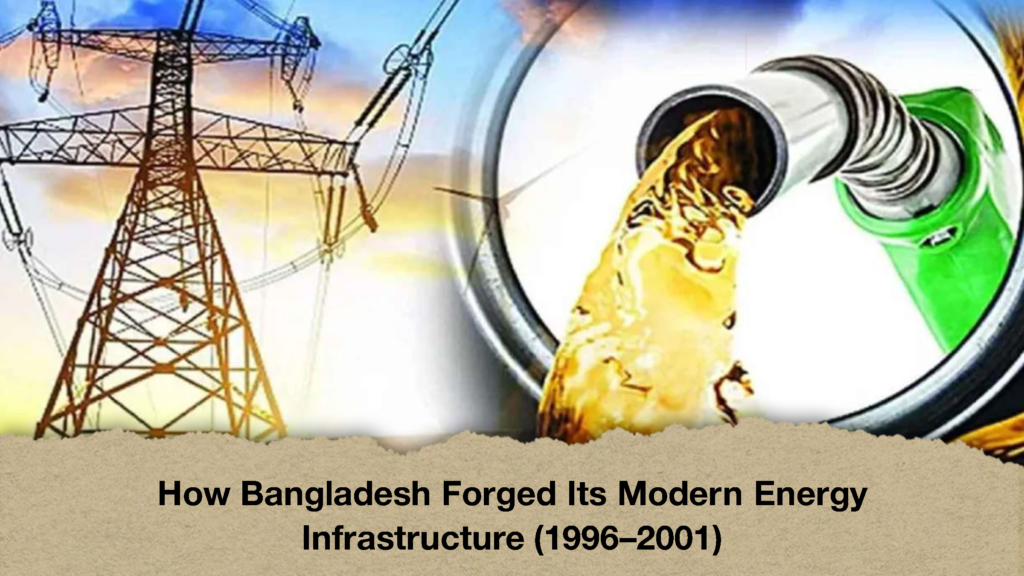
Viewing the period between 1996 and 2001 through a narrow political lens fails to capture its profound impact on Bangladesh’s socio-economic development. Far beyond a standard five-year governmental tenure, this era represented the blueprint for the country’s long-term energy and power infrastructure. When the Sheikh Hasina-led Awami League administration assumed office in 1996, it inherited a deeply fragile energy landscape. Strategic policies, targeted investments, and structural reforms initiated during those pivotal years established the bedrock upon which the nation’s subsequent industrial expansion was built.
By the mid-1990s, Bangladesh faced an escalating energy crisis characterized by severe constraints in gas extraction, transmission, and power generation. Over-extraction from key fields such as Bakhrabad and Feni had compromised overall production capacities. Compounding the crisis, a lack of cross-country transmission infrastructure meant that natural gas extracted in one region could not reach industrial hubs elsewhere.
The most glaring manifestation of this systemic failure was the isolation of the gas-rich Greater Sylhet region from the demand-heavy Chittagong zone. Without a connecting pipeline, heavy industries and power generation units across the southern belt faced severe gas starvation. Factory floors stalled, generation capacity plummeted, and multi-hour daily load-shedding became a grueling reality for households and businesses alike.
Recognising that power generation could not be treated in isolation from fuel supply networks, the administration adopted an integrated planning framework—a crucial paradigm shift in national policy. Rather than focusing solely on building generation units, the government began linking gas extraction, cross-country transmission, and grid integration into a unified strategy.
Within a remarkably short timeframe, the administration executed the construction of the 58-kilometre Ashuganj-Bakhrabad cross-country gas transmission pipeline. This milestone project integrated the eastern gas grid, dramatically enhancing supply to the Chittagong region, stabilizing fertilizer production, and repowering languishing power plants.
Simultaneously, ambitious steps were taken to extend gas supply to the traditionally neglected western region of Bangladesh. By laying pipelines along the newly constructed Bangabandhu Jamuna Multipurpose Bridge and extending transmission networks from Elenga through Hatikumrul to Baghabari, the government opened a vital new energy corridor for western districts.
Efforts to bolster raw natural gas reserves and expand supply channels yielded significant results during this period. The Saldanadi, Meghna, and Beani Bazar gas fields were successfully connected to the national grid. Infrastructure at the offshore Sangu field was developed and integrated, opening Bangladesh’s first offshore gas supply avenues. At the same time, major production developments at the Jalalabad field alongside discoveries in Moulvibazar strengthened the foundation for long-term reserves.
Parallel reforms transformed the electricity generation landscape through the landmark Private Sector Power Generation Policy. Breaking away from exclusive reliance on state-funded projects, Bangladesh opened its energy market to Independent Power Producers (IPPs). Large-scale generation projects—most notably the 420 MW Meghnaghat and 360 MW Haripur plants—were initiated under this private investment framework. To address immediate supply shortfalls, the government deployed flexible solutions, including barge-mounted power plants and small-scale IPPs strategically located near gas distribution nodes.
By 2001, approximately 52 power generation units of varying capacities had reached final stages of planning, construction, or commissioning. More significantly, Bangladesh had established the structural framework of a coherent energy supply chain.
The enduring lesson of the 1996–2001 period lies in the necessity of systemic integration. A power plant without dedicated gas supplies remains idle; gas reserves without transmission pipelines are stranded; and electricity produced without a resilient national grid cannot reach consumers. By synchronising exploration, transmission, generation, and distribution, the administration laid down an enduring framework for structural economic growth.
Although momentum slowed due to investment deficits in subsequent years—leading to renewed energy shortages by the late 2000s—the foundational work accomplished between 1996 and 2001 remains a vital turning point in the history of Bangladesh’s national infrastructure.