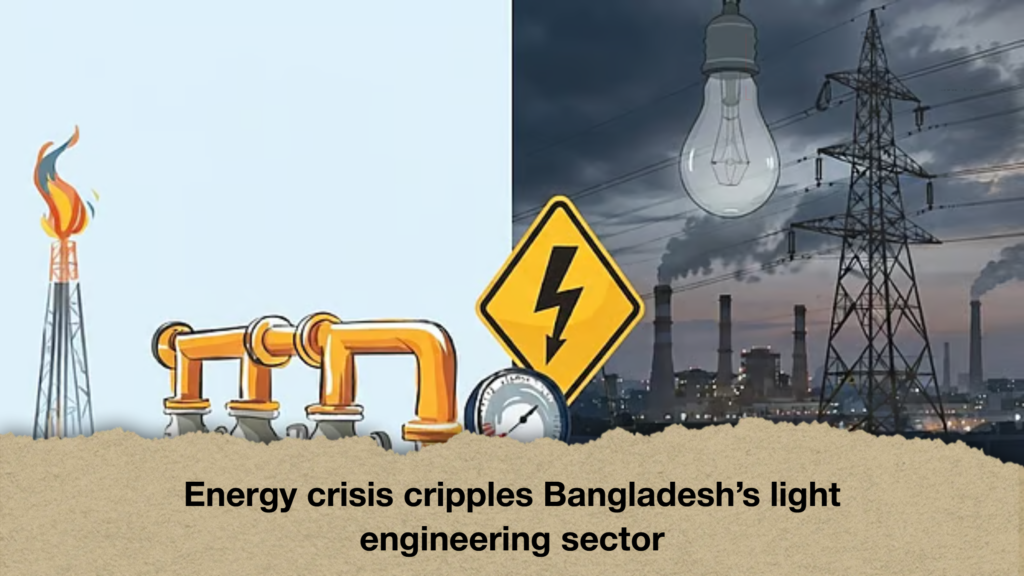
A severe and persistent energy crisis, characterized by acute gas shortages and frequent power cuts, is heavily impacting Bangladesh’s light engineering sector. Small and medium enterprises (SMEs) are struggling with plummeting output, rising operational overheads, and shrinking market demand, bringing many manufacturing units to the brink of closure.
Faisal Polymer Industries, a water-tap manufacturer based in Dhaka’s Jatrabari area for over a decade, exemplifies the struggles facing urban workshop owners. According to Managing Director Md Solayman Parsi, the melting of brass to cast taps requires continuous furnace operation powered by steady gas supplies. However, low pressure over the past four to five months has choked operations. The factory now runs for barely three or four hours a day, causing production to plummet by more than sixty percent.
Daily fixed operational costs of roughly eighteen thousand taka must be met regardless of output, requiring a daily production value of seven to eight lakh taka to break even. Current output languishes at just three to four lakh taka, driving heavy financial losses. Consequently, the firm’s workforce has shrunk from thirty employees a year ago to a mere twelve.
The Jatrabari cluster alone hosts around 350 large and small tap-manufacturing units, with smaller operators relying on shared casting facilities. Thus, infrastructure bottlenecks ripple through the entire local supply chain. According to the Bangladesh Engineering Industry Owners Association, the country boasts roughly fifty thousand light engineering workshops supporting approximately 650,000 jobs across industrial hubs in Keraniganj, Narayanganj, Bogura, Pabna, and Gazipur.
Industrial clusters nationwide report daily power outages lasting six to eight hours alongside critically low gas pressure. Essential processes like metal casting, molding, and heat treatment are frequently suspended. Agro Machinery Industries Limited, an agricultural equipment maker in Gazipur’s Shalna cluster, reports that production has halved due to frequent load-shedding lasting up to an hour per outage, leaving the firm struggling to meet client orders. Meanwhile, expenses continue to climb despite reduced productivity. Brothers Engineering, a plastic mould maker in Keraniganj, reports a thirty percent spike in electricity bills alongside a forty percent jump in diesel expenditure for backup generators, even as monthly production dropped by thirty percent.
SME Foundation Managing Director Anwar Hossain Chowdhury notes that entrepreneurs frequently report their inability to fulfil existing orders on schedule due to infrastructure hurdles. Without swift intervention, vulnerable businesses face mounting defaults on bank loans, unpaid wages, and the very real prospect of permanent closure, threatening the broader manufacturing ecosystem that relies on these localized spare parts and machinery components.
How crucial will targeted policy interventions be to sustain vulnerable SMEs through this prolonged infrastructural crunch?