More than 500 teachers at public universities across Bangladesh are reportedly facing investigations, disciplinary measures and various forms of workplace harassment following allegations linked to political activities.
The controversy centres on a report published by an online news outlet on 4 August 2026, which claimed that 404 teachers from 22 public universities were involved in alleged efforts to bring back former Prime Minister Sheikh Hasina. According to the report, the information was based primarily on a Telegram group containing the names of teachers from different universities.
Several teachers whose names reportedly appeared in the group have denied any knowledge of the platform or participation in its activities. They have alleged that the publication of the report has since exposed them to sustained psychological pressure and administrative difficulties at their respective institutions.
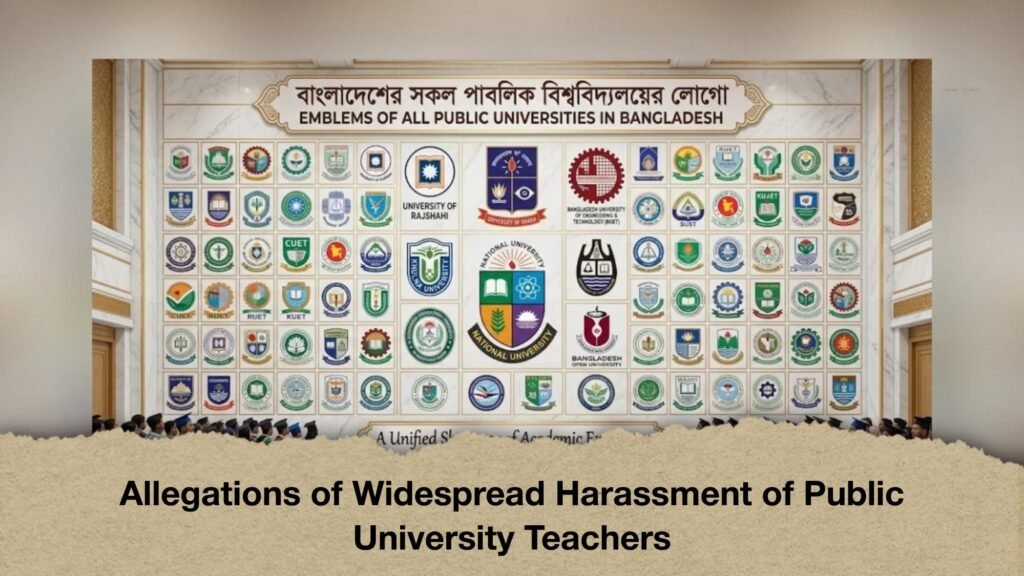
The issue has subsequently spread across a number of public universities. According to allegations cited in the report, investigation or information-gathering committees have been formed at institutions including the University of Dhaka, University of Rajshahi, University of Chittagong, Islamic University, Jagannath University, Shahjalal University of Science and Technology, Khulna University, Kazi Mohammad Nafiz Science and Technology University, Begum Rokeya University, Mawlana Bhashani Science and Technology University, Sher-e-Bangla Agricultural University, Patuakhali Science and Technology University, Noakhali Science and Technology University, Jatiya Kabi Kazi Nazrul Islam University, Kurigram Agricultural University and Gopalganj Science and Technology University.
Teachers have reportedly been served notices in connection with allegations of sedition. In some cases, however, the allegations appear to extend beyond the names published in the report. Teachers who had previously supported particular panels in university elections have also reportedly been called for questioning.
The allegations have raised concerns because disciplinary action is said to have been taken in some cases before investigations have been completed or wrongdoing established.
At Jagannath University, allegations have emerged that the salaries of Professor Dr Abdul Awad, Professor Dr Md Nazrul Islam and Dr Mobarak Hossain have been stopped. There are also claims that some teachers have faced delays in promotion and career advancement, while others have been removed from departmental or teaching responsibilities.
A further concern involves medical treatment abroad. At the University of Dhaka, Dr Mushfiq Mannan Chowdhury and 10 other teachers have reportedly not received the necessary no-objection certificates to travel overseas for serious medical treatment.
At Islamic University, Professor Mahbubur Rahman has reportedly faced an incident in which a group of people entered his office, vandalised property and allegedly subjected him to harassment. There are also allegations that qualified teachers in the Department of Marketing were overlooked in favour of a particular dean being assigned a committee leadership role, while students protesting the decision subsequently faced a counter-investigation.
Rajshahi University has also featured prominently in the allegations. Professor Prashanta Kumar, Associate Professor Sadikul Islam Sagar, Assistant Professor Umme Habiba Jesmin and Professor Salma Khatun have reportedly been suspended or removed from their positions. At Patuakhali Science and Technology University and Noakhali Science and Technology University, teachers have allegedly been subjected to distressing questioning during investigations and served show-cause notices.
The allegations have also prompted questions about the wider purpose of the investigations. Claims have emerged that the process could be connected to attempts to remove existing teachers and create opportunities for new appointments or promotions. Such claims, however, would require independent verification and evidence before they could be established as fact.
The dispute comes against the backdrop of significant political and institutional changes in Bangladesh following 5 August 2024. In the aftermath of the political transition, teachers at educational institutions across the country faced allegations of forced resignation, suspension of salary and financial benefits, and restrictions on entering their workplaces.
The Ministry of Education subsequently issued several directives and official orders in response to incidents of forced resignation and physical and psychological harassment at educational institutions. Among other measures, those orders called for teachers who had been forced to resign to be reinstated and for suspended monthly payment orders to be restored, with legal action contemplated where institutions failed to comply.
The current allegations involving public universities have therefore renewed debate over the boundary between legitimate institutional investigations and administrative harassment.
Barrister Tanvir Rahman, a former University of Dhaka teacher and senior lawyer at the Supreme Court, has warned of the potential institutional consequences. He has argued that dismissing teachers or attaching allegations of sedition to them solely on the basis of a media report could create serious difficulties for higher education.
According to him, experienced university teachers possess knowledge developed over years of academic and professional work, and replacing them cannot immediately compensate for the loss of that expertise.
He has also argued that allegations involving sedition should be dealt with through the appropriate state institutions and judicial process. University administrations, he maintains, should not assume the role of law-enforcement agencies or courts when dealing with serious criminal allegations.
The wider legal debate concerns freedom of thought, conscience and expression. Article 39 of the Constitution of Bangladesh recognises freedom of thought, conscience and speech as fundamental rights. International human rights instruments also recognise freedom of expression and the right to education.
Article 19 of the Universal Declaration of Human Rights protects freedom of expression, while Article 26 recognises the right to education. The International Covenant on Civil and Political Rights protects freedom of expression under Article 19, while the International Covenant on Economic, Social and Cultural Rights recognises the right to education under Article 13.
Academic freedom is another important element of the debate. The 1997 UNESCO Recommendation concerning the Status of Higher-Education Teaching Personnel places emphasis on academic freedom, professional independence, institutional autonomy and fair protection for teaching staff.
Concerns have reportedly been raised by academics, researchers, lawyers, human rights advocates and intellectuals over allegations of broad-based investigations targeting university teachers because of their perceived political affiliations. There have also been calls for international academic organisations, including Scholars at Risk and teacher associations in the United States, Canada and Europe, to monitor the situation.
For Bangladesh’s higher education sector, the stakes extend beyond individual employment disputes. Prolonged administrative uncertainty can disrupt teaching, research and institutional governance, while pressure on academics may contribute to the loss of experienced scholars and researchers.
A university’s primary role is to provide an environment for teaching, research, critical thinking and the free exchange of ideas. Political affiliation, personal political views and involvement in a specific criminal offence are not necessarily the same thing.
Where credible evidence of wrongdoing exists, an impartial and time-bound investigation can establish the facts. Such proceedings, however, need to follow applicable law and institutional rules, while allowing the accused an opportunity to respond.
The allegations now surrounding dozens of teachers therefore raise a broader question about how public universities should respond to political disputes while preserving academic independence and due process. Ensuring that investigations are based on evidence rather than political assumptions, and that disciplinary action follows established legal procedures, will be crucial to restoring confidence in university administration.
For thousands of students, the immediate priority remains uninterrupted education. A stable academic environment requires institutional accountability, protection of lawful rights and a clear distinction between political opinion and proven misconduct.