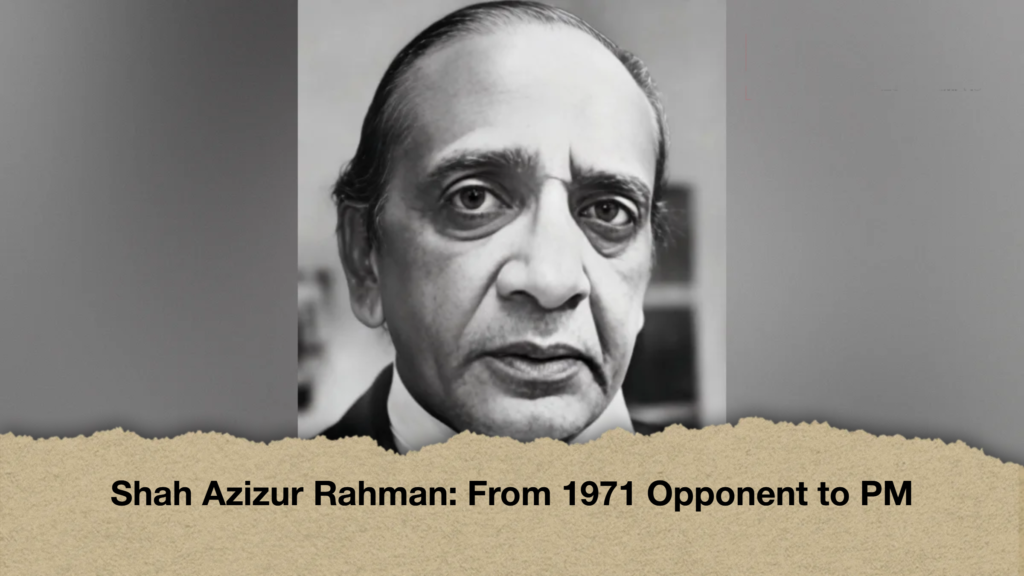
Bangladesh’s political history contains figures whose careers cannot be understood through a single political label. Shah Azizur Rahman was one such figure. A prominent parliamentarian, accomplished speaker and multilingual politician, he occupied important positions in Pakistan-era politics before becoming a senior leader of the Bangladesh Nationalist Party and eventually serving as prime minister of independent Bangladesh.
His political legacy, however, remains deeply contested because of his position during the 1971 Liberation War. While millions of Bengalis fought for independence, Shah Azizur Rahman supported the unity of Pakistan and opposed the movement for an independent Bangladesh. Years later, he rose to one of the highest offices in the country he had opposed establishing.
Early life and political beginnings
Shah Azizur Rahman was born in Kushtia on 23 November 1925. He became involved in politics during his student years and took part in the political movement surrounding the demand for Pakistan.
He was associated with the All-Bengal Muslim Students League and served as its general secretary. After the creation of Pakistan in 1947, he continued his political activities in East Pakistan and gradually established himself as an influential political speaker.
During the political debates of the 1960s, he opposed the autonomy-oriented politics associated with Sheikh Mujibur Rahman and the Awami League. His political outlook remained closely connected with the Pakistani state structure.
His role during the Liberation War
The most controversial chapter of Shah Azizur Rahman’s career came in 1971.
As the independence movement turned into a Liberation War, he took a clear position against Bangladesh’s independence and supported the territorial integrity of Pakistan. His activities during the conflict subsequently became a major part of the historical debate surrounding his political career.
In November 1971, he travelled to the United Nations as leader of a Pakistani delegation. There, he presented the Bangladesh independence movement as an internal matter of Pakistan and rejected allegations of atrocities by Pakistani forces. He also appealed to Muslim-majority countries not to recognise Bangladesh.
His position stood in direct opposition to the Bengali independence movement at a time when the war had already transformed the political and humanitarian landscape of the region.
Arrest after independence
Following Pakistan’s defeat and Bangladesh’s independence in December 1971, Shah Azizur Rahman was arrested and detained under legislation concerning collaborators. He was later released in 1973 under the general amnesty announced by the government of Sheikh Mujibur Rahman.
His political career, however, was far from over.
The political order of Bangladesh changed dramatically after the assassination of Sheikh Mujibur Rahman and most of his family on 15 August 1975. In the new political environment, Shah Azizur Rahman gradually returned to active politics.
In 1976, he took an important role in the revived Muslim League. He subsequently entered the political circle associated with Ziaur Rahman, whose administration was reshaping the country’s political landscape.
Rise within the BNP
When Ziaur Rahman launched the Bangladesh Nationalist Party in 1978, Shah Azizur Rahman emerged as one of its senior figures. He served as the party’s senior vice-president and held ministerial responsibilities in Ziaur Rahman’s government, including responsibility for labour and industry.
His political rise continued after the 1979 parliamentary election, when he was elected from the Kushtia-3 constituency as a BNP candidate.
The following development marked the peak of his political career.
Becoming prime minister
On 15 April 1979, Shah Azizur Rahman became prime minister of Bangladesh under President Ziaur Rahman. He also served as leader of the House.
His appointment represented one of the most striking reversals in Bangladesh’s early political history. A politician who had opposed the country’s independence in 1971 had, less than a decade later, become the head of its government.
The episode reflected the profound political changes that took place in Bangladesh during the years following independence. Political alliances shifted, previously marginalised figures returned to public life, and the country’s governing structure underwent major transformation.
After Ziaur Rahman’s assassination
Ziaur Rahman was assassinated in Chattogram on 30 May 1981. Justice Abdus Sattar subsequently assumed the presidency, while Shah Azizur Rahman remained prime minister.
His government, however, lasted less than a year.
On 24 March 1982, army chief Hussain Muhammad Ershad seized power in a military coup, removing President Abdus Sattar’s government. Shah Azizur Rahman consequently lost the premiership.
His political career again entered a period of uncertainty. In 1985, following a split within the BNP, he led one faction of the party and was for a period associated with Ershad’s political initiatives. He later moved away from that alignment and, towards the end of his life, expressed solidarity with the mainstream BNP under Khaleda Zia.
A skilled speaker and parliamentarian
Political controversy dominated much of the historical discussion surrounding Shah Azizur Rahman, but his abilities as a speaker and parliamentarian were also widely recognised.
He was regarded as an accomplished orator and was known for his command of several languages. Alongside Bengali and English, he was proficient in Urdu, Persian and Arabic.
That combination of political skill and controversial political choices created a particularly complex legacy. His supporters and contemporaries could point to his parliamentary abilities and rhetorical strength, while his opponents highlighted his position during the Liberation War as a defining element of his political record.
Death and historical legacy
Shah Azizur Rahman died in Dhaka on 1 September 1989, aged 63.
His political journey remains significant because it mirrors several major turning points in Bangladesh’s modern history: the Pakistan movement, politics in East Pakistan, the Liberation War, the political transformation after independence, the rise of military rule and the emergence of new political alliances.
His career also illustrates how dramatically political fortunes could change during Bangladesh’s formative years. A man who had opposed independence in 1971 eventually became a senior leader of one of the country’s major political parties and served as prime minister.
For younger generations, Shah Azizur Rahman’s life is therefore more than the biography of a former head of government. It is a case study in the complexities of political history, where ideology, power, changing alliances and national transformation intersect.
Understanding such figures requires examining both their achievements and their political positions at critical moments. Shah Azizur Rahman’s record cannot be separated from his stance during the Liberation War, just as his later role in independent Bangladesh cannot be separated from the political changes that followed.
His legacy remains controversial precisely because of this extraordinary contradiction: he opposed the creation of Bangladesh in 1971, yet later became prime minister of the independent country.
That contrast is an enduring part of Bangladesh’s political history and continues to invite historical scrutiny and debate.