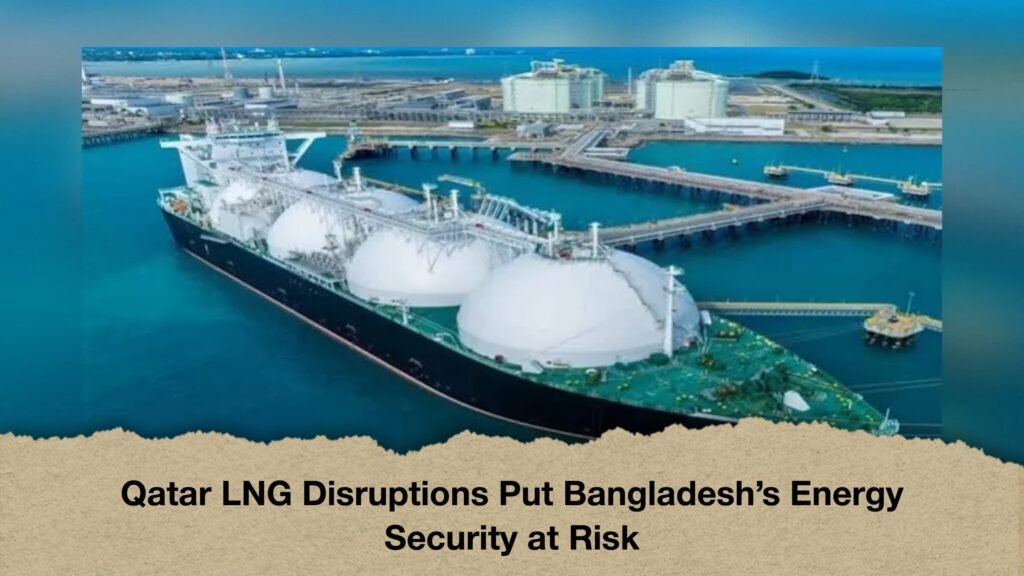
Uncertainty over liquefied natural gas supplies from Qatar is deepening, with disruptions linked to the Strait of Hormuz expected to continue for longer than initially anticipated. Bangladesh is among the countries facing significant exposure to the disruption because of its reliance on imported LNG to help meet domestic gas demand.
QatarEnergy has extended the force majeure situation affecting LNG deliveries as the movement of LNG through the Strait of Hormuz remains severely restricted. The disruption has made supplies increasingly uncertain for buyers across Asia and Europe, with several customers being warned that scheduled cargoes may not be delivered on time.
According to a report by Euronews, QatarEnergy has told buyers in Pakistan that deliveries could remain cancelled through October. LNG cargoes intended for Bangladesh are also expected to face disruption beyond September. Several European buyers have reportedly received similar notices.
The latest cancellations have reportedly extended into the first part of November, raising concerns that the disruption could persist well beyond the immediate period. Buyers are therefore looking for alternative sources of LNG, while some are reducing gas consumption or switching to other fuels where possible.
The scale of the disruption can be seen from the experience of Italian energy company Edison. Under its agreement with QatarEnergy, 29 LNG cargoes have been cancelled since April. Together, those shipments were expected to contain around 3.8 billion cubic metres of natural gas.
Edison has said it has managed to secure alternatives for 21 of the cancelled cargoes, representing roughly 2 billion cubic metres of gas. The company said these replacement supplies have allowed it to maintain its commitments to customers despite the interruptions.
QatarEnergy first declared force majeure over the Strait of Hormuz situation in March. The measure has subsequently been extended from month to month as conditions have deteriorated.
Anne-Sophie Corbeau, an expert at Columbia University’s Centre on Global Energy Policy, said the disruption could continue for some time in the absence of a political resolution. She also noted that QatarEnergy had not provided a firm indication of when LNG exports through the affected route would return to normal.
The continued extensions reflect that uncertainty. QatarEnergy did not respond to Euronews’ request for comment.
Global LNG supplies under pressure
The disruption has had a significant effect on international LNG trade. Data from ICIS show that Qatar exported only 18 LNG cargoes during the first six months of the conflict, compared with 509 during the same period a year earlier.
The sharp reduction in exports has also affected Qatar’s gas revenues. The country is estimated to have lost around $24 billion in gas sales as a result of the disruption.
Other LNG exporters are helping to offset part of the shortfall. According to Corbeau, supplies from the United States and Canada have increased, while new production facilities that began operating over the past year have added to available supply. LNG production has also risen in Nigeria and Malaysia.
Even with those increases, however, the additional supply has not been sufficient to replace all of the LNG that would normally have come from Qatar. Some Asian markets have responded by cutting gas consumption or turning to alternative fuels.
Europe is taking a somewhat different approach. Rather than competing aggressively for expensive LNG in the spot market, European buyers are making greater use of gas already held in storage. This has helped limit the need for additional spot purchases at elevated prices.
Corbeau said cargoes that are available in the market are increasingly being secured by buyers capable of paying higher prices. Despite the elevated cost of LNG, some buyers in South-East Asia remain active in the market.
She has also warned that LNG supplies from Qatar and the United Arab Emirates could remain disrupted for an extended period. Although production is increasing elsewhere, the additional output may not be enough to compensate fully for the lost supplies. As a result, global LNG trade could decline in 2026.
Bangladesh faces particular exposure
The disruption does not affect every LNG-importing country to the same extent. The European Union imported less LNG between April and August than it did during the same period a year earlier, while China’s imports also declined.
Bangladesh, however, faces a more sensitive situation because imported LNG forms an important part of the country’s gas supply system. LNG is used to supplement domestic natural gas production, particularly when local supply is insufficient to meet demand from power generation, industry and other major consumers.
A prolonged interruption in Qatari cargoes could therefore place additional pressure on Bangladesh’s gas supply arrangements. Securing replacement cargoes may become more difficult if other importers are competing for the same limited supplies.
Price is another concern. When LNG becomes scarce, buyers may have to pay more to secure alternative cargoes. For a country dependent on imported energy, higher procurement costs can increase pressure on the wider energy sector.
The availability of replacement supplies will also depend on conditions in the international market. Although the United States, Canada, Nigeria and Malaysia are increasing LNG production or exports, those additional volumes are already being sought by buyers in different regions.
For Bangladesh, the uncertainty is therefore not limited to whether individual cargoes will arrive. The longer-term concern is whether sufficient alternative LNG can be secured at manageable prices if disruptions continue beyond the dates currently indicated.
With QatarEnergy repeatedly extending its force majeure declaration and no clear timetable for a return to normal LNG transport through the Strait of Hormuz, Bangladesh and other exposed importers are likely to remain under pressure. The duration of the disruption, the availability of alternative supplies and movements in international LNG prices will be crucial factors in determining how severely the crisis affects energy security in the months ahead.