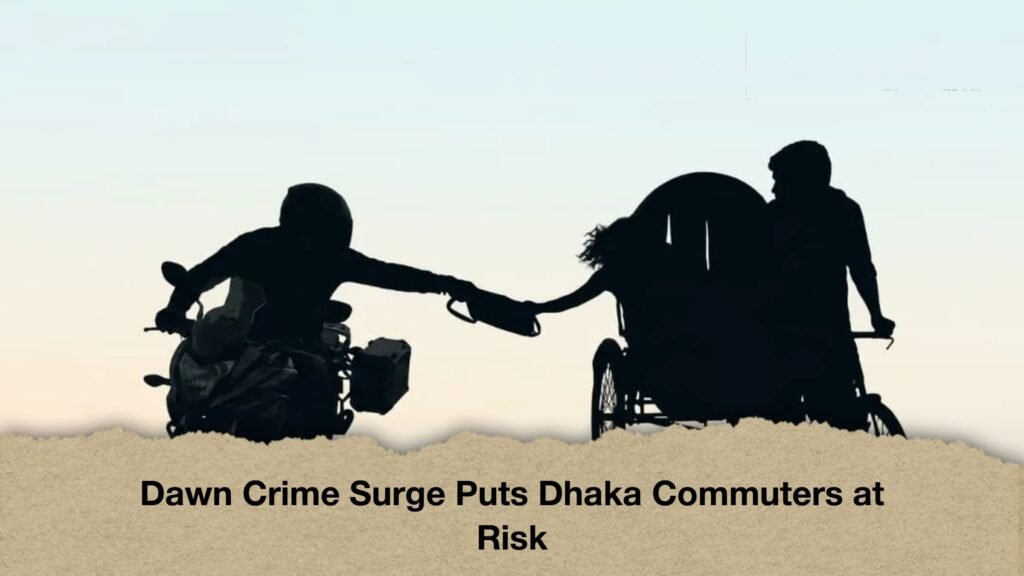
Dhaka’s roads can become particularly vulnerable in the hours before sunrise, when traffic thins, most businesses remain closed and fewer people are available to intervene in an emergency. A series of recent incidents suggests that muggers are exploiting this window, with several attacks resulting in serious injuries and deaths.
At around 6.30am on 29 August, Ranjina Parvin, headteacher of Bagbari Government Primary Girls’ School in Bogura, was travelling by rickshaw to a hospital when a group of muggers on a motorcycle suddenly grabbed her handbag. The force of the attack caused her to fall from the moving rickshaw, leaving her with severe head injuries. She was taken to hospital, where doctors pronounced her dead.
Law-enforcement sources say the incident was not isolated. Similar attacks have been reported at different locations in and around Dhaka, with the early morning emerging as a particularly vulnerable period.
In June 2026, shortly after returning to Dhaka following the Eid holiday, a woman was seriously injured after falling from a rickshaw when a mugger pulled at her belongings. She later died while receiving treatment.
Earlier, on 1 July 2023, police constable Moniruzzaman Talukder was stabbed to death by muggers in Farmgate at around 4.15am. The incident highlighted the risks faced not only by ordinary commuters but also by law-enforcement personnel during the late-night and early-morning hours.
Another fatal incident occurred in Keraniganj on 24 October 2024. An auto-rickshaw driver, Mohammad Nayan, 25, was stabbed by muggers in the early morning. The attackers fled with his vehicle after the assault.
There were also reports during 2024 of workers and professionals travelling to their workplaces being attacked in areas around Dhaka during the early hours. In 2025, a police officer was stabbed in Kutubkhali, Jatrabari. In the same year, a man named Hanif was killed after being beaten by local residents while allegedly attempting a mugging in Mohammadpur.
Taken together, these incidents point to a persistent security concern during the hours between late night and early morning. The danger is not confined to the loss of money or personal belongings. Sudden attacks can cause victims to fall from moving vehicles, while the use of knives and other weapons can turn a robbery into a fatal assault.
Why the early morning is particularly vulnerable
Law-enforcement officials have identified several factors that can make the period from the middle of the night until morning attractive to muggers.
One major factor is the relatively low volume of traffic. After midnight, many roads in the capital become considerably quieter. Following the killing of police constable Moniruzzaman in 2023, Dhaka Metropolitan Police said roads become largely deserted after around 2am, allowing criminals to exploit the reduced presence of potential witnesses and vehicles.
Another factor is the predictable movement of passengers arriving by bus, train or launch. People getting off at transport hubs often follow familiar routes towards their homes or workplaces. Such predictable movement can make them easier targets, particularly when they are travelling alone.
The closure of most shops and businesses during these hours also reduces the number of people on the streets. Fewer pedestrians, shopkeepers and other witnesses can mean fewer immediate opportunities for victims to seek assistance or for suspects to be identified.
The increasing use of motorcycles has added another dimension. Attackers can approach a moving rickshaw or pedestrian quickly, snatch a bag or other belongings and leave the area within moments, making pursuit more difficult.
Areas repeatedly identified as vulnerable
Mugging is not confined to one particular part of Dhaka. Police and law-enforcement authorities have identified a number of locations as vulnerable at different times.
These include Farmgate, Karwan Bazar, Shahbagh, Moghbazar, Malibagh Railway Gate, Kakrail, Motijheel, Gulistan, Fulbaria, Kamalapur, Babubazar, Rajarbagh, Jatrabari, Sayedabad, Wari, Gandaria, Jurain Railway Gate, the Mirpur-1 to Technical intersection corridor, Shialbari intersection in Mirpur-6, Kalshi, Badda, Bhatara, Basila, roads in front of the National Parliament complex, Hatirjheel and roads around the airport.
Police data indicate that the Tejgaon division is among the areas facing the highest level of risk from mugging and related offences. Wari, Mirpur, Uttara, Lalbagh, Gulshan, Motijheel and Ramna have also featured prominently in police assessments.
Badda, Bhatara, Mirpur and Pallabi have recorded repeated mugging incidents. Other areas identified as vulnerable include Shahbagh, Moghbazar, Ramna, Malibagh Railway Gate, Chankharpool, the Dhaka Medical College area, Gulistan, Dhanmondi, Jigatala, New Market, Panthapath and Science Laboratory.
However, not every location identified as a general mugging hotspot should automatically be considered an early-morning hotspot. The risk during the pre-dawn hours is particularly relevant in places where passengers arrive by public transport, workers begin their journeys, roads remain relatively quiet and offenders have an easy escape route.
From that perspective, areas such as Farmgate, Karwan Bazar, Kamalapur, Sayedabad, Jatrabari, Gulistan, Motijheel, Wari, Mirpur, Badda and Bhatara warrant particular attention during the early morning.
A separate Dhaka Metropolitan Police analysis identified 51 vulnerable locations in the Tejgaon division. It also identified 32 in Motijheel, 27 in Mirpur, 25 in Ramna and 21 in Gulshan. The figures show that the problem extends beyond isolated stretches of deserted road and can affect residential neighbourhoods, markets, transport centres and frequently used commuter routes.
More than 500 mugging cases recorded in 2025
Data held by the Dhaka Metropolitan Police show that 531 mugging-related cases were recorded across Dhaka in 2025, with 1,435 people arrested. In 2026, 172 cases have so far been recorded and 402 people arrested.
Across the two periods, the number of reported cases stands at 703, while the combined number of arrests is 1,837.
The divisional figures also show significant differences in the scale of reported cases and arrests.
In Ramna, 41 cases were recorded in 2025 and 144 people were arrested. In 2026, the division recorded 17 cases and 37 arrests.
Lalbagh recorded 27 cases and 53 arrests in 2025, followed by five cases and seven arrests in 2026. Wari recorded 93 cases and 217 arrests in 2025, while the corresponding figures for 2026 were 38 cases and 98 arrests.
Motijheel recorded 101 cases and 144 arrests in 2025. In 2026, it recorded 25 cases and 36 arrests.
Tejgaon recorded the highest number of cases among the divisions listed for 2025, with 146 cases and 510 arrests. In 2026, it recorded 34 cases and 138 arrests.
Mirpur recorded 55 cases and 219 arrests in 2025, followed by 16 cases and 40 arrests in 2026. Gulshan recorded 27 cases and 73 arrests in 2025, followed by 20 cases and 31 arrests in 2026.
Uttara recorded 41 cases and 75 arrests in 2025, while the figures for 2026 stood at 17 cases and 15 arrests.
The statistics underline the continuing scale of the problem, although the number of arrests should not be interpreted as a direct measure of the number of offenders responsible for the reported cases.
Police deploy 89 checkpoints
Against the backdrop of recent incidents, Dhaka Metropolitan Police has increased its focus on the period between midnight and 8am.
Mohammad Osman Gani, additional police commissioner for crime and operations at the DMP, said special measures had been introduced to prevent muggings during these hours. According to him, police have established 89 checkpoints at different locations across the capital over recent days.
Each checkpoint is staffed by an officer and eight other police personnel.
The DMP is also deploying four to five mobile patrol teams from each police station during the same period. Each team consists of an officer and seven other members. Officials describe these deployments as additional measures specifically intended to prevent muggings, beyond the force’s normal policing arrangements.
According to DMP information, approximately 2,112 to 2,462 police personnel are involved in the 89 checkpoints and station-based mobile patrols during the midnight-to-morning period. Regular patrols, pickets, foot patrols and other policing duties continue alongside these special deployments.
Mohammad Akhtar Hossain, deputy commissioner of the DMP’s Media and Public Relations division, said police teams remain active around the clock and use a range of preventive measures. These include checkpoints, foot patrols, mobile teams and picket teams operating across different regions.
He said field-level operations are regularly supervised by divisional deputy commissioners, additional deputy commissioners and assistant commissioners. When complaints are received, cases are filed and suspects are arrested where appropriate, he added.
The recent deployment represents a stronger policing focus on a period when Dhaka’s roads are quieter and commuters can be more exposed. Whether the additional checkpoints and patrols reduce early-morning mugging will depend not only on police presence, but also on sustained surveillance, rapid response and consistent action against repeat offenders.
For commuters travelling before sunrise, however, the recent incidents have highlighted a clear concern: the journey to work, hospital or home can become particularly hazardous when the city has yet to fully wake up.