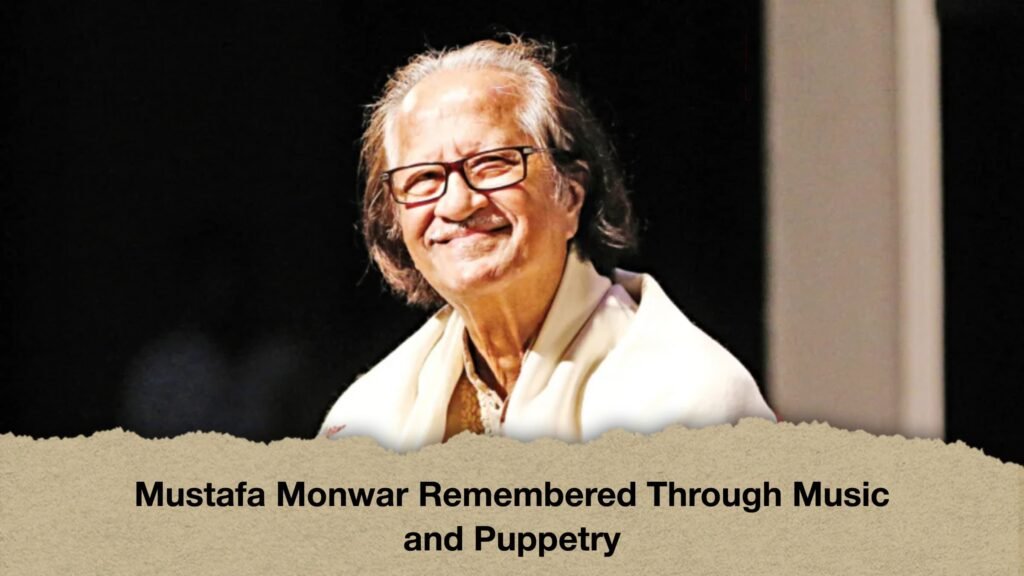
Mustafa Monwar, one of Bangladesh’s prominent artists, puppeteers and cultural figures, was remembered through music, dance and puppetry at an event marking what would have been his 91st birthday. The programme brought together artists, former colleagues and students to reflect on his long creative career and his enduring contribution to the country’s cultural landscape.
The commemorative programme was held yesterday evening at Bangladesh Shilpakala Academy in the capital. Titled ‘A Lifelong Pursuit of Colour, Line, Imagination and Aesthetics’, the event was jointly organised by Multimedia Puppet Theatre and Bangladesh Shilpakala Academy.
It was the first formal programme held to mark Monwar’s birthday since his death on 29 June this year. Coming only a few months after his passing, the gathering served as an opportunity for people who had worked with him, learned from him and followed his work to remember his contribution to Bangladesh’s artistic and cultural life.
The programme featured musical and dance performances alongside puppet theatre, reflecting the range of artistic forms with which Monwar was closely associated. Former colleagues and students also shared memories of his professional life, recalling his approach to art and his role in encouraging creative work among younger generations.
Monwar is widely regarded as an important pioneer in the development of puppetry in Bangladesh. Although best known in some circles as a painter, his creative career extended across several platforms, including puppet theatre, stage productions, radio and television. His work for children, in particular, introduced generations of young viewers to imaginative storytelling through visual and performing arts.
For Monwar, puppetry was more than a form of entertainment. He used the medium to communicate social ideas and human values, combining visual artistry with storytelling and imagination. His approach helped demonstrate how puppetry could engage audiences with subjects drawn from everyday life while remaining accessible and appealing, particularly to children.
His contribution also extended to the cultural activities surrounding Bangladesh’s Liberation War in 1971. During the war, he used puppet theatre to engage with children in refugee camps, providing them with moments of relief and entertainment amid the uncertainty and trauma of displacement. His work during that period remains part of the wider story of how artists contributed to people’s lives during the Liberation War.
After independence, Monwar continued to work towards expanding the practice of puppetry in Bangladesh. His involvement helped bring greater attention to the artistic possibilities of the medium, while his work across different cultural platforms contributed to its wider public presence.
Television was another significant part of his career. Through programmes and puppet productions aimed at children and young audiences, he helped popularise a distinctive form of visual storytelling. His work brought together entertainment, imagination and accessible narratives, leaving a lasting impression on viewers who encountered his productions during their formative years.
Monwar’s artistic practice was not confined to a single discipline. His experience in painting informed his work in other media, while his engagement with theatre, puppetry, broadcasting and television broadened the reach of his creative ideas. This ability to move between artistic forms became one of the defining features of his career.
His contribution to the arts and culture was formally recognised when he received the Ekushey Padak in 2004. The award marked one of the significant national recognitions of his long career and reflected his contribution as an artist and cultural practitioner.
The birthday programme sought to present that diverse legacy through live performance rather than remembrance alone. By bringing together music, dance, puppet theatre and personal recollections, the organisers created a setting in which different aspects of Monwar’s creative life could be revisited.
Memories shared by former colleagues and students also highlighted his influence beyond his own body of work. His engagement with younger artists and his commitment to creativity formed an important part of the recollections presented at the event.
Monwar’s career remains closely connected with the development of Bangladesh’s modern cultural landscape. His work demonstrated how different artistic forms could be brought together to communicate ideas, tell stories and reach audiences beyond the conventional boundaries of fine art.
The commemorative programme therefore served both as a tribute to a major cultural figure and as an effort to introduce his creative legacy to a new generation. Through the language of music, dance and puppetry, the event recalled an artist whose influence extended across several generations and whose contribution remains an important part of Bangladesh’s artistic heritage.