Staff Reporter
While showing an arrested individual as arrested in a new case—commonly known as a “show arrest” or “shon arrest”—is technically part of legal procedure for investigation, its recent misuse has sparked intense concern. Prominent media entrepreneur and Managing Director of Mohna Television, Shahed Ahmed Mazumder, has been languishing in jail for an extended period due to this controversial practice, where he is repeatedly shown arrested in new cases right at the prison gate after securing bail in previous ones. According to his family, he is being continuously denied his rightful release through a barrage of fabricated and politically motivated charges.
Family members claim that Shahed has been imprisoned for over a year in connection with an initial case. Throughout this prolonged ordeal, he has been granted bail at least four times across various cases. However, each time legal bail was secured, he was re-arrested right outside the prison gates on fresh charges, most recently on August 26, plunging his family and well-wishers into deep despair.
According to the family, the Counter Terrorism and Transnational Crime (CTTC) unit of the police detained Shahed from the capital’s Gulshan area last year, subsequently showing him arrested in a sabotage case filed at the Gulshan police station. Despite having no direct involvement, successive legal entanglements continued. Consequently, older and unresolved cases from Mirpur Model and Gulshan police stations were used to show him repeatedly under “show arrest,” which the victim’s family terms entirely conspiratorial, motivated, and a grave violation of basic human rights.
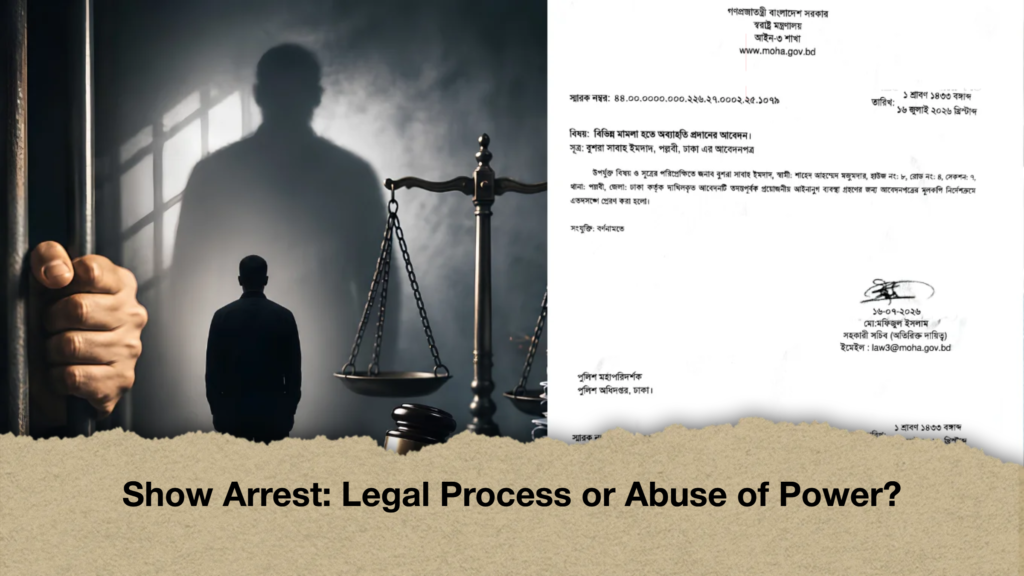
The practice of “show arrest” has persisted despite explicit directives from the Ministry of Home Affairs. The issue gained renewed national media attention following a humanitarian appeal filed by Shahed’s wife, Bushra Sabah Emdad. On July 16, the Law-3 Branch of the Ministry of Home Affairs issued a specific directive to the Inspector General of Police (IGP) instructing that Shahed Ahmed be cleared from the irrelevant cases.
However, the family alleges that nearly a month after that official directive, police once again showed Shahed arrested in a new case. This has raised serious questions regarding the police force’s commitment to implementing high-level government orders. The family points out that while the current administration is tirelessly striving to establish sound governance and a transparent, accountable state, such controversial police actions act as a major obstacle to fulfilling the government’s core agenda.
Due to this continuous cycle of politically motivated arrests, Shahed has been unable to step outside the prison walls despite securing bails from the courts. The family asserts that the legal mechanism of “show arrest,” originally intended for genuine investigative purposes, is now being weaponized as a tool for indefinite detention. This is happening despite Shahed Ahmed Mazumder being completely apolitical.
Human rights activists and prominent legal experts have strongly criticized the situation from legal and human rights perspectives. Advocate Lalon Hossain, a human rights defender, notes that securing bail is a constitutional and fundamental right of any citizen. However, repeated “show arrests” systematically subvert that right. While “show arrests” may be a normal procedure in high-profile cases or involving hardened criminals in the greater national interest, subjecting an entirely apolitical individual to such treatment not only strips him of his rights but also casts doubt on the broader administration of justice.
Senior Supreme Court advocate Khandaker Hasan Shahriar further elaborated that “show arrests” undeniably represent a severe abuse of executive power by the police, often driven by invisible economic or political interests. In no civilized or democratic country is an individual kept indefinitely behind bars before being proven guilty in a court of law. Yet in Bangladesh, citizens are trapped by “show arrests” even after winning bail from higher courts.
The lawyer added that if a bailed accused has other pending cases or arrest warrants, the concerned investigating officer should already possess that information and take timely legal action beforehand. An investigator suddenly discovering this “awareness” right after a suspect is granted bail raises serious suspicions. Whether a name appears in the First Information Report (FIR) or not, invoking “show arrest” indiscriminately against suspects through an abuse of power is entirely unjustified.
Furthermore, invoking a “show arrest” in a new case following a bail grant should only occur if there is explicit evidence linking the individual through Section 161 or 164 statements of witnesses or co-accused under the Code of Criminal Procedure; otherwise, it constitutes a blatant misuse of the law that creates room for undue gains by vested quarters, he noted.
Highlighting the broader context of civic rights and governance, Dr. Iftekharuzzaman, Executive Director of Transparency International Bangladesh (TIBA), stated that unlawful arrests, harassment, and mechanical “show arrest” practices must be halted immediately to ensure citizens’ access to justice, personal liberty, and equal protection of the law.
Analyzing the family’s background claims, Shahed Ahmed was born into a political family but was never directly or indirectly involved in politics. Instead, his passions lay in cultural, creative, and social engagements, with playing the guitar and painting on canvas serving as his daily pursuits. His family firmly maintains that he had no minimum connection to the conflict-ridden incidents for which he has been arrested, nor was he present in those specific areas at the material times.
Meanwhile, with her husband imprisoned for a long duration, Bushra Sabah has been living an extremely miserable and helpless life with their two innocent young daughters. Deprived of the sole breadwinner, she has been waging a lone legal, social, and administrative battle. She has strongly urged high-level government intervention to impartially investigate the matter, uncover the absolute truth, and ensure humane and legal justice for Shahed Ahmed.
Prior to publication, repeated attempts to contact the Gulshan and Mirpur Model police stations for specific comments yielded no response, as responsible officials declined to speak on the matter. However, DMP Deputy Commissioner of Media, Md. Akhtar Hossain, advised discussing the issue with senior police leadership rather than commenting publicly through the media.
Reviewing the legal foundation and background of “show arrests,” following the fall of the previous regime, the interim government led by Dr. Muhammad Yunus promulgated an ordinance titled the “Code of Criminal Procedure (Second Amendment) Ordinance, 2025” on August 10, 2025. Section “167A” of that ordinance formally introduced the term “show arrest” into law, outlining judicial magistrates’ powers regarding such detainees across three subsections.
Subsequently, following a political transition, the newly formed government repealed that ordinance and enacted the “Code of Criminal Procedure (Amendment) Act, 2026” (Act No. 11 of 2026). The inclusion of Section “167A” regulating “show arrests” continues to remain intact within the currently enforced legislation.
Additionally, Section 351 of the Code of Criminal Procedure explicitly dictates that if, during the inquiry or trial of a cognizable offense, evidence clearly demonstrates that any person present in court is deeply linked to the offense, the court holds the special power to instantly detain or register them as arrested without a summons or warrant—a process legally defined as a show arrest. However, at the field level, police often bypass this legal pathway, mechanically applying for “show arrests” the moment an accused secures bail.
Ultimately, the recurring pattern of re-arresting prominent media entrepreneur Shahed Ahmed Mazumder right at the prison gates despite successive legal bails has reignited profound legal and ethical questions concerning the proper application versus the abuse of “show arrests” within the nation’s judicial framework.