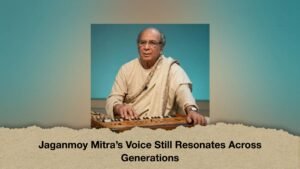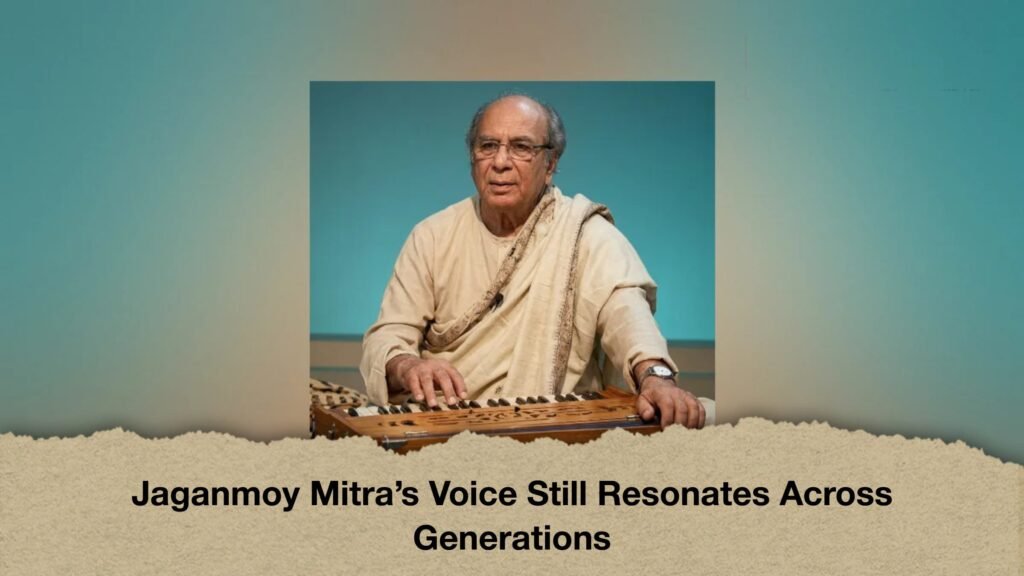
Few voices in Bengali music have remained as closely associated with love, separation and longing as that of Jaganmoy Mitra. Decades after his death, his recordings continue to evoke the emotional world of an earlier era, particularly through poetic songs that gave musical expression to romance, distance, waiting and heartbreak.
Mitra was not confined to one musical tradition. Alongside Bengali modern songs and Nazrul Sangeet, he was trained in and performed forms including dhrupad, khayal, thumri and tappa, as well as raga-based compositions, Baul music and kirtan. Yet it was as a singer of poetic Bengali songs that he established his most enduring reputation.
His best-known recording, ‘Chithi—Tumi Aaj Koto Dure’, recorded in 1948, became a defining work of his career. The song captured the ache of separation through the intimate image of a letter addressed to someone far away. Its emotional directness allowed generations of listeners to relate the song to their own experiences of love, absence and remembrance.
According to figures attributed to HMV in accounts of the recording, around 2.5 million copies of the song were sold from the 78-rpm record era through the cassette period. Such a figure reflected the exceptional popularity the song achieved within Bengali music.
A childhood shaped by music and loss
Jaganmoy Mitra was born in Kolkata on 6 September 1918 into a family with a strong interest in music. His childhood began under difficult circumstances. His father, Jatindranath Mitra, died at the age of 25 just over a month before Jaganmoy was born.
Mitra was his father’s only child. He therefore grew up without his father or siblings, but music became an increasingly important part of his early life.
His grandfather Bidhubhushan Mitra and uncle Panchanan Mitra were both keenly interested in music. His uncle played the harmonium and studied classical ragas under a teacher. The young Jaganmoy would sit nearby and listen, gaining an early familiarity with musical practice.
His formal education began at home, and he passed the Entrance examination in 1934. By then, music had already become a serious pursuit. At around 10 or 11 years of age, he began receiving training from Keshab Mukhopadhyay in several branches of classical music, including dhrupad, khayal, thumri and tappa.
Early recognition of an exceptional talent
Mitra’s abilities received significant public recognition in 1938, when he competed in a music competition organised by the Bengal Music Association. He won first place in dhrupad, tappa, thumri, raga-based Baul and kirtan, while securing third place in the poetic-song category.
That same year brought another important opportunity. He began recording for HMV, marking the start of a professional recording career that would span several decades.
His early recognition was strengthened by ‘Priyo Hote Priyotor’ and ‘Tomar Matan Kato Na Nayan’, written by Pranab Roy and composed by Kamal Dasgupta. These recordings helped introduce his voice to a much wider audience.
A valued connection with Kazi Nazrul Islam
Mitra also developed a close association with Kazi Nazrul Islam. Nazrul heard Mitra’s rendition of ‘Jodi Bashona Mone Dibe Dahan Jwala’ at HMV and praised the singer’s voice. Their association subsequently developed into a lasting relationship.
Mitra’s repertoire extended beyond Nazrul Sangeet. In 1941, he recorded several Rabindra Sangeet compositions, demonstrating the breadth of his musical interests and training.
In 1942, he recorded two notable poetic songs, ‘Sat Ti Bochor Age’ and ‘Sat Ti Bochor Pore’. Together with ‘Chithi—Tumi Aaj Koto Dure’, these recordings became particularly associated with the emotional, reflective character of his poetic-song repertoire.
The singer of love and separation
The 1940s and 1950s were particularly significant periods in Mitra’s career. He recorded numerous songs that became closely associated with his name, including ‘Bhalobasha More Bhikhari Korechhe’, ‘Ami Duronto Baishakhi Jhor’, ‘Jader Jibon Bhora Shudhu Ankhijal’, ‘Tumi Ki Ekhon Dekhichho Swapan’, ‘Bhuli Nai Bhuli Nai’, ‘Meneci Go Haar’, ‘Ami Swapan Dekhechhi’, ‘Swapan Surabhi Makha’, ‘Gobhir Nishithe Ghum’, ‘Premer Tajmahal’, ‘Hriday Jeno Kahare Cheyechhilo’, ‘Tomare To Aajao Bhuli Nai’ and ‘Shaono Raate Jodi’.
Many of these songs dealt with themes that are universal rather than tied to a particular period. Love, separation, memory and uncertainty are experiences that remain familiar to listeners regardless of generation.
Mitra’s vocal style suited such material particularly well. His singing could convey tenderness without excessive ornamentation, while his treatment of melancholy gave songs of separation a restrained emotional intensity. That balance became an important part of his artistic identity.
His classical training also provided a strong foundation for his work in modern Bengali music. The combination of technical knowledge and expressive singing allowed him to move between different traditions while retaining a recognisable vocal character.
A legacy that outlived the singer
Jaganmoy Mitra died on 4 February 2003. His death marked the end of a long life devoted to Bengali music, but it did not bring an end to the listening life of his songs.
His recordings remain significant reminders of a period when Bengali poetic songs were becoming an important part of popular musical culture. Before the arrival of modern digital listening platforms, records and later cassettes played a central role in carrying songs from one generation to another. Mitra’s recordings travelled through those changing formats and retained their appeal.
‘Chithi—Tumi Aaj Koto Dure’ remains the song most readily associated with his legacy, but his contribution extends well beyond that single recording. His body of work reflects the range of Bengali music of his time and the enduring power of a voice capable of turning private emotions into shared musical experiences.
Jaganmoy Mitra is no longer present to sing those songs. Yet the recordings remain. In them, listeners can still find the familiar feelings of waiting for someone distant, remembering someone lost and holding on to an affection that time has failed to erase.
That is why his place in Bengali musical history continues to endure. His voice belonged to a particular era, but the emotions expressed through it remain timeless.