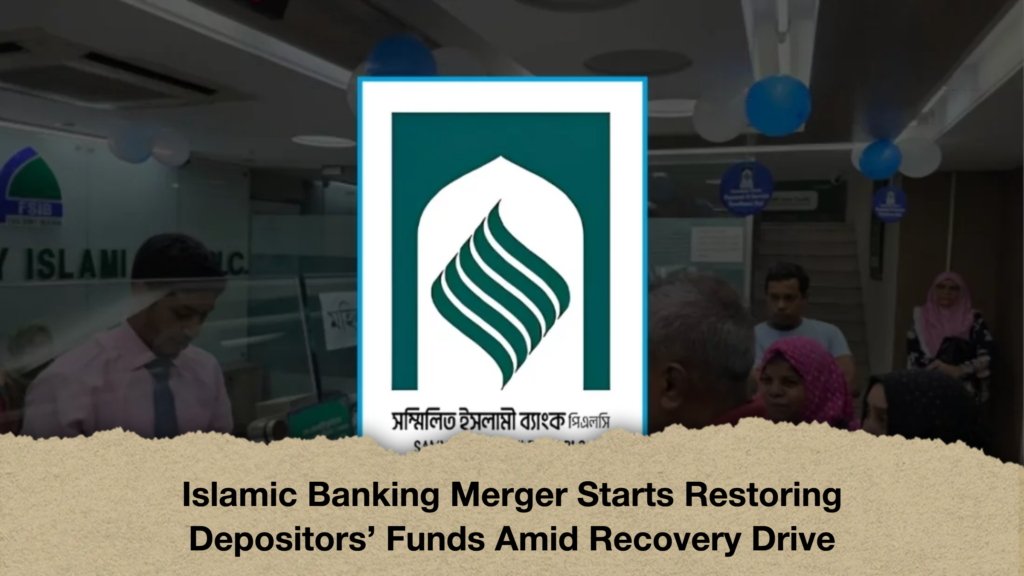
Sommilito Islamic Bank, a single entity recently formed through the state-led consolidation of five distressed Sharia-compliant financial institutions, has taken its first major stride towards normalising operations. On Monday, 7th September, the institution initiated a large-scale disbursement process, releasing a total of 250 crore taka to roughly 6,000 depositors on the very first day. The bank simultaneously restored online funds transfer capabilities, providing a much-needed push to its daily operations and signalling a turn towards financial recovery.
The newly created bank brings together First Security Islamic Bank, Social Islami Bank, Union Bank, Global Islami Bank, and EXIM Bank under a unified framework initiated by the former interim government. Although operating under a single umbrella, the individual branches retain separate operational procedures for the time being, maintaining a nationwide network of 761 outlets across Bangladesh.
To facilitate the payout, the bank invited withdrawal requests between 1st and 6th September, receiving applications from 74,000 customers claiming a collective sum of 3,925 crore taka. To ensure that branches experienced no liquidity bottlenecks and that no customer left empty-handed, Bangladesh Bank allocated a dedicated 5,000 crore taka liquidity support package.
Managing Director Md Abedur Rahman Sikder confirmed that arrangements have been finalised to settle claims for all verified applicants. However, turnout on the opening day was lower than expected, as several depositors chose to leave their capital with the bank following discussions with staff. A few individuals even re-deposited their funds shortly after withdrawal, pointing to a subtle initial regain in consumer trust. Major commercial branches in Dhaka—including Gulshan, Mohakhali, Banani, and Motijheel—saw steady streams of customers who were greeted with flowers by bank officials. At the Uttara branch of the former Union Bank, Manager A B M Mokarram Mahmud reported that out of eight scheduled applicants, four collected their cash, whilst others were contacted to arrange convenient collection times. Depositors were also permitted to collect accumulated profit yields.
The restructuring follows severe financial distress caused by years of widespread lending irregularities. Four of the merged institutions were previously controlled by the Chittagong-based business magnate Saiful Alam (S. Alam), whilst EXIM Bank was governed by Naza Group Chairman Nazrul Islam Mazumder. Audits commissioned following the political transition in August 2024 revealed that approximately 80 per cent of the total loan portfolios across the five banks had been systematically misappropriated. The resulting capital drain left the institutions virtually illiquid and unable to honour routine customer withdrawals.
In response, authorities revoked the equity stakes of the former owners, transferred overall ownership to the government, and initiated the merger to safeguard the wider financial system. The current BNP administration, which assumed office in February, has continued to advance this integration strategy. With liquidity support actively flowing and digital transfer channels back online, the bank now faces the long-term task of restoring complete public confidence and rebuilding its balance sheet.