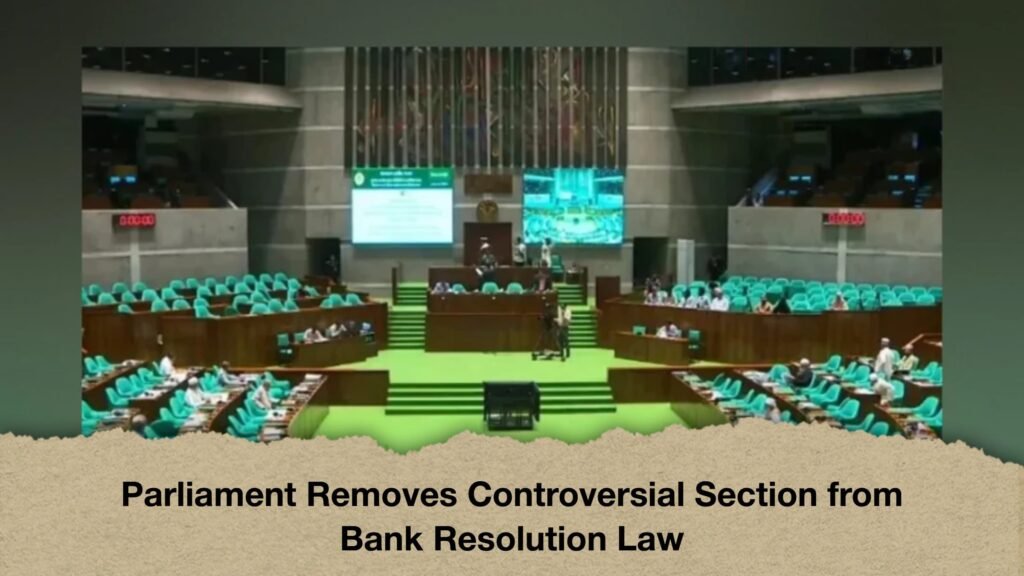
Bangladesh’s parliament has passed the Bank Resolution (Amendment) Bill, 2026, removing the controversial Section 18(a) from the country’s Bank Resolution Act. Finance Minister Amir Khosru Mahmud Chowdhury introduced the bill in parliament on Wednesday (9 September), after which it was passed by voice vote. The report of the parliamentary standing committee on the Ministry of Finance was also presented to the House.
The amendment repeals Section 18(a) of the Bank Resolution Act, 2026 in its entirety. The provision had originally been introduced as part of a market-based framework aimed at dealing with troubled scheduled banks, particularly those facing capital shortages and liquidity pressures.
Explaining the decision, the finance minister said the provision was intended to facilitate the restructuring of distressed banks while reducing the need for liquidation and limiting pressure on public finances. The mechanism was designed to provide an alternative route for addressing banks in financial difficulty through private-sector participation rather than relying solely on government resources.
However, the mechanism failed to attract any participant capable of meeting the stringent regulatory requirements attached to it. According to the government’s explanation, no individual, shareholder or institutional investor was able to fulfil the conditions after the law came into effect. As the provision could not achieve the purpose for which it had been introduced, the government decided to repeal it.
Documents related to the legislation show that Section 18(a) was not part of the original Bank Resolution Ordinance formulated during the interim government. It was subsequently incorporated when the ordinance was converted into an Act after the current government took office.
Under the provision, before a bank entered the formal resolution process, its previous shareholders or another eligible individual or institution could apply to Bangladesh Bank to reacquire the bank’s assets, liabilities and shares. The opportunity was subject to the regulatory conditions specified in the law.
The provision, however, became a contentious issue in the financial sector soon after the Bank Resolution Act was passed. Concerns were particularly raised over the possible implications for five troubled Shariah-based banks being merged to form Sammilito Islami Bank.
The main concern centred on whether former directors and shareholders of the affected banks could potentially use the provision to seek a return to ownership during the restructuring process. The issue drew additional attention because the resolution of financially troubled banks involves sensitive decisions concerning ownership, assets, liabilities and the future structure of the institutions.
At the same time, the government’s original rationale for Section 18(a) was to create a market-oriented option for restructuring distressed banks. Such a mechanism could, in principle, allow suitable investors to take part in resolving a troubled institution while avoiding liquidation and reducing potential reliance on public funds.
In practice, however, the stringent eligibility requirements meant that no qualified investor emerged. With the mechanism failing to generate the intended participation and amid continuing debate over its implications, the government moved to remove the provision.
The passage of the amendment now formally eliminates Section 18(a) from the Bank Resolution Act. This means the specific opportunity previously available to former shareholders or other eligible parties to seek the reacquisition of a bank’s assets, liabilities and shares before the institution entered resolution will no longer exist under that provision.
The amendment comes as Bangladesh continues to address challenges surrounding distressed banks and their restructuring. The removal of Section 18(a) therefore represents a significant adjustment to the legal framework governing bank resolution, particularly in relation to ownership and private-sector participation in the restructuring of troubled financial institutions.