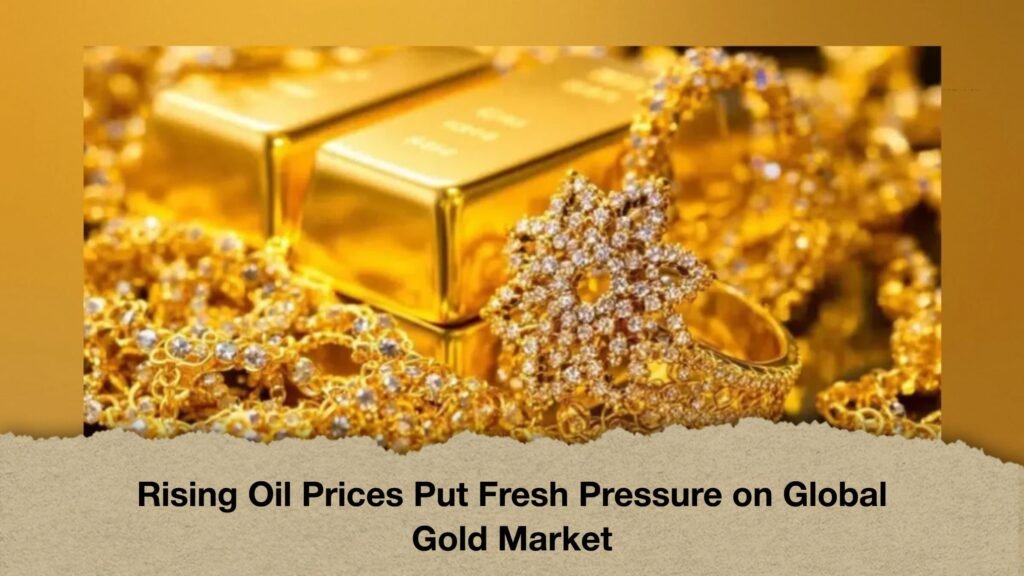
Gold prices slipped in global markets on Monday as a sharp rise in oil prices heightened concerns over inflation and strengthened expectations that the US Federal Reserve could raise interest rates at its policy meeting this week.
At around 9:30am Bangladesh time on Monday (14 September), spot gold was down 0.3 per cent at $4,334.31 an ounce. The decline followed a fall on Friday, when gold recorded its third consecutive weekly loss. US gold futures also weakened, falling 0.8 per cent to $4,375 an ounce.
Tim Waterer, chief market analyst at KCM Trade, said current market conditions were not particularly favourable for gold. Higher energy prices, coupled with growing expectations of interest-rate increases ahead of policy meetings by the Federal Reserve and the Bank of Japan, have placed additional pressure on the precious metal.
The relationship between interest rates and gold is a key factor for investors. Gold does not pay interest or provide a regular income, unlike many interest-bearing financial assets. When expectations of higher rates increase, investors may find bonds and other yield-generating assets more attractive, potentially reducing demand for gold.
Recent US inflation data have contributed to the shift in market expectations. Figures released last week showed that consumer inflation in the United States increased in August. The core inflation measure also recorded its largest increase in four months, adding to concerns that price pressures may prove more persistent than previously expected.
According to the CME FedWatch tool, markets were pricing in an 86.5 per cent probability of an interest-rate increase at the Federal Reserve’s policy meeting scheduled for Tuesday and Wednesday. Before the latest inflation figures were released, the probability had been around 67 per cent.
The sharp change in expectations underlines how closely financial markets are watching US inflation. A sustained rise in consumer prices can make monetary policy decisions more difficult for central banks, particularly when higher energy costs threaten to feed into broader inflationary pressures.
The Bank of Japan is also expected to raise interest rates on Friday, according to prevailing market expectations. Persistent inflation and stable economic growth, alongside rising energy costs and continuing tensions in the Middle East, have increased the possibility of further monetary tightening by major central banks.
Gold is traditionally viewed as a safe-haven asset and is often used by investors as a hedge against inflation and periods of economic or geopolitical uncertainty. Yet its appeal can weaken when interest rates rise because the metal does not generate interest. If yields on other assets become more attractive, some investors may shift capital away from gold.
Despite the recent decline, the metal could attract fresh buyers if prices fall further. Waterer said ongoing uncertainty over geopolitical developments and monetary policy could encourage investors to return to gold, particularly if concerns about the global economic outlook intensify.
Oil prices provided another source of concern for markets on Monday, rising by more than 2 per cent. New Houthi attacks in Saudi Arabia and an Iranian attack on a vessel in the Gulf increased fears about possible disruptions to energy supplies.
Concerns were compounded by the closure of an important Saudi oil pipeline, which raised the prospect of tighter supplies. A sustained rise in crude prices could add to inflationary pressure in economies that rely heavily on imported energy, potentially complicating the task facing central banks.
Diplomatic efforts surrounding the Strait of Hormuz have also encountered difficulties. A planned meeting between Iran and Gulf countries was postponed, adding another layer of uncertainty to the situation in the Middle East. Developments around the strategic waterway are closely watched by energy markets because of its significance to regional and international oil supplies.
Other precious metals also experienced mixed movements. Spot silver fell 0.7 per cent to $64.02 an ounce. Platinum was almost unchanged at $1,796.90 an ounce, while palladium was little changed at $1,298.80 an ounce.
Gold’s direction in the coming sessions is likely to depend heavily on central-bank decisions, inflation trends and developments in the Middle East. Expectations of higher interest rates could continue to weigh on the precious metal, while renewed geopolitical tensions or increased economic uncertainty could restore its appeal as a safe-haven investment.