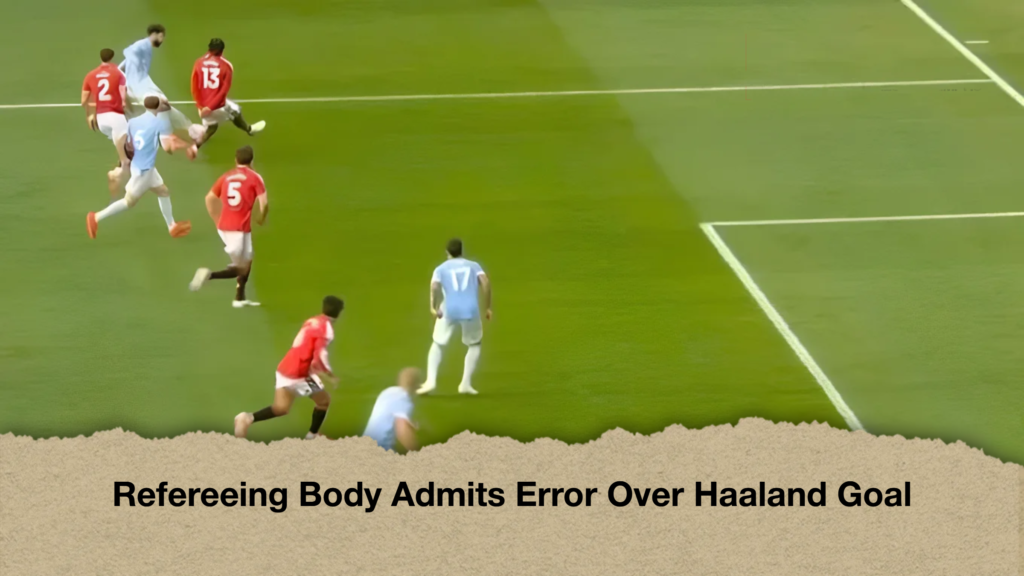
England’s professional refereeing body has admitted that a mistake was made in allowing Erling Haaland’s goal during Manchester City’s 1-0 Premier League victory over Manchester United at Old Trafford on Sunday.
City secured the win despite being reduced to 10 men, with Haaland’s strike proving decisive. However, the goal became the subject of intense debate after questions were raised over the role of another City player who was in an offside position during the build-up.
Professional Game Match Officials Limited, now operating as Professional Game Referees, said the Video Assistant Referee (VAR) had made an error of judgement. The organisation issued its explanation within hours of the match and said it had contacted Manchester United to acknowledge the mistake.
According to the refereeing body, VAR should have recommended that referee Michael Oliver go to the pitchside monitor and personally review the incident before the final decision was made.
The controversy began with a cross from Josko Gvardiol on the left. The ball changed direction after striking a nearby defender. Haaland was initially judged to have been offside when the cross was delivered, but a VAR review established that the Norwegian forward was actually in an onside position.
That, however, was not the only offside question involved in the move.
Enzo Fernández was in an offside position when Gvardiol delivered the cross. Fernández moved towards the ball and attempted to get into a position to head it past Manchester United goalkeeper Senne Lammens. He did not make contact with the ball, but his movement became central to the subsequent debate over whether his position had affected the defending team.
United defender Lisandro Martínez was close to Fernández during the attack. Martínez’s argument was that he would not have been positioned in the same way had the City player not moved towards the ball. While the footage leaves room for debate over that particular claim, the central issue for the officials was whether Fernández’s offside position constituted an offence by interfering with an opponent.
Haaland was eventually left with a clear opportunity. He beat Lammens and found the net, producing the only goal of the match.
In its statement, the refereeing body explained that the on-field decision had initially been an offside call against Haaland. VAR subsequently checked the incident and correctly established that he was onside.
The problem, according to the organisation, came in the assessment of Fernández’s involvement.
A spokesperson said Fernández had not played the ball, meaning the question of whether his offside position amounted to an offence involved an element of judgement. However, VAR failed to identify the potential impact of his position on the play.
The organisation concluded that Oliver should have been advised to review the incident himself at the pitchside monitor. Such a review would have allowed the referee to make a final judgement after considering Fernández’s movement and its possible effect on the United players.
The refereeing body also confirmed that it had contacted Manchester United to explain that it regarded the incident as an error of judgement. A review of the incident will now be conducted.
The admission has added another layer to a match already marked by controversy. Although the final result remains a 1-0 victory for Manchester City, the acknowledgement from the refereeing authorities means the decision to allow Haaland’s goal will face renewed scrutiny.
The incident also highlights the difficult distinction officials must make in offside situations. A player can be in an offside position without necessarily committing an offence if they do not become involved in play in a way that meets the relevant criteria. Determining whether an offside player has interfered with an opponent can therefore require careful assessment of movement, positioning and the circumstances surrounding the ball.
In this case, the refereeing organisation believes that assessment was not carried out sufficiently by VAR. Its admission has effectively confirmed that the process should have involved a further on-field review before Haaland’s decisive goal was allowed to stand.