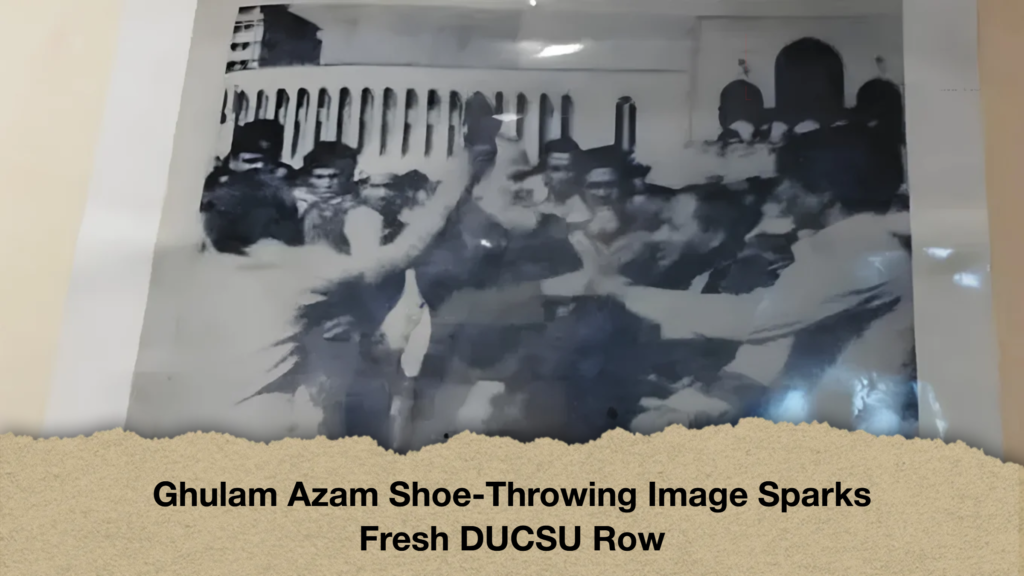
A fresh controversy has emerged at the Dhaka University Central Students’ Union (DUCSU) museum after the Bangladesh Chhatra Federation displayed an old photograph showing an angry crowd throwing shoes at Ghulam Azam.
The photograph was put up at the DUCSU museum on Monday, 14 September, amid an ongoing dispute over the display of a portrait of Muhammad Ali Jinnah, the founder of Pakistan.
According to information available about the newly displayed image, it dates back to the 1980s. It shows an agitated crowd in the Baitul Mukarram area throwing shoes towards Ghulam Azam. The image has now drawn renewed attention because of the wider dispute over which historical figures and events should be represented in the DUCSU museum.
The latest development comes after the display of Jinnah’s portrait triggered discussion and criticism at the university. Questions were also raised over the reported removal of photographs depicting Sheikh Mujibur Rahman and other historical figures associated with Bangladesh’s Liberation War.
The controversy surrounding Jinnah’s portrait has already prompted a response from Bangladesh Jatiyatabadi Chhatra Dal. Leaders of the organisation met the university vice-chancellor and demanded that the portrait be removed. They also gave the university administration an ultimatum to take action against DUCSU over the matter.
The dispute escalated further on Monday when former Dhaka University student Tayeb Haldar entered the DUCSU museum and tore down the displayed photographs. He reportedly entered the museum at around 2pm and removed the images from the display.
The incident involving Jinnah’s portrait has since been followed by the Chhatra Federation’s decision to put up the historic photograph of Ghulam Azam being targeted with shoes. The move has added a new dimension to an already sensitive debate over the representation of political history at one of the country’s most prominent public universities.
Ghulam Azam was a prominent figure of Bangladesh’s Jamaat-e-Islami and was widely associated with opposition to Bangladesh’s independence during the 1971 Liberation War. His political role and wartime position have remained deeply contentious in Bangladesh.
Against that historical backdrop, the decision to display the photograph is likely to attract further debate over how politically sensitive figures and events should be presented in an institutional museum. The latest incident has also highlighted tensions surrounding the preservation, removal and presentation of historical photographs at DUCSU at a time when competing interpretations of Bangladesh’s political history remain highly sensitive.
The sequence of events—from the display of Jinnah’s portrait to its removal and the subsequent installation of the old photograph involving Ghulam Azam—has therefore turned the DUCSU museum into the centre of a wider discussion about historical memory and political representation at Dhaka University.