Farmers in Bhurungamari upazila of Kurigram are continuing to face difficulties securing fertiliser for Aman rice, vegetables and early winter crops, with a clear gap emerging between the quantities they say they need and the allocations made by the agriculture authorities.
While farmers have described the situation as a shortage, the Department of Agricultural Extension (DAE) has rejected that assessment. Officials argue that some farmers are collecting more fertiliser than required, while others are buying supplies early in preparation for the upcoming Rabi season. The contrasting claims have left farmers questioning whether existing allocations are sufficient to meet actual field-level demand.
Farmers have also alleged favouritism and unequal distribution at sales points. They claim that some people are able to collect several sacks at once, while ordinary farmers sometimes have to share a single sack among three or four people. There are also allegations that influential individuals have accumulated fertiliser for the season.
Reports of fertiliser being recovered from stockpiles during administrative drives have added to the farmers’ concerns. They say such incidents raise questions about whether supplies are reaching those who need them most.
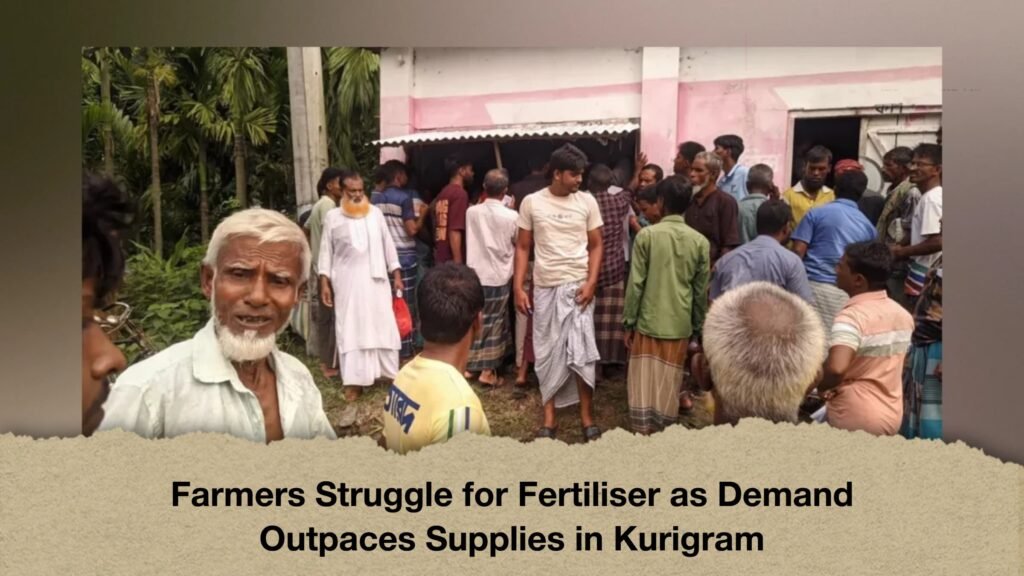
A visit to several unions in Bhurungamari found farmers moving from one designated sales point to another in search of fertiliser. Many said they were returning empty-handed despite having an immediate requirement for their crops.
At the designated sales centre at Lakshmir Mor in Ward 3 of Bangshonahat Union, the situation was particularly evident on Thursday, 10 September. At around 9am, some farmers were seen leaving with a full sack of fertiliser, while three or four others were sharing one sack. At least 200 farmers reportedly returned without receiving any fertiliser.
Abu Bakkar, a farmer from South Bharatchhara village in Bangshonahat Union, alleged that distribution was not being carried out fairly.
“সারের জন্য ঘুরতে ঘুরতে জান শ্যাষ। বারে বারে একে লোক সার পায়। আমরা ঘুইরাও পাই না। নিয়ম করি দেইক, তাইলে সবাই পায়। সার দেয় মুখ দেইখা,” he told Bangla Tribune.
Farmers alleged that people known to dealers or local political figures were being given priority. Retailers and representatives of dealers, however, denied the allegations.
Motiur Rahman, a fertiliser seller at the Lakshmir Mor centre, said the supply was simply inadequate compared with the number of farmers seeking it.
“We received 40 sacks—30 sacks of DAP and 10 sacks of TSP. There were more than 300 farmers. Two or three farmers took one sack together, but even that was not enough. We did not receive a single sack of urea. This ward needs at least another 150 sacks,” he said.
At Camp Mor in the same union, Abul Hashem, a representative of BCIC-authorised dealer Messrs Janarddan Chandra Saha, also acknowledged the supply problem, saying the amount of fertiliser being received was insufficient for the union’s requirements.
The shortage is also being felt in the charland along the Dudhkumar River, where farmers have begun cultivating early brinjal for the Rabi season. Several farmers said they needed urea and DAP at this stage but were unable to obtain adequate supplies.
Mojammel Haque, a farmer from Gunaiyer Kuthi village, said farmers had been told they would receive 10kg each. He alleged, however, that some people were able to obtain several sacks through personal connections and payments, while ordinary farmers had to visit sales points four or five times without success.
A significant gap between recommended use and allocation
Figures from the DAE indicate that the issue is not simply confined to individual sales centres. This year, 121,175 hectares of land have been brought under Aman cultivation across Kurigram, alongside 2,250 hectares of vegetables. Early brinjal has been planted on 345 hectares, while cauliflower and cabbage together cover around 200 hectares.
In Bhurungamari alone, Aman cultivation covers 16,900 hectares and vegetables account for 440 hectares. Early brinjal has already been planted on 273 hectares, against a target of 690 hectares.
According to agriculture officials, the recommended seasonal application of urea is 195kg per hectare for transplanted Aman, 260kg for brinjal, 260kg for cauliflower and 390kg for cabbage.
Based on these recommended rates, around 23,629 tonnes of urea would be required for the district’s Aman acreage. The estimated requirement for cauliflower and cabbage is about 65 tonnes, while early brinjal requires around 90 tonnes. Taken together, the crops mentioned would require approximately 23,784 tonnes of urea. For Aman and early brinjal alone in Bhurungamari, the estimated requirement is about 3,365 tonnes.
Against this, the district received 12,483 tonnes of urea during July, August and September, of which Bhurungamari was allocated 1,403 tonnes.
The difference is similarly visible for other fertilisers. The estimated requirement for TSP for the crops mentioned is around 6,164 tonnes, while Aman alone requires approximately 10,905 tonnes of DAP. Yet the district received 2,104 tonnes of TSP and 5,067 tonnes of DAP during the three-month period.
The agriculture department has increased fertiliser allocations compared with the previous financial year in some areas. Urea allocation is higher than in 2025–26, while the allocation of DAP has risen by 665 tonnes compared with 2023–24. However, urea allocation remains 550 tonnes lower than it was in 2023–24.
Agriculture department disputes shortage claims
Abdullah Al Mamun, deputy director of the DAE in Kurigram, said farmers’ actual fertiliser requirements should not be calculated solely by comparing recommended application rates with allocations.
He said around half of the non-urea fertiliser applied at the recommended rate during the Boro season remains in the soil, meaning less is required during the subsequent Aman season. Urea, however, still needs to be applied according to recommended rates across different seasons.
He also pointed out that DAP and TSP do not necessarily need to be applied together on the same land. Where DAP is used, TSP may not be required, while the need for urea can fall by around 5 per cent.
Responding to questions about the lower allocation compared with the calculated requirement, Mamun said the difference should not be described as a shortage. According to him, fertiliser allocation and use have historically been managed in this way.
He said many Aman fields remain fertile during the season and regular rainfall can reduce the need for additional urea. Excessive fertiliser application can also cause crops to lodge, potentially affecting production.
Mamun confirmed that Bhurungamari has requested additional supplies of urea and DAP beyond its regular allocation.
For farmers, however, the immediate concern remains access. As early Rabi crops expand and demand for fertiliser rises, they say the allocation figures may look adequate on paper but do not always translate into sufficient supplies at local sales centres. The continuing dispute between official assessments and farmers’ experience has therefore kept fertiliser availability at the centre of concern in Bhurungamari.