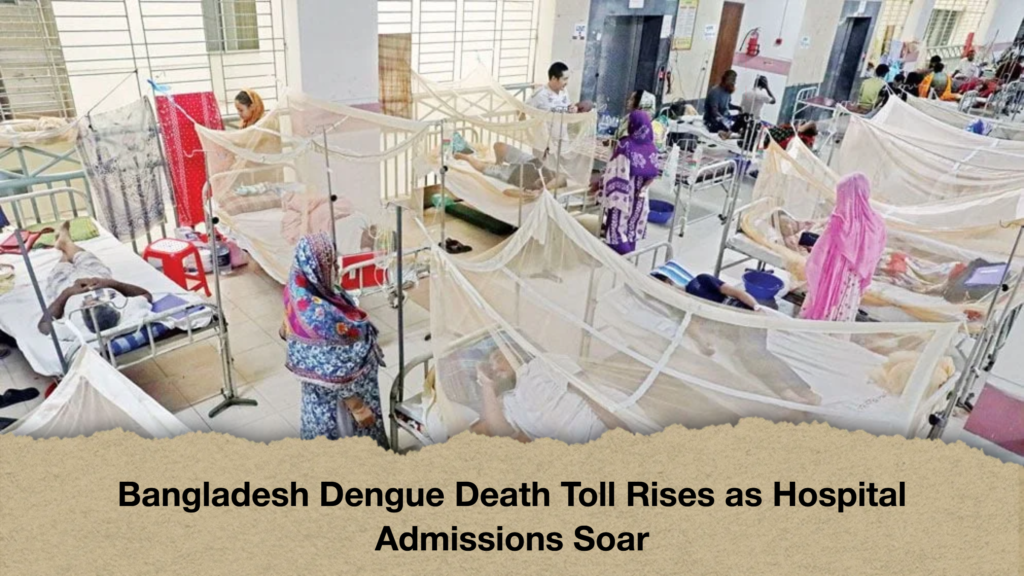
Bangladesh’s ongoing dengue epidemic continues to inflict a severe toll on public health, with seven further deaths recorded across the nation within a 24-hour period. According to the latest situational bulletin released on Tuesday, 15 September, by the Health Emergency Operation Centre and Control Room under the Directorate General of Health Services (DGHS), medical facilities nationwide also registered 1,593 new patient admissions over the same timeframe.
The latest official metrics demonstrate a widespread geographic distribution of the vector-borne infection, expanding well beyond urban epicentres into district towns and rural communities. Dhaka Division, excluding the twin city corporations, accounted for the highest single-day influx with 383 new hospitalisations. Outside the central division, Khulna Division experienced a significant regional surge, recording 290 admissions.
Metropolitan medical centres within the capital also face persistent admissions. Dhaka North City Corporation reported 171 new hospitalisations, whilst Dhaka South City Corporation registered 132. Across other administrative divisions, regional healthcare facilities recorded steady numbers: Chittagong Division admitted 165 patients, Barisal Division recorded 159, and Rajshahi Division logged 137. Further north and east, Mymensingh Division registered 82 admissions, Rangpur Division recorded 65, and Sylhet Division logged nine.
| Administrative Region / Area | 24-Hour Admissions |
| Dhaka Division (Excluding City Corporations) | 383 |
| Khulna Division | 290 |
| Dhaka North City Corporation | 171 |
| Chittagong Division | 165 |
| Barisal Division | 159 |
| Rajshahi Division | 137 |
| Dhaka South City Corporation | 132 |
| Mymensingh Division | 82 |
| Rangpur Division | 65 |
| Sylhet Division | 9 |
The cumulative toll for the current calendar year has reached 55,163 total hospitalisations, with fatalities standing at 164. Epidemiological trends indicate that hospital wards are operating under continuous pressure, driven by daily admissions across both metropolitan and rural administrative zones.
Dengue fever, caused by any of four related dengue viruses transmitted by Aedes mosquitoes, typically presents with high fever, severe retro-orbital eye pain, joint and muscular aching, fatigue, vomiting, and characteristic skin rash. Severe cases can rapidly escalate into life-threatening complications, including severe plasma leakage, internal haemorrhage, respiratory distress, and organ impairment. Public health authorities strongly advise prompt medical evaluation upon the onset of fever to mitigate the risk of severe clinical outcomes.
Control of the disease relies predominantly on managing vector populations. Aedes mosquitoes breed primarily in artificial containers holding clear, stagnant water, such as discarded tyres, plant saucers, uncovered water tanks, and active construction sites. Municipal health teams and medical experts continue to urge residents to eliminate standing water sources around residential properties, maintain diligent sanitation, and seek early diagnostic testing to curb further transmission.