Rising clashes with Iran-backed Houthi forces in Yemen have forced Saudi Arabia to seek urgent intelligence and military assistance from various regional and Western allies, just weeks after establishing a tripartite security treaty. The operational lag between signing the accord and building its military infrastructure has pushed Riyadh to pursue multi-channel security support.
On 7 August 2026, Saudi Crown Prince Mohammed bin Salman, Turkish President Recep Tayyip Erdogan, and Pakistani Prime Minister Shehbaz Sharif signed the historic “Mecca Joint Defense Agreement” in Mecca. Designed around a mutual defense framework reminiscent of NATO’s collective security clause, the treaty dictates that an armed assault on any single signatory constitutes an attack against all three.
Steps to formalise the pact advanced quickly. By late August, the three nations agreed to establish a joint defense secretariat based in Saudi Arabia, led initially by a Pakistani Secretary-General for a three-year term. Turkish officials outlined ambitious goals involving joint land, naval, and air exercises, air defense integration, and deep defense-industrial cooperation. However, Turkish and Pakistani leadership emphasized that the agreement targets no specific nation, explicitly omitting Iran as a designated common enemy. Building a fully functional joint command framework across three nations cannot happen overnight.
The timing proved challenging as Houthi forces launched rapid offensives in Yemen, consolidating influence near the critical Bab al-Mandab Strait. The advance created immediate threats to Saudi territorial security, Red Sea navigation, and global energy transport. Confronted with a shortage of missile interceptors and critical real-time battlefield intelligence, Riyadh dispatched requests for urgent military support to France, the United Kingdom, Pakistan, and Egypt.
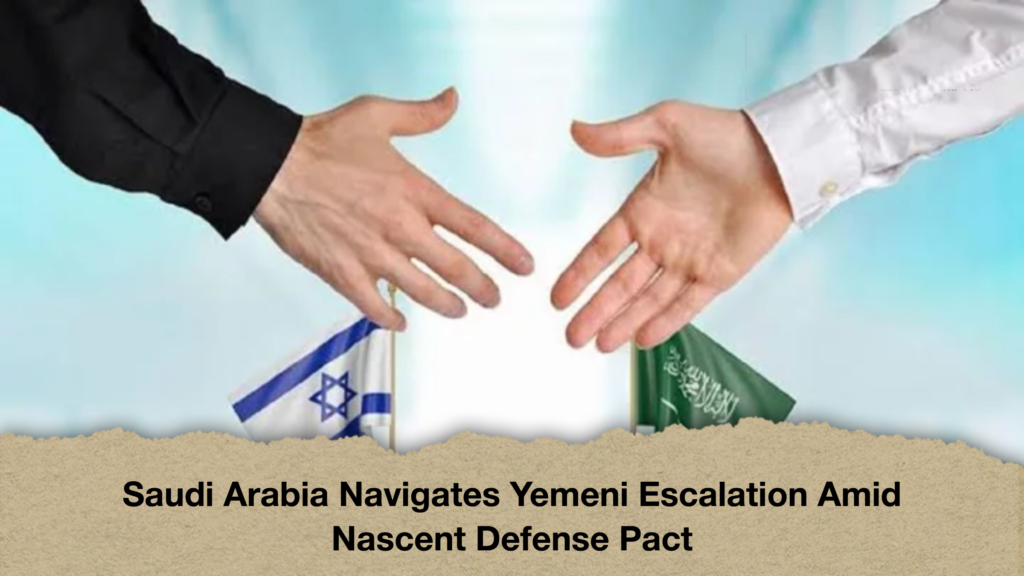
Concurrently, broader regional security discussions have taken shape. On 15 September, senior military officials from the United States, Israel, and eight Arab nations—including Saudi Arabia—met secretly in Germany to discuss regional defense coordination regarding Iran. While Saudi Arabia maintains no formal diplomatic ties with Israel, these multilateral talks highlighted Riyadh’s willingness to engage in wide-ranging intelligence-sharing platforms alongside Washington to secure early-warning air defense data.
Signatory partners are treading carefully. Pakistan deployed troops near the Saudi border as a deterrent while simultaneously engaging in high-level diplomacy with Tehran to de-escalate Houthi aggression. Turkey views the Mecca pact primarily as a long-term defense industry and strategic cooperation framework rather than an obligation to join ongoing regional battles immediately.
Rather than abandoning its allies, Saudi Arabia is managing a dual approach: methodically constructing the institutional machinery of the Mecca Joint Defense Agreement while simultaneously leveraging traditional Western, Arab, and intelligence networks to counter immediate security threats.